Hub-Spoke Microsegmentation with Azure Firewall, Private Link, and NSG Isolation
A 2019 Zero Trust cloud networking blueprint uniting Hub-Spoke forced tunneling via Azure Firewall Threat Intelligence with Azure Private Link to eliminate public PaaS data plane exposure.
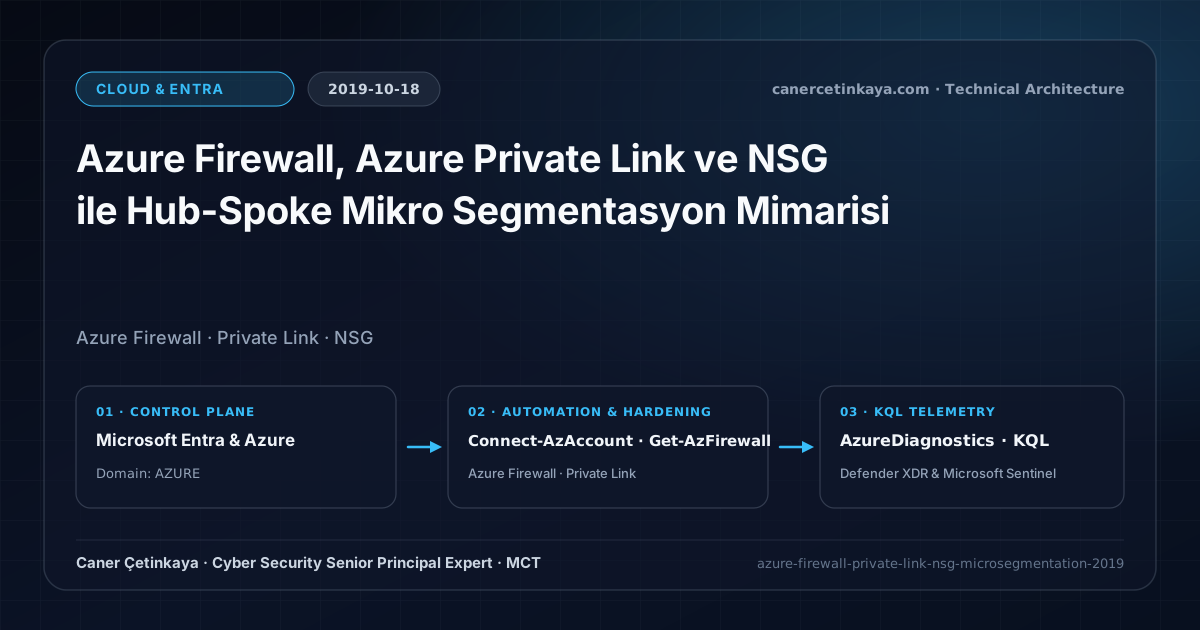
Executive Summary and Network Access Context
Writing basic Network Security Group (NSG) subnet rules fails to inspect encrypted outbound FQDN exfiltration or stop Azure PaaS services like Storage and SQL from traversing public internet endpoints. Combining Azure Private Link (which projects PaaS data planes directly onto internal VNet IPs) with Hub-centralized Azure Firewall Threat Intelligence and 0.0.0.0/0 User Defined Routes delivers deterministic East-West and North-South microsegmentation.
From an architectural evolution standpoint, this foundational design connects directly to modern platform controls. Established in 2019 as the core Azure Hub-Spoke segmentation model, Azure Firewall and Private Link continue anchoring modern Azure Firewall Premium IDPS, AVNM, and Defender for Cloud CSPM guardrails.
Trust Boundaries, Traffic Flows, and Design Principles
- Attaching a Spoke UDR routing 0.0.0.0/0 toward the Hub Azure Firewall Virtual Appliance prevents direct internet breakout and catches unauthorized C2 exfiltration.
- Azure Firewall Application Rules restrict outbound HTTPS strictly to whitelisted FQDNs while Threat Intelligence Deny mode blocks known malicious IPs/domains automatically.
- Azure Private Link eliminates public endpoint routing over the internet, binding PaaS targets to private VNet addresses across the Microsoft backbone.
- Management and application ingress must avoid raw public ports (
RDP 3389,SSH 22) by routing throughPrivate Endpoints,Azure Bastion, orSSEtunnels backed by symmetricUDRegress inspection.
Prerequisites, Network Dependencies, and RBAC Requirements
- Licensing & Resources: Azure Firewall deployment hours/data processing plus Azure Private Link endpoints, backed by Log Analytics workspace diagnostics.
- Topology & RBAC: Provision dedicated /26 AzureFirewallSubnet in Hub VNet and isolate Network Contributor administration from Spoke workload owners via least privilege.
- Private DNS Prerequisite: Link Azure Private DNS Zones (e.g., privatelink.blob.core.windows.net) to Hub/Spoke VNets so workloads resolve private endpoints natively.
Technical Verification, Access Controls, and Telemetry
PowerShell Network Posture and Configuration Check
PowerShell commands enforcing Azure Firewall Threat Intel Deny mode and auditing Storage Public Access flags:
- Execution Environment and Prerequisites: Requires Az.*.
- Least Privilege and Operation Separation: Run with scoped Azure Reader (audit) / Contributor (state changes) privileges. This block pairs **read-only (
Get-*/Search-*) posture queries with state-changing (New-*/Set-*/Enable-*)** examples; execute mutating steps strictly under change control in a pilot ring (using-WhatIfwhere supported) before broad rollout. - Security Control Mapped and Boundary Note: Verifies active policy state and guards against silent drift or mis-scoped rollouts without blind production changes.
# 1. Switch Azure Firewall Threat Intelligence mode to Deny malicious traffic
Connect-AzAccount
$AzFw = Get-AzFirewall -ResourceGroupName "RG-NET-HUB" -Name "AZFW-HUB-PROD"
$AzFw.ThreatIntelMode = "Deny"
Set-AzFirewall -AzureFirewall $AzFw

# 2. Verify Storage Account disables Public Network Access and holds active Private Endpoints
Get-AzStorageAccount -ResourceGroupName "RG-DATA-PROD" -Name "stprodconfidential01" |
  Select-Object StorageAccountName, PublicNetworkAccess, @{Name="PrivateEndpoints";Expression={$_.PrivateEndpointConnections.Count}}
Network Traffic Telemetry and KQL Verification Query
KQL query auditing denied Azure Firewall rule hits and Threat Intelligence blocks:
// Execution Scope: Read-only hunting/audit query (Log Analytics Reader / Security Reader)
// Data Source: Azure Resource Diagnostic Settings -> Log Analytics / Microsoft Sentinel (AzureDiagnostics)
AzureDiagnostics
| where TimeGenerated > ago(7d)
| where Category in ("AzureFirewallApplicationRule", "AzureFirewallNetworkRule")
| where msg_s has "Deny" or msg_s has "ThreatIntel"
| project TimeGenerated, Category, msg_s
| summarize BlockCount = count() by Category, msg_s
| order by BlockCount desc
Critical Architectural Assessment, Outage Risks, and Rollback Strategy
- Asymmetric Routing Dropping Private Endpoint Packets: Verify Spoke UDRs and subnet network policies so traffic transiting Hub Firewall returns symmetrically.
- Over-Broad Port 443 Network Rules: Allowing raw TCP 443 without FQDN Application Rules lets malware exfiltrate sensitive payloads to arbitrary external buckets.
- Risks Mitigated vs. Residual Limitations:
Private Endpoints,Azure Bastion,Azure Firewall, andEntra Global Secure Accesseliminate direct publicRDP/SSHexposure, lateral L3 VPN traversal, and unrestricted internet egress; they do not mitigate application-layer exploits (SQLi,SSRF) traversing authorized tunnels, compromised local endpoint binaries, or overly permissive spoke-to-spokeNSGrules. - New Dependencies and Production Failure Modes: Connectivity relies on consistent
Private DNS Zonelinking, symmetricUDRpaths, and healthy endpoint SSE clients/connectors. Misconfigured0.0.0.0/0routing loops or missing private DNS zones instantly sever VM and hybrid application traffic in production. - Rollback and Pilot Validation Procedure: Validate firewall rules,
NSGpriorities, andSSEforwarding profiles against a canary VNet or pilot cohort first; maintain scriptedAz.NetworkUDR/NSGsnapshots and SSE bypass toggles to restore routing swiftly.
Verified Primary Sources & Open-Source Repositories
This architectural guide was cross-corroborated against the official advisories, Microsoft Learn docs, and open-source PowerShell / KQL repositories below.
Multi-Channel Distribution Summary (X & LinkedIn Draft)
Toggle X (Twitter) & LinkedIn sharing drafts
Multi-Channel Distribution Summary (X & LinkedIn Draft)
Toggle X (Twitter) & LinkedIn sharing draftsPublished our 2019 Azure networking guide uniting Hub-Spoke Azure Firewall Threat Intel filtering with Private Link to kill public PaaS exposure. #AzureFirewall #PrivateLink
Hub-Spoke Zero Trust segmentation: enforcing 0.0.0.0/0 UDR inspection through Azure Firewall and sealing Storage/SQL PaaS endpoints via Private Link.