Cross-Platform Defender for Endpoint: Linux eBPF Sensor, macOS, and Live Response
Eliminating auditd CPU bottlenecks on production Linux workloads with the native Defender eBPF sensor while standardizing macOS Tamper Protection and RBAC-governed Live Response.
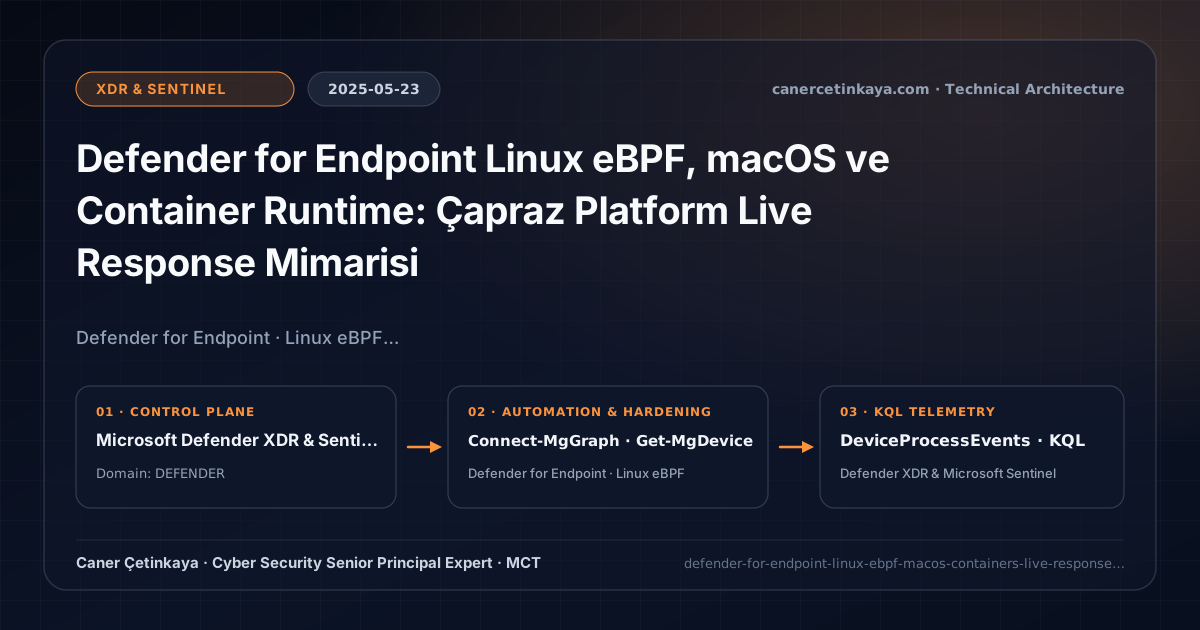
Executive Summary and Detection and Response Context
Once SOC teams mastered Defender for Endpoint Live Response across Windows laptops, production Linux and Kubernetes infrastructure engineers frequently resisted onboarding EDR due to auditd socket contention and CPU spikes under heavy database I/O. Maturing through 2025, Defender’s native Linux eBPF sensor shifts syscall monitoring into safe in-kernel bytecode—eliminating auditd overhead while unifying cross-platform triage.
From an architectural evolution standpoint, this foundational design connects directly to modern platform controls. Retiring legacy Linux auditd overhead via native eBPF telemetry and aligning Windows/macOS/Linux incident triage under a single Live Response standard in 2025 underpins modern hybrid server and container runtime EDR.
Detection Boundaries, Telemetry Pipelines, and Design Principles
Linux eBPF Sensorreplaces legacy userspaceauditdpipelines, streaming process execution, socket connections, and container behavior smoothly intoDeviceEvents/DeviceProcessEventsat minimal CPU cost.- Intune manages
macOSSystem Extensions, TCC privacy permissions, and Tamper Protection seamlessly without end-user clicks. Cross-Platform Live Responseempowers Tier-2 responders to acquire forensic triage bundles, terminate reverse shells, and collect suspicious binaries across Windows, Linux, and macOS straight from Defender XDR without inbound SSH/RDP.- Endpoint
EDR,ASRrules, andTamper Protectionmust remain intact beneath automatedXDR/Sentinelresponse playbooks, gating destructive containment actions over critical infrastructure with analyst review.
Prerequisites, Sensor/Workspace Dependencies, and RBAC
- Licensing:
Defender for Servers P1/P2(or MDE for Servers) covers Linux/Windows servers; M365 E5 / MDE P2 covers Windows & macOS workstations. - Kernel & RBAC: Supported Linux kernel distributions (RHEL 8/9, Ubuntu 20.04/22.04/24.04, SLES 15), Intune
Endpoint Security Managerfor macOS profiles, and scoped Live Response roles. - Script Security: Store audited, pre-approved bash/PowerShell forensic collection modules inside the Defender Live Response Library with unsigned execution toggled off.
Technical Verification, Endpoint/SIEM Audits, and Controls
PowerShell Posture Check and Staged Pilot Validation
Validating Linux/macOS mdatp eBPF health and checking OS distribution across Entra-registered endpoints:
- Execution Environment and Prerequisites: Requires Microsoft.Graph.
- Least Privilege and Operation Separation: Run with scoped Least-privilege Graph `.Read.All` scopes (delegated admin role only for writes) privileges. All statements above are **read-only (
Get-*/Test-*/Search-*)** verification checks making no direct configuration edits; still validate module/network prerequisites in a test cohort first. - Security Control Mapped and Boundary Note: Verifies active policy state and guards against silent drift or mis-scoped rollouts without blind production changes.
# 1. Verify Linux/macOS MDE eBPF sensor & tamper protection status on host
# mdatp health --field edr_ebpf_enabled
# mdatp health --field healthy
# mdatp health --field tamper_protection

# 2. Audit cross-platform Windows, macOS, and Linux device distribution via Microsoft Graph
Connect-MgGraph -Scopes "Device.Read.All"
Get-MgDevice -All | Group-Object OperatingSystem | Select-Object Name, Count
Defender XDR and Sentinel KQL Hunting Query
KQL query hunting suspicious Linux/macOS reverse shells, SUID abuse, and piped downloads in DeviceProcessEvents:
// Execution Scope: Read-only hunting/audit query (Log Analytics Reader / Security Reader)
// Data Source: Microsoft Defender XDR Advanced Hunting / Sentinel MDE Connector (DeviceProcessEvents)
DeviceProcessEvents
| where Timestamp > ago(14d)
| where DeviceName !endswith ".local" or InitiatingProcessFolderPath startswith "/"
| where ProcessCommandLine has_any ("/dev/tcp/", "nc -e", "python3 -c", "chmod +s", "curl | bash", "wget -O-")
| project Timestamp, DeviceName, AccountName, FileName, ProcessCommandLine, InitiatingProcessFileName
| order by Timestamp desc
Critical Architectural Assessment, Response Risks, and Rollback Strategy
- Leaving Redundant Verbose auditd Rules Enabled Alongside eBPF: Duplicate syscall collection wastes CPU on busy web/database nodes; audit whether legacy auditd rules can be tapered back once
edr_ebpf_enabledreads true. - Granting Broad Live Response Script Execution to Every L1 Analyst: Separate read-only diagnostic tiers from script/remediation responders via Unified RBAC.
- Risks Mitigated vs. Residual Limitations:
MDE EDR,ASRrules,Live Response, andSentinel/XDRSOAR playbooks compress detection-to-containment windows and halt script/memory injection; they do not protect un-onboarded assets, sub-OS firmware compromises without hardware root-of-trust, or telemetry blind spots duringLog Analyticsingestion throttling. - New Dependencies and Production Failure Modes: Efficacy hinges on continuous sensor check-ins, active
Tamper Protection, and properly scopedLogic Appsmanaged identities. Forcing aggressiveASRrules directly intoBlockwithoutAudittuning breaks signed business macros, custom ERP tools, and developer build pipelines. - Rollback and Pilot Validation Procedure: Run new
ASRrules inAuditmode across 14–30 days inspectingDeviceEvents(ActionType startswith "Asr"); roll back breaking rules per device ring via Intune orSet-MpPreference(AuditMode) and disable misbehavingSentinelplaybooks while keeping detection rules alive.
Verified Primary Sources & Open-Source Repositories
This architectural guide was cross-corroborated against the official advisories, Microsoft Learn docs, and open-source PowerShell / KQL repositories below.
Multi-Channel Distribution Summary (X & LinkedIn Draft)
Toggle X (Twitter) & LinkedIn sharing drafts
Multi-Channel Distribution Summary (X & LinkedIn Draft)
Toggle X (Twitter) & LinkedIn sharing draftsLowering Linux EDR overhead with Defender for Endpoint eBPF sensors and cross-platform Live Response. #DefenderForEndpoint #LinuxSecurity #eBPF
Unified Cross-Platform EDR: Transitioning Linux production servers off auditd onto eBPF, enforcing macOS Tamper Protection, and isolating Live Response RBAC.