VPN-Free Zero Trust Remote Access with Azure AD Application Proxy and Kerberos KCD
A 2020 remote access architecture publishing internal ERP, HR, and intranet web apps behind Azure AD Pre-Authentication and Conditional Access MFA with zero inbound firewall ports using Application Proxy and Kerberos Constrained Delegation (KCD).
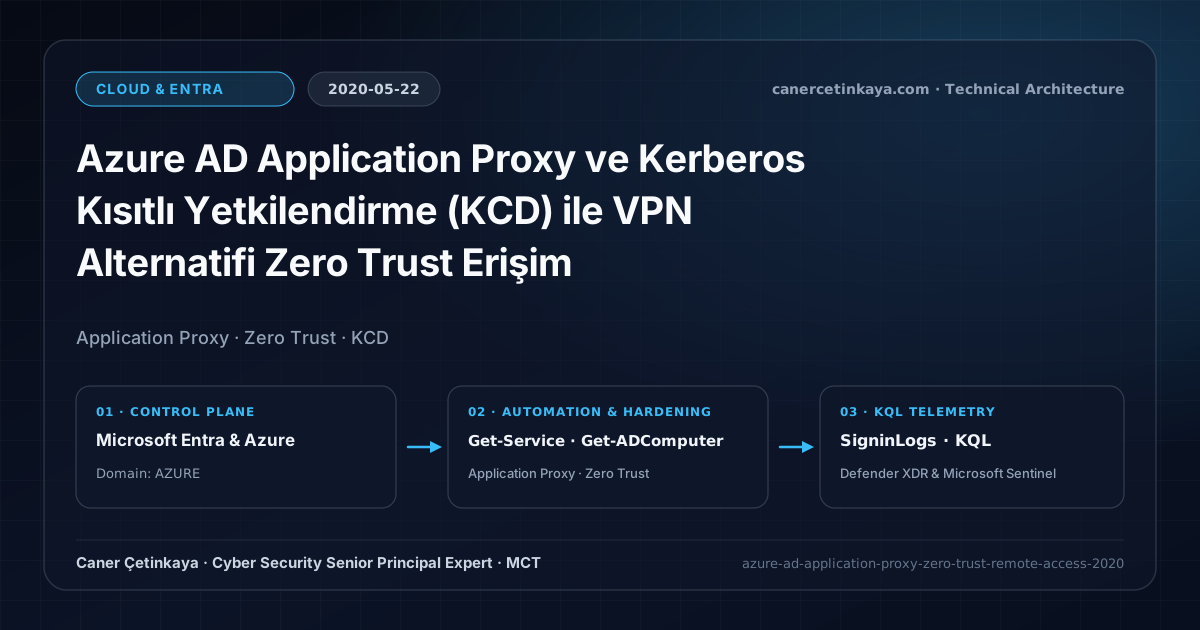
Executive Summary and Network Access Context
Pushing thousands of remote employees across legacy full-tunnel VPN appliances bottlenecks datacenter circuits and exposes internal subnets to L3 lateral movement from infected laptops—while publishing IIS portals directly through DMZ NAT rules exposes applications to unauthenticated exploits. Azure AD Application Proxy establishes outbound-only TLS tunnels from internal connectors, enforcing cloud Conditional Access and MFA before a single HTTP packet reaches internal servers.
From an architectural evolution standpoint, this foundational design connects directly to modern platform controls. Serving in 2020 as an immediate alternative to split-tunnel VPN gateways and DMZ reverse proxies, Azure AD Application Proxy converges today with Microsoft Entra Private Access (Global Secure Access SSE) for per-app Zero Trust networking.
Trust Boundaries, Traffic Flows, and Design Principles
- Eliminates inbound 443 NAT rules using lightweight internal Connectors maintaining outbound TLS 1.2 channels to Azure Service Bus.
- Pre-Authentication enforces Azure AD Conditional Access and MFA at the Microsoft cloud edge before forwarding requests.
- Kerberos Constrained Delegation (KCD) allows Connectors to request Kerberos service tickets on behalf of authenticated cloud users against legacy Integrated Windows Auth apps.
- Management and application ingress must avoid raw public ports (
RDP 3389,SSH 22) by routing throughPrivate Endpoints,Azure Bastion, orSSEtunnels backed by symmetricUDRegress inspection.
Prerequisites, Network Dependencies, and RBAC Requirements
- Licensing: Azure AD Application Proxy requires Azure AD Premium P1 or P2 (EMS E3/E5 or Microsoft 365 E3/E5).
- Infrastructure & RBAC: Deploy at least two redundant Windows Server 2016/2019 Connectors (never on Domain Controllers), target HTTP SPNs, and least-privilege Application Administrator governance.
- KCD Prerequisite: Grant Connector machine accounts protocol-transition delegation rights (msDS-AllowedToDelegateTo) targeting each internal app HTTP SPN.
Technical Verification, Access Controls, and Telemetry
PowerShell Network Posture and Configuration Check
PowerShell script checking local Connector Windows services, target HTTP SPN, and AD KCD delegation attributes:
- Execution Environment and Prerequisites: Requires ActiveDirectory / RSAT / AD Sync / AD FS management host.
- Least Privilege and Operation Separation: Run with least-privilege inspection or scoped administrative permissions. All statements above are **read-only (
Get-*/Test-*/Search-*)** verification checks making no direct configuration edits; still validate module/network prerequisites in a test cohort first. - Security Control Mapped and Boundary Note: Verifies active policy state and guards against silent drift or mis-scoped rollouts without blind production changes.
# 1. Verify Application Proxy Connector and Updater services health
Get-Service -Name "WAPCSvc", "WAPCUpdaterSvc" -ErrorAction SilentlyContinue | Select-Object Name, Status, StartType

# 2. Audit backend SPN and Connector Kerberos Constrained Delegation (msDS-AllowedToDelegateTo)
setspn -L "SRV-ERP-WEB01$"
Get-ADComputer -Identity "SRV-APPPROXY-01" -Properties "msDS-AllowedToDelegateTo" |
  Select-Object Name, msDS-AllowedToDelegateTo
Network Traffic Telemetry and KQL Verification Query
KQL query tracking remote SigninLogs access and Conditional Access pass rates on Application Proxy apps:
// Execution Scope: Read-only hunting/audit query (Log Analytics Reader / Security Reader)
// Data Source: Microsoft Entra ID Diagnostic Settings -> Log Analytics / Microsoft Sentinel (SigninLogs / AuditLogs)
SigninLogs
| where TimeGenerated > ago(14d)
| where AppDisplayName in ("ERP-Finance-Portal", "HR-Intranet") or ResourceDisplayName has "Proxy"
| project TimeGenerated, UserPrincipalName, AppDisplayName, IPAddress, ConditionalAccessStatus, ResultType, DeviceDetail
| summarize AccessCount = count(), Failures = countif(ResultType != 0) by AppDisplayName, ConditionalAccessStatus
| order by AccessCount desc
Critical Architectural Assessment, Outage Risks, and Rollback Strategy
- Running a Single Connector or Hosting on a DC: A lone Connector breaks remote access during OS reboots; pair two dedicated member servers inside an HA Connector Group.
- Leaving Body Link Translation Disabled on Legacy Apps: Hardcoded internal links (intranet.corp) break externally unless Translate URLs in Application Body stays enabled.
- Risks Mitigated vs. Residual Limitations:
Private Endpoints,Azure Bastion,Azure Firewall, andEntra Global Secure Accesseliminate direct publicRDP/SSHexposure, lateral L3 VPN traversal, and unrestricted internet egress; they do not mitigate application-layer exploits (SQLi,SSRF) traversing authorized tunnels, compromised local endpoint binaries, or overly permissive spoke-to-spokeNSGrules. - New Dependencies and Production Failure Modes: Connectivity relies on consistent
Private DNS Zonelinking, symmetricUDRpaths, and healthy endpoint SSE clients/connectors. Misconfigured0.0.0.0/0routing loops or missing private DNS zones instantly sever VM and hybrid application traffic in production. - Rollback and Pilot Validation Procedure: Validate firewall rules,
NSGpriorities, andSSEforwarding profiles against a canary VNet or pilot cohort first; maintain scriptedAz.NetworkUDR/NSGsnapshots and SSE bypass toggles to restore routing swiftly.
Verified Primary Sources & Open-Source Repositories
This architectural guide was cross-corroborated against the official advisories, Microsoft Learn docs, and open-source PowerShell / KQL repositories below.
Multi-Channel Distribution Summary (X & LinkedIn Draft)
Toggle X (Twitter) & LinkedIn sharing drafts
Multi-Channel Distribution Summary (X & LinkedIn Draft)
Toggle X (Twitter) & LinkedIn sharing draftsPublish internal IWA/Kerberos web apps safely with zero inbound firewall ports using Azure AD Application Proxy and KCD. #ZeroTrust #EntraID
Replacing VPN bottlenecks cleanly: Azure AD Application Proxy cloud pre-authentication, redundant Connectors, and Kerberos Constrained Delegation.