Azure AD Connect Architecture Comparison: PHS, Pass-Through Auth (PTA), and Seamless SSO
Evaluating Password Hash Synchronization (PHS), Pass-Through Authentication (PTA), and Seamless SSO topologies for resilient hybrid identity without AD FS overhead.
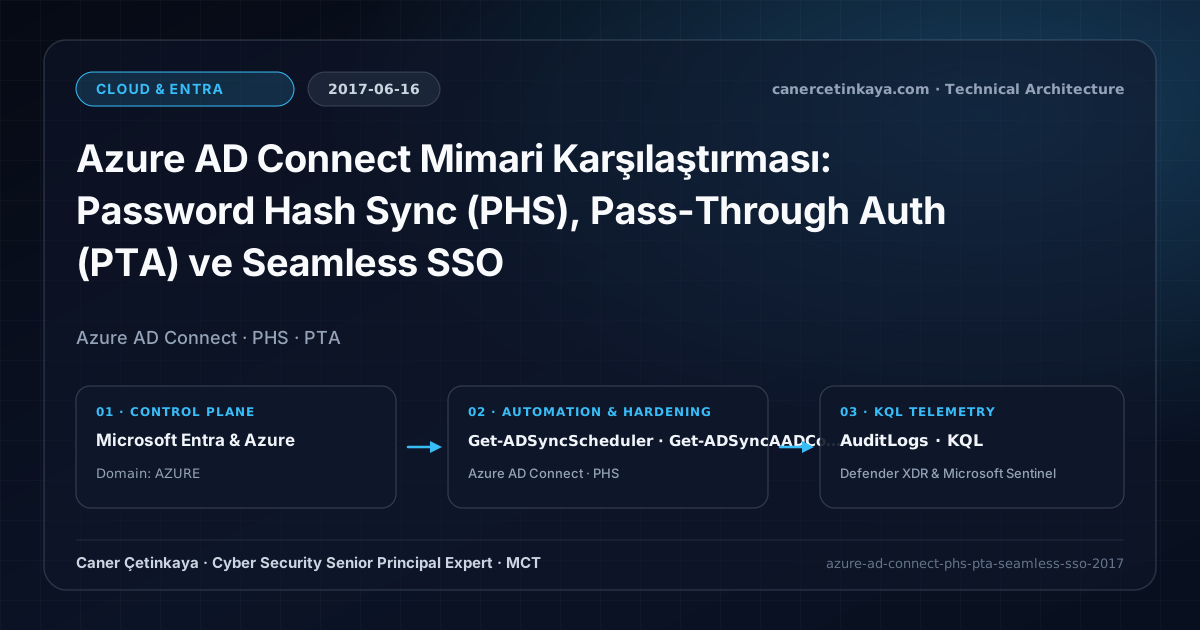
Executive Summary and Hybrid Identity Sync Context
Many enterprises connecting Active Directory to Office 365 assume heavy on-premises AD FS farms are required—introducing unnecessary single points of failure and maintenance complexity. Conversely, misconceptions about Password Hash Synchronization (PHS) keep teams from adopting cloud resilience and leaked-credential detection. This guide compares PHS, PTA, and Seamless SSO across Tier-0 security boundaries and failover architecture.
From an architectural evolution standpoint, this foundational design connects directly to modern platform controls. The 2017 Azure AD Connect PHS + Seamless SSO pattern evolved into today’s Microsoft Entra Connect Sync and lightweight Microsoft Entra Cloud Sync, core components of Entra ID Identity Resilience.
Trust Boundaries and Hybrid Identity Design Principles
- PHS applies a second per-user salted 1,000-iteration PBKDF2 SHA-256 transformation on top of AD hashes; cleartext passwords never leave premises.
- Enabling PHS unlocks Azure AD Identity Protection leaked-credential threat detection across cloud sign-ins.
- PTA delegates real-time authentication over outbound TLS 443 Service Bus tunnels using multiple redundant on-premises agents.
- Seamless SSO uses the
AZUREADSSOACCKerberos computer account so corporate domain-joined PCs sign in silently without prompting.
Prerequisites, Privilege Matrix, and Infrastructure Dependencies
- Licensing: Azure AD Free covers PHS, PTA, and Seamless SSO; Password Writeback and Leaked Credentials require EMS E3/E5.
- Tier-0 Isolation: Treat Azure AD Connect servers identically to Domain Controllers with strict Privileged Access Workstation (PAW) administration.
- RBAC: Hybrid Identity Administrator role on cloud side.
Technical Verification, Sync Health, and Security Controls
PowerShell Sync Inspection and Trust Validation
Audit ADSync scheduler, PHS status, and Staging Mode configuration via PowerShell:
- Execution Environment and Prerequisites: Requires ActiveDirectory / RSAT / AD Sync / AD FS management host.
- Least Privilege and Operation Separation: Run with least-privilege inspection or scoped administrative permissions. This block pairs **read-only (
Get-*/Search-*) posture queries with state-changing (New-*/Set-*/Enable-*)** examples; execute mutating steps strictly under change control in a pilot ring (using-WhatIfwhere supported) before broad rollout. - Security Control Mapped and Boundary Note: Verifies active policy state and guards against silent drift or mis-scoped rollouts without blind production changes.
Import-Module ADSync

# 1. Verify synchronization schedule and Staging Mode flag
Get-ADSyncScheduler | Select-Object SyncCycleEnabled, CurrentlyEffectiveSyncCycleInterval, StagingModeEnabled

# 2. Confirm PHS and Seamless SSO feature enablement
Get-ADSyncAADCompanyFeature | Select-Object PasswordHashSync, PasswordWriteback, SeamlessSingleSignOn

# 3. Trigger an immediate delta synchronization cycle
Start-ADSyncSyncCycle -PolicyType Delta
Hybrid Identity Telemetry and KQL Query
KQL query auditing Azure AD Connect directory synchronization activity:
// Execution Scope: Read-only hunting/audit query (Log Analytics Reader / Security Reader)
// Data Source: Microsoft Entra ID Diagnostic Settings -> Log Analytics / Microsoft Sentinel (AuditLogs)
AuditLogs
| where TimeGenerated > ago(14d)
| where LoggedByService == "Directory Synchronization" or OperationName has_any ("Update user", "Change password", "Directory synchronization")
| extend Actor = tostring(InitiatedBy.user.userPrincipalName)
| project TimeGenerated, OperationName, Category, Result, Actor, TargetResources
| summarize Events = count() by OperationName, Result, bin(TimeGenerated, 1d)
| order by TimeGenerated desc
Critical Architectural Assessment, Production Risks, and Rollback Strategy
- Exposing Connect Server to Tier-2 Admins: Compromise of Azure AD Connect equates to full Active Directory replication privilege.
- Stale AZUREADSSOACC Kerberos Key: Failing to roll over the Seamless SSO decryption key every 30 days undermines Kerberos security.
- Single PTA Agent Bottleneck: Always deploy at least three PTA agents across distinct fault domains.
- Risks Mitigated vs. Residual Limitations: Hardened sync topologies, Cloud Kerberos Trust, and cloud-native endpoint cuts mitigate single-server sync outages, weak cipher fallback, and plaintext AD replication risks; yet they do not prevent pre-existing privilege escalation inside on-premises
Tier-0OUs, legacy apps unable to authenticate without local AD join, or permanent directory deletions once soft-delete windows expire. - New Dependencies and Production Failure Modes: Stability depends on unique
mS-DS-ConsistencyGuid(SourceAnchor) binding, outbound TLS 1.2 connectivity, and synchronized time/DNS resolution for Cloud Kerberos Trust. DisablingAccidental Deletion Thresholdsor misconfiguring scoping filters can mass-delete active cloud accounts and revoke licenses in a single sync cycle. - Rollback and Pilot Validation Procedure: Always validate sync changes on a cold-standby
Staging Modehost (Connector Space Preview) before exporting; pause runaway cycles immediately withSet-ADSyncScheduler -SyncCycleEnabled $falseand scope hybrid trust GPOs strictly to pilot OUs first.
Verified Primary Sources & Open-Source Repositories
This architectural guide was cross-corroborated against the official advisories, Microsoft Learn docs, and open-source PowerShell / KQL repositories below.
Multi-Channel Distribution Summary (X & LinkedIn Draft)
Toggle X (Twitter) & LinkedIn sharing drafts
Multi-Channel Distribution Summary (X & LinkedIn Draft)
Toggle X (Twitter) & LinkedIn sharing draftsCompared Azure AD Connect PHS, Pass-Through Auth (PTA), and Seamless SSO with Tier-0 hardening and KQL auditing. #AzureADConnect #HybridIdentity
Why Password Hash Sync (PHS) plus Seamless SSO and a standby Staging Mode server deliver superior resilience over complex AD FS farms.