Enterprise Azure OpenAI Security: Private Endpoints, Managed Identity, and Content Safety
Securing custom enterprise generative AI applications by disabling API keys via Entra Managed Identity (`disableLocalAuth`), enforcing Private Endpoints, and hardening Azure AI Content Safety.
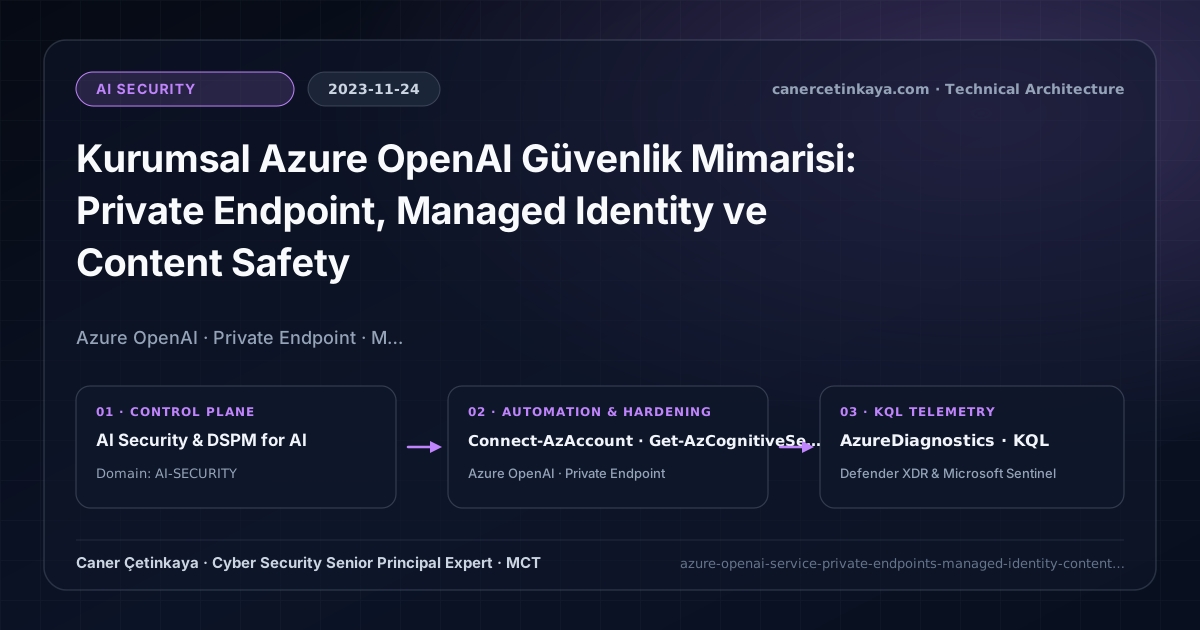
Executive Summary and AI Security Context
As enterprises rapidly built internal RAG copilots in 2023, two architectural mistakes dominated pentest findings: hardcoding static Azure OpenAI API keys and exposing public inference endpoints lacking prompt-injection defenses. Combining Azure Private Link, Entra Managed Identity with disableLocalAuth, and Azure AI Content Safety establishes defense-in-depth for enterprise GenAI workloads.
From an architectural evolution standpoint, this foundational design connects directly to modern platform controls. Establishing the Zero-Trust enterprise LLM baseline in late 2023, disableLocalAuth paired with Private Endpoints now underpins sovereign AI deployments and AI Agent Endpoint Hardening.
Data Boundaries, Permission Inheritance, and Design Principles
- Setting
publicNetworkAccess = Disabledalongside anAzure Private Endpointkeeps inference prompts exclusively on the private backbone controlled by Azure Firewall & Private DNS. - Authenticating applications with
Managed Identityassigned the data-planeCognitive Services OpenAI Userrole eliminates rotatable API key secrets from repos and pipelines. Azure AI Content Safetyand Prompt Shields intercept jailbreak patterns, direct prompt injections, and high-severity harm vectors pre- and post-completion.- Enterprise AI gateways and
Copilotgrounding paths remain defensible only when they inheritManaged IdentityRBAC,Private Endpointisolation, and SharePointRCD/RACsite access boundaries.
Prerequisites, Network/Licensing Scope, and RBAC Requirements
- Licensing & Infrastructure: Azure Subscription with approved Azure OpenAI resource, VNet/Private DNS infrastructure, and Log Analytics diagnostics.
- RBAC Least Privilege: Assign runtime identities strictly
Cognitive Services OpenAI User, separating control-planeContributorprivileges completely. - Network Prerequisite: Resolve
privatelink.openai.azure.comcleanly inside private DNS zones prior to switching off public endpoints.
Technical Verification, Model Access Audits, and Controls
PowerShell AI Security Configuration Validation
Enforcing DisableLocalAuth and inspecting OpenAI RBAC data-plane role assignments via Az PowerShell:
- Execution Environment and Prerequisites: Requires Az.*.
- Least Privilege and Operation Separation: Run with scoped Azure Reader (audit) / Contributor (state changes) privileges. This block pairs **read-only (
Get-*/Search-*) posture queries with state-changing (New-*/Set-*/Enable-*)** examples; execute mutating steps strictly under change control in a pilot ring (using-WhatIfwhere supported) before broad rollout. - Security Control Mapped and Boundary Note: Verifies active policy state and guards against silent drift or mis-scoped rollouts without blind production changes.
# 1. Inspect current network and local-auth posture of the Azure OpenAI resource
Connect-AzAccount
$OpenAi = Get-AzCognitiveServicesAccount -ResourceGroupName "rg-ai-prod" -Name "aoai-enterprise-prod"
$OpenAi | Select-Object AccountName, PublicNetworkAccess, DisableLocalAuth

# 2. Enforce Entra Managed Identity only by disabling static API keys
Update-AzCognitiveServicesAccount -ResourceGroupName "rg-ai-prod" -Name "aoai-enterprise-prod" -DisableLocalAuth $true

# 3. Audit OpenAI data-plane RBAC assignments
Get-AzRoleAssignment -Scope $OpenAi.Id | Where-Object { $_.RoleDefinitionName -like "*OpenAI*" } |
  Select-Object DisplayName, RoleDefinitionName, ObjectType
AI Security Telemetry and KQL Verification Query
KQL query monitoring Azure OpenAI authentication failures, rate-limit throttling, and content filter events:
// Execution Scope: Read-only hunting/audit query (Log Analytics Reader / Security Reader)
// Data Source: Azure Resource Diagnostic Settings -> Log Analytics / Microsoft Sentinel (AzureDiagnostics)
AzureDiagnostics
| where TimeGenerated > ago(14d)
| where ResourceProvider == "MICROSOFT.COGNITIVESERVICES"
| where Category in ("Audit", "RequestResponse")
| project TimeGenerated, Resource, OperationName, ResultSignature, CallerIPAddress, DurationMs
| summarize Requests = count(), DeniedOrFiltered = countif(toint(ResultSignature) in (400, 401, 403, 429)) by OperationName, ResultSignature
| order by DeniedOrFiltered desc, Requests desc
Critical Architectural Assessment, Oversharing Risks, and Rollback Strategy
- Leaving Local Authentication Active After Coding Managed Identity: Forgotten developer test keys in
.envfiles bypass Entra authorization entirely untilDisableLocalAuthturnstrue. - Over-Logging Sensitive Prompt Payloads into Shared SIEM Tables: Stream operational audit telemetry (
AzureDiagnostics) while scoping sensitive input/output trace inspection carefully. - Risks Mitigated vs. Residual Limitations:
Private Endpoints,Managed Identity, content safety filters, and SharePoint oversharing (SAM) guards stop leaked AI API keys and limit unintended Copilot grounding across over-shared sites; yet they cannot prevent authorized users from querying sensitive data they legitimately holdReadaccess to (without Purview DLP/label boundaries) or guard against subtle reasoning hallucinations. - New Dependencies and Production Failure Modes: Architecture relies on
DisableLocalAuthreadiness,Private DNSalignment,SharePoint Advanced Managementsite flags, andSecurity CopilotSCUallocation. Flipping local key auth off prematurely or applyingRestricted SharePoint Searchglobally breaks legacy bots and org-wide search. - Rollback and Pilot Validation Procedure: Stage private AI access and SharePoint
RCD/RACcontrols on non-production subscriptions and pilot SharePoint sites first; roll back disruption safely via scopedSet-SPOSiteorUpdate-AzCognitiveServicesAccountchanges rather than re-exposing public endpoints.
Verified Primary Sources & Open-Source Repositories
This architectural guide was cross-corroborated against the official advisories, Microsoft Learn docs, and open-source PowerShell / KQL repositories below.
Multi-Channel Distribution Summary (X & LinkedIn Draft)
Toggle X (Twitter) & LinkedIn sharing drafts
Multi-Channel Distribution Summary (X & LinkedIn Draft)
Toggle X (Twitter) & LinkedIn sharing draftsZero-trust Azure OpenAI architecture: disabling API keys, Private Endpoints, Managed Identity, and Content Safety. #AzureOpenAI #AISecurity #ZeroTrust
Securing Enterprise Generative AI: Moving Azure OpenAI past static API keys with `disableLocalAuth`, Private Link DNS, and Prompt Shields.