Defender Cloud Security Posture Management (DCSPM): Attack Path Analysis and Agentless Scanning
Cutting through CSPM alert fatigue using Defender CSPM Cloud Security Graph, Attack Path Analysis, and Agentless VM Disk/Secret Scanning across Azure, AWS, and GCP.
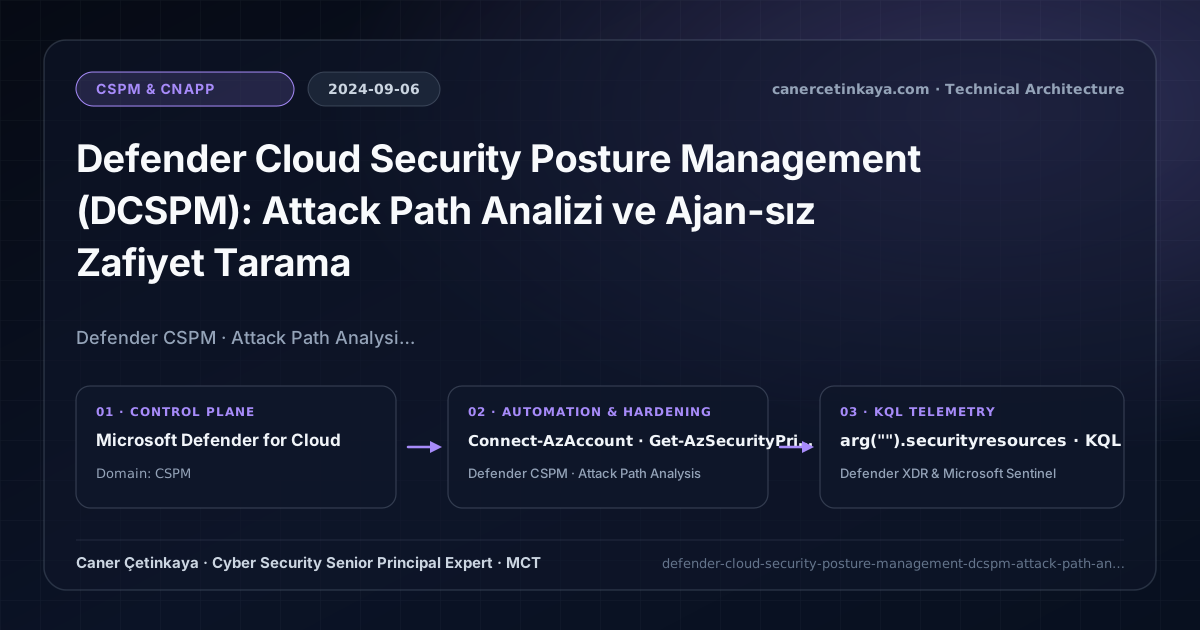
Executive Summary and Cloud Posture Context
Flat CSPM checklists bury cloud engineers beneath thousands of "Medium" and "High" findings—treating a patched-but-isolated sandbox VM identically to an internet-exposed container holding an overprivileged Managed Identity to production Key Vault. Built atop Multicloud CSPM Connectors, paid Defender CSPM (DCSPM) pairs Agentless Disk Scanning with Cloud Security Graph Attack Paths to expose genuine multi-hop breach chains.
From an architectural evolution standpoint, this foundational design connects directly to modern platform controls. Shifting cloud security from flat compliance checklists to graph-driven risk prioritization in 2024, Defender CSPM anchors today’s Multicloud CSPM & DevSecOps vulnerability triage.
Detection Boundaries, Asset Scope, and Design Principles
Attack Path Analysiscorrelates internet ingress, high-severity CVEs, misconfigured IAM trusts, and reachable Crown Jewel storage/databases directly on the Cloud Security Graph.Agentless VM Scanninginspects out-of-band OS snapshots across Azure VMs, AWS EC2, and GCP instances to uncover vulnerabilities and hardcoded secrets with zero agent CPU impact.Governance Rulesautomatically assign vulnerable attack-path ownership and remediation SLAs directly to engineering teams inside Defender for Cloud.- Cloud and SaaS posture engines (
CSPM/SSPM), attack-path graphs, and OAuth governance must tie directly to concrete privilege reduction and IaC/PR gates rather than accumulating unactioned alert queues.
Prerequisites, Connector Coverage, and RBAC Separation
- Licensing: Paid
Defender CSPMplan (Foundational free tier lacks Attack Path Analysis, Agentless Scanning, and Sensitive Data Discovery). - RBAC Access: Subscription/Management Group
Security AdminplusOwner/Contributorprivileges for configuring Governance SLA assignments. - CMK Note: Scanning Customer-Managed-Key encrypted disks agentlessly requires explicit Disk Encryption Set KMS access grants.
Technical Verification, Posture Score, and OAuth Audits
PowerShell Cloud and SaaS Posture Assessment
Verifying Defender CloudPosture plan state and querying active Attack Paths via Az.ResourceGraph PowerShell:
- Execution Environment and Prerequisites: Requires Az.*.
- Least Privilege and Operation Separation: Run with scoped Azure Reader (audit) / Contributor (state changes) privileges. All statements above are **read-only (
Get-*/Test-*/Search-*)** verification checks making no direct configuration edits; still validate module/network prerequisites in a test cohort first. - Security Control Mapped and Boundary Note: Verifies active policy state and guards against silent drift or mis-scoped rollouts without blind production changes.
# 1. Confirm Defender CSPM (CloudPosture) plan pricing and active extensions
Connect-AzAccount
Get-AzSecurityPricing -Name "CloudPosture" | Select-Object Name, PricingTier, Extensions

# 2. Query active Attack Paths by risk level using Azure Resource Graph
Search-AzGraph -Query "securityresources | where type == 'microsoft.security/attackpaths' | summarize Count = count() by tostring(properties.riskLevel)"
Cloud Security Telemetry and KQL Query
Microsoft Sentinel arg("") cross-service Azure Resource Graph query listing critical and high Attack Paths:
// Execution Scope: Read-only hunting/audit query (Log Analytics Reader / Security Reader)
// Data Source: Azure Resource Graph / Microsoft Sentinel arg("") cross-service query (Defender CSPM Attack Paths)
arg("").securityresources
| where type == "microsoft.security/attackpaths"
| extend RiskLevel = tostring(properties.riskLevel), DisplayName = tostring(properties.displayName)
| where RiskLevel in ("Critical", "High")
| project id, DisplayName, RiskLevel
| summarize PathCount = count() by DisplayName, RiskLevel
| order by PathCount desc
Critical Architectural Assessment, Production Risks, and Rollback Strategy
- Mixing Sandbox Subscriptions with Production Crown Jewels Inside Equal SLAs: Scoped resource tags (
Env=Prod) keep SecOps teams laser-focused on true blast-radius choke points. - Fixing Live Cloud Misconfigurations Without Updating Terraform/Bicep: Remediating CSPM findings manually in the Azure Portal causes configuration drift until IaC modules are updated.
- Risks Mitigated vs. Residual Limitations:
Defender CSPM, attack-path graphs,FIM, andShadow AIOAuth governance curb public cloud exposure, drift on sensitive host files, and illicit consent grants; however, they do not stop zero-day runtime exploits before patches/detections arrive, logic bugs in custom SaaS apps, or credential abuse on accounts outside connector RBAC scope. - New Dependencies and Production Failure Modes: Coverage relies on active multi-cloud read connectors (
AWS/GCP), endpoint/VM agents, andApp GovernanceAPI feeds. Blindly enabling automatic OAuth revocation or strict PR/deployment gates can interrupt authorized vendor workflows or release pipelines. - Rollback and Pilot Validation Procedure: Operate OAuth app governance and IaC admission gates in audit/alert mode before activating enforcement; export
Get-MgOauth2PermissionGrantbaselines and retain Defender policy exemptions to reinstate inadvertently paused integrations.
Verified Primary Sources & Open-Source Repositories
This architectural guide was cross-corroborated against the official advisories, Microsoft Learn docs, and open-source PowerShell / KQL repositories below.
Multi-Channel Distribution Summary (X & LinkedIn Draft)
Toggle X (Twitter) & LinkedIn sharing drafts
Multi-Channel Distribution Summary (X & LinkedIn Draft)
Toggle X (Twitter) & LinkedIn sharing draftsFixing real multi-hop breach chains instead of drowning in alerts with Defender CSPM Attack Path Analysis. #DefenderForCloud #DCSPM #Multicloud
Graph-Driven Cloud Security: Turning on Defender CSPM Agentless Disk Scanning, mapping Crown Jewel Attack Paths, and enforcing Governance SLAs.