Multi-Cloud CSPM and DevSecOps Automation for Azure, AWS, and Google Cloud
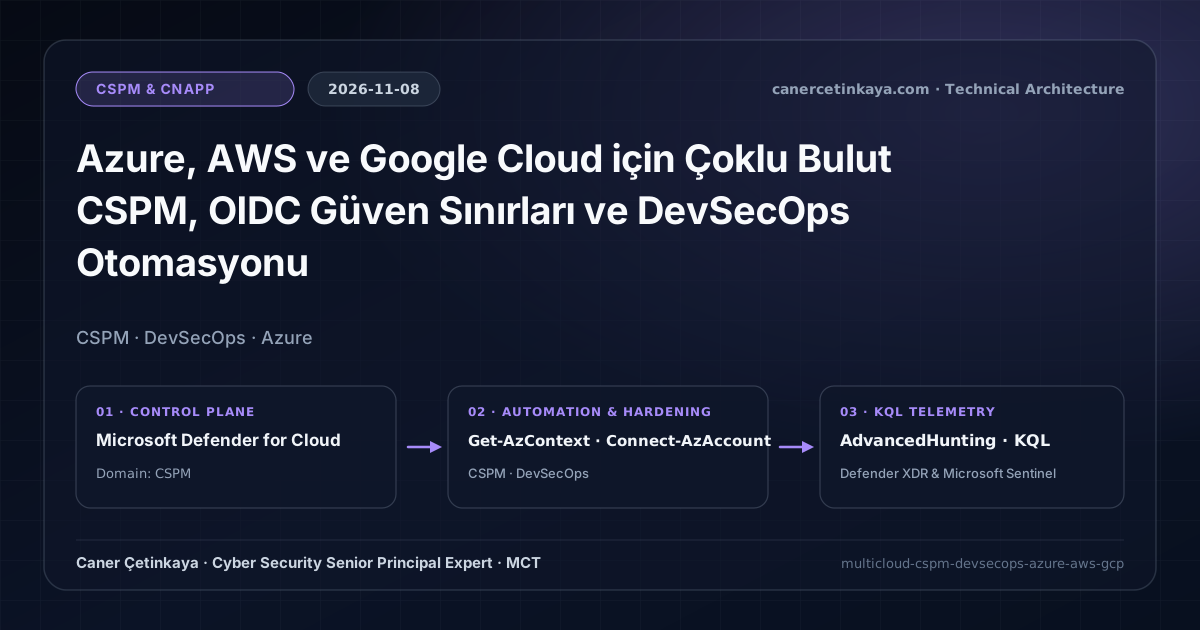
Unified CNAPP security across Microsoft Defender for Cloud, AWS Security Hub, and GCP Security Command Center: OIDC federation trust boundaries, GitHub Actions Checkov PR gates, read-only Az.ResourceGraph audits, Continuous Export KQL correlation, and critical risk analysis.
Executive Summary
When enterprises run production workloads concurrently across Azure, AWS, and Google Cloud Platform (GCP), security posture fragments across disconnected consoles. Attackers exploit cross-cloud blind spots—pivoting from an over-privileged AWS IAM role or an unguarded CI/CD federation rule into production Azure subscriptions. This guide architectures unified CNAPP visibility in Microsoft Defender for Cloud alongside pre-merge Infrastructure-as-Code (IaC) security gates, highlights strict OIDC trust boundaries, and details critical gaps CSPM alone does not solve.
Threat Model and Multi-Cloud Trust Boundaries
Defensible cross-cloud governance isolates four distinct planes:
- Identity Federation Boundary: Eliminate long-lived
AWS_ACCESS_KEY_IDsecrets and GCP service account JSON keys in favor of short-lived OIDC tokens scoped strictly to protected branches (main) and protected environment approvals. - Pre-Merge IaC Pipeline Boundary: Catching public storage buckets or unencrypted volumes after production deployment wastes operational effort; enforce scanning at pull request time before templates merge.
- Preventive Cloud Guardrails: Defender for Cloud provides unified assessment and Attack Path correlation, whereas actual deployment prevention still depends on native Azure Policy, AWS Organizations SCPs, and GCP Organization Policy Constraints.
- Control Plane Pairing: Protect cloud control-plane identities via Entra ID Identity Resilience and PIM Exclusions.
Technical Implementation: PR Security Gate and Resource Graph Audit
1. Least-Privilege GitHub Actions Pull Request Gate
- Environment & Permissions: Standard
ubuntu-latestrunner scoped solely tocontents: readandsecurity-events: write—never grant production cloud OIDC token minting permissions to untrusted pull request build jobs. - Boundary Limitation: Static Checkov rules catch misconfigured code in
infra/, not out-of-band manual changes made directly inside cloud portals.
name: DevSecOps Multi-Cloud IaC Gate
on:
  pull_request:
    branches: ["main"]
permissions:
  contents: read
  security-events: write
jobs:
  security-gate:
    runs-on: ubuntu-latest
    steps:
      - uses: actions/checkout@v4
      - name: Run Checkov Multi-Cloud Scan
        uses: bridgecrewio/checkov-action@v12
        with:
          directory: infra/
          framework: terraform,bicep
          soft_fail: false
2. Read-Only Multi-Cloud Assessment Audit (PowerShell)
- Environment & Least Privilege: PowerShell 7.4+ with
Az.AccountsandAz.ResourceGraphunder theSecurity Readerrole. - Edge Case: Newly onboarded AWS and GCP connectors require initial discovery cycles to populate findings; large enterprises should account for Resource Graph pagination (
-First 100+).
#Requires -Modules Az.Accounts, Az.ResourceGraph
# Environment: PowerShell 7.4+ | Least Privilege: Security Reader (read-only audit)
$ErrorActionPreference = 'Stop'

if (-not (Get-AzContext)) {
    Connect-AzAccount | Out-Null
}

$ArgQuery = @"
securityresources
| where type == 'microsoft.security/assessments'
| extend Status = tostring(properties.status.code),
         Severity = tostring(properties.metadata.severity),
         Environment = tostring(properties.resourceDetails.Source)
| where Status == 'Unhealthy' and Severity == 'High'
| summarize UnhealthyCount = count() by Environment, DisplayName = tostring(properties.displayName)
| order by UnhealthyCount desc
"@

try {
    Search-AzGraph -Query $ArgQuery -First 100 | Select-Object -First 15 | Format-Table -AutoSize
} catch {
    Write-Warning "Resource Graph query failed (check context or permissions): $($_.Exception.Message)"
}
KQL Correlation: CSPM Posture Meets Active Alerts
- Data Source & Limitations: Requires Defender for Cloud Continuous Export into Log Analytics (
SecurityRecommendation) alongsideSecurityAlert(Log Analytics Reader). Because Azure Resource IDs, AWS ARNs, and GCP paths vary in casing, both sides normalize viatolower().
// Data Source: Defender for Cloud Continuous Export -> Log Analytics (SecurityRecommendation + SecurityAlert)
// Purpose: Prioritize High/Critical CSPM findings on resources that also exhibit active SecurityAlerts.
let ActiveAlerts = SecurityAlert
| where TimeGenerated > ago(7d)
| where AlertSeverity in ("High", "Critical")
| summarize ActiveAlertCount = count() by ResourceKey = tolower(ResourceId);
SecurityRecommendation
| where TimeGenerated > ago(7d)
| where RecommendationState == "Unhealthy"
| where RecommendationSeverity in ("High", "Critical")
| extend
    ResourceKey = tolower(AssessedResourceId),
    CloudProvider = coalesce(tostring(AdditionalData.CloudProvider), "Azure")
| join kind=leftouter ActiveAlerts on ResourceKey
| summarize
    OpenFindings = dcount(AssessedResourceId),
    CorrelatedAlerts = sum(coalesce(ActiveAlertCount, 0))
    by CloudProvider, RecommendationName, RecommendationSeverity
| order by CorrelatedAlerts desc, OpenFindings desc
Critical Architectural Assessment
- What Risk It Mitigates: Removes leaked static cloud keys from repositories, prevents obvious IaC security defects from merging, and unifies multi-cloud risk visibility.
- What Risks It Does NOT Mitigate: CSPM does not patch application-layer vulnerabilities, prevent abused valid OAuth sessions, or protect against an attacker compromising the CI/CD runner itself and misusing its legitimately scoped OIDC token.
- New Dependencies Introduced: Relies on cross-cloud IAM connector roles, Log Analytics ingestion cost controls, and engineering discipline against manual portal hotfixes (configuration drift).
- Production Failure Conditions: Enforcing strict
soft_fail: falseon noisy rules without an exception process stalls urgent incident fixes; forwardingLowposture items into SOC queues triggers severe alert fatigue. - Rollback Plan: Stage new Checkov checks as non-blocking warnings before enforcement and keep temporary
--skip-checkexemptions peer-reviewed so blocking rules can be bypassed safely for emergency patches; reconcile any emergency portal hotfix back into Git IaC immediately afterward.
Implementation Roadmap
- Phase 1: Migrate static CI/CD cloud credentials to branch- and environment-locked OIDC federation.
- Phase 2: Enable Checkov PR gates for Critical/High findings and onboard read-only AWS/GCP connectors in Defender for Cloud.
- Phase 3: Activate Continuous Export and route
SecurityRecommendation+SecurityAlertcorrelations into SOC prioritization.
Verified Primary Sources & Open-Source Repositories
This architectural guide was cross-corroborated against the official advisories, Microsoft Learn docs, and open-source PowerShell / KQL repositories below.
Multi-Channel Distribution Summary (X & LinkedIn Draft)
Toggle X (Twitter) & LinkedIn sharing drafts
Multi-Channel Distribution Summary (X & LinkedIn Draft)
Toggle X (Twitter) & LinkedIn sharing draftsEliminating static keys with OIDC is only half the DevSecOps architecture—unconstrained OIDC subject claims let untrusted branches assume production cloud roles. Updated multi-cloud CSPM blueprint with Checkov gates, Az.ResourceGraph, and KQL. #CSPM #DevSecOps
Rebuilt our Multi-Cloud CSPM & DevSecOps architecture guide covering OIDC Workload Identity trust boundaries, least-privilege Checkov PR gates, read-only Az.ResourceGraph telemetry, Continuous Export KQL correlation, and rollback design.