Digital Sovereignty Architecture: Microsoft Sovereign Cloud, Azure Local, and Cryptographic Key Control
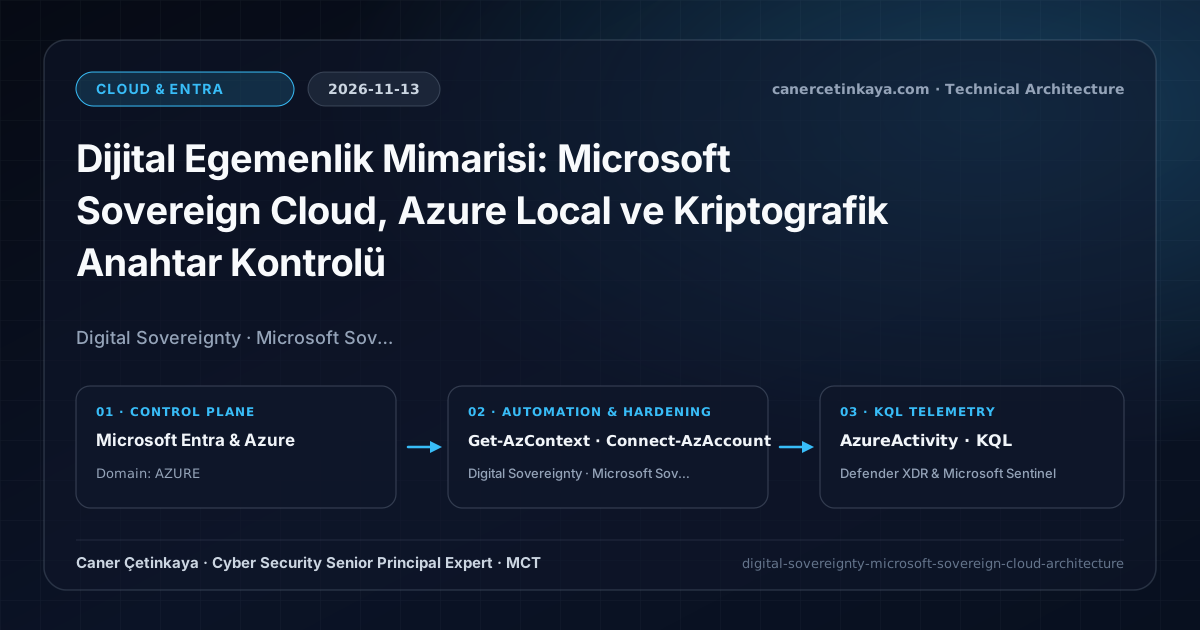
Separating data residency from true cryptographic and operational sovereignty: Sovereign Control Panel, Managed HSM vs. External Key Management (EKM) trade-offs, Confidential Computing bounds, disconnected Azure Local risks, and AzureActivity KQL auditing.
Executive Summary
In regulated financial, public-sector, energy, and defense architectures, digital sovereignty is routinely oversimplified into geographic data residency. Yet geographic placement alone does not protect data if an external support operator, hypervisor memory dump, or cloud-held key could undermine trust boundaries. This guide dissects technical, operational, and cryptographic sovereignty across Microsoft Sovereign Cloud, Azure Managed HSM, External Key Management (EKM), Confidential Computing, and disconnected Azure Local clusters, alongside candid architectural trade-offs and rollback strategies.
Problem Definition: Residency vs. Technical and Operational Control
Enterprise sovereignty governance addresses four distinct control dimensions:
- Cryptographic Ownership at Rest: Ensuring root key material remains under exclusive customer lifecycle governance rather than platform-managed encryption.
- Hardware Memory Isolation in Use: Standard VMs expose memory contents to underlying host layers unless protected inside processor-backed Trusted Execution Environments (TEEs).
- Support Operator Transparency: Customer Lockbox, Just-in-Time approval, and EU/EFTA Data Guardian / Production Touch Ledger logs convert implicit trust into verifiable operator consent.
- Disconnected Continuity: Enabling mission-critical systems to continue operating locally on Azure Local (hosting local data services, Foundry Local, GitHub Enterprise Local, and Microsoft 365 Local) when external WAN links fail or are intentionally severed.
Trade-Offs: Managed HSM vs. External Key Management (EKM)
Choosing between Azure Key Vault Managed HSM and External Key Management (EKM) requires weighing sovereignty purity against operational availability:
- Managed HSM runs as single-tenant FIPS 140-3 Level 3 HSM pools hosted in cloud regions, pairing high cloud availability with customer-exclusive HSM security domains.
- External Key Management retains cryptographic keys inside customer premises or third-party HSM appliances, maximizing formal key possession but introducing network latency and a severe single point of failure: if the WAN or on-premises HSM appliance drops, dependent cloud workloads cannot wrap or unwrap data keys.
Prerequisites, Separation of Duties, and Policy Boundaries
- PIM Separation of Duties: Isolate
Resource Policy Contributor,Key Vault Crypto Officer, andCustomer Lockbox Approveracross distinct principals backed by time-bound Microsoft Entra Privileged Identity Management approvals. - Policy Enforcement Without Outages: Enforce regional residency and Confidential Computing SKU rules (
Standard_DC*AMD SEV-SNP /Standard_EC*Intel TDX) through Azure Policy via Infrastructure-as-Code pipelines or Azure Portal Policy Assignments, staging policies in Audit mode before switching to Deny so managed PaaS scale sets are never blocked unexpectedly.
Technical Verification: Read-Only HSM and Policy Compliance (PowerShell)
The script operates strictly in read-only mode to audit Managed HSM posture and non-compliant Azure Policy resources.
- Environment: PowerShell 7.4+ with
Az.Accounts,Az.KeyVault, andAz.PolicyInsights. - Required Least-Privilege Permissions: Subscription
Readerand Managed HSM read/audit role (Managed HSM Crypto Auditor). - Scope & Failure Handling: Note that
Get-AzKeyVaultKey -HsmName ...queries the Managed HSM data plane; running outside an authorized Private Endpoint or management jump host triggers a structured network warning rather than failing blindly.
#Requires -Modules Az.Accounts, Az.KeyVault, Az.PolicyInsights
# Environment: PowerShell 7.4+ | Least Privilege: Reader + Managed HSM Crypto Auditor (read-only)
$ErrorActionPreference = 'Stop'

if (-not (Get-AzContext)) {
    Connect-AzAccount | Out-Null
}

Write-Host "[1/3] Auditing single-tenant Managed HSM instances..." -ForegroundColor Cyan
$Hsms = Get-AzKeyVaultManagedHsm
$Hsms |
    Select-Object HsmName, Location, ResourceGroupName, ProvisioningState, PublicNetworkAccess |
    Format-Table -AutoSize

Write-Host "[2/3] Inspecting HSM key types, sizes, and expiration posture..." -ForegroundColor Cyan
foreach ($Hsm in $Hsms) {
    try {
        Get-AzKeyVaultKey -HsmName $Hsm.HsmName |
            Select-Object @{ Name = 'HsmName'; Expression = { $Hsm.HsmName } }, Name, KeyType, KeySize, CurveName, Enabled, Expires |
            Format-Table -AutoSize
    } catch {
        Write-Warning "Cannot reach Managed HSM '$($Hsm.HsmName)' data plane (check Private Endpoint or RBAC): $($_.Exception.Message)"
    }
}

Write-Host "[3/3] Listing non-compliant policy assignments (first 25)..." -ForegroundColor Yellow
Get-AzPolicyState -Filter "ComplianceState eq 'NonCompliant'" |
    Select-Object Timestamp, ResourceId, PolicyDefinitionName, PolicyAssignmentScope -First 25 |
    Format-Table -AutoSize
Auditing Operator Access and Policy Exemptions via KQL
- Data Source & Role: Azure Activity Logs streamed to Log Analytics (
AzureActivity,Log Analytics Reader). - Limitations:
AzureActivitylogs control-plane operations (Lockbox requests, HSM resource modifications, andPolicyExemptions); cryptographic data-plane key usage requires enabling Managed HSM DiagnosticAuditEventlogging separately.
// Data Source: Azure Subscription Activity Logs -> Log Analytics (AzureActivity)
// Purpose: Audit Customer Lockbox approvals, Managed HSM control-plane edits, and PolicyExemptions.
AzureActivity
| where TimeGenerated > ago(14d)
| where OperationNameValue has_any (
    "MICROSOFT.CUSTOMERLOCKBOX/REQUESTS",
    "MICROSOFT.KEYVAULT/MANAGEDHSMS",
    "MICROSOFT.AUTHORIZATION/POLICYEXEMPTIONS"
)
| summarize
    EventCount = count(),
    LatestActivity = max(TimeGenerated),
    Statuses = make_set(ActivityStatusValue, 5)
    by Caller, CallerIpAddress, OperationNameValue, ResourceGroup, SubscriptionId
| order by LatestActivity desc
Pair long-lived cryptographic lifecycle planning with Post-Quantum Cryptography (PQC) Readiness and multi-cloud CI/CD gates in Multi-Cloud CSPM and DevSecOps Automation.
Critical Architectural Assessment
- What Risk It Mitigates: Eliminates unapproved cross-border compute placement, protects active VM memory via hardware TEEs, gates cloud support access via Customer Lockbox, and supports local survivability during WAN disconnects.
- What Risks It Does NOT Mitigate: Does not patch insecure application code inside Confidential VMs, prevent compromised over-privileged administrators, or protect against irrevocable data loss if Managed HSM Security Domain quorum backups are lost.
- New Dependencies Introduced: Reliance on on-premises HSM availability when deploying EKM, and full customer patching/hardware lifecycle operations on disconnected Azure Local clusters.
- Production Failure Conditions: Enforcing strict
DenySKU policies on root management groups without Audit testing breaks PaaS/AKS auto-scaling; losing quorum on Managed HSM Security Domain keys renders encrypted storage unrecoverable. - Rollback Strategy: Deploy custom Sovereign Landing Zone policies in
Auditmode first and maintain prior key versions with Purge Protection enabled so workloads can safely revert encryption key bindings or downgrade policy enforcement toAuditwithout outage.
Implementation Roadmap
- Phase 1: Classify workloads into public sovereign, confidential compute, and disconnected Azure Local tiers.
- Phase 2: Enable Sovereign Control Panel monitoring, PIM separation of duties,
Audit-mode SLZ policies, andAzureActivitySentinel rules. - Phase 3: Pilot Managed HSM and Confidential VMs before gating production deployments or migrating disconnected workloads onto Azure Local.
Verified Primary Sources & Open-Source Repositories
This architectural guide was cross-corroborated against the official advisories, Microsoft Learn docs, and open-source PowerShell / KQL repositories below.
Multi-Channel Distribution Summary (X & LinkedIn Draft)
Toggle X (Twitter) & LinkedIn sharing drafts
Multi-Channel Distribution Summary (X & LinkedIn Draft)
Toggle X (Twitter) & LinkedIn sharing draftsData residency alone is not digital sovereignty. Updated architecture analysis weighs Managed HSM vs EKM latency and availability trade-offs, Confidential VM hardware bounds, disconnected Azure Local overhead, and AzureActivity KQL monitoring. #DigitalSovereignty #Azure
Rebuilt our Digital Sovereignty blueprint across Microsoft Sovereign Cloud, Azure Managed HSM, External Key Management (EKM), Confidential Computing, and Azure Local—focusing on control continuity trade-offs, least-privilege Az.KeyVault verification, failure modes, and rollback governance.