Eliminating Inbound Reverse Proxies with Exchange Modern Hybrid Agent Architecture
A 2020 hybrid messaging blueprint using the Exchange Modern Hybrid Agent to execute MRSProxy mailbox migrations and Free/Busy queries over outbound-only encrypted tunnels without exposing internal Exchange endpoints to the internet.
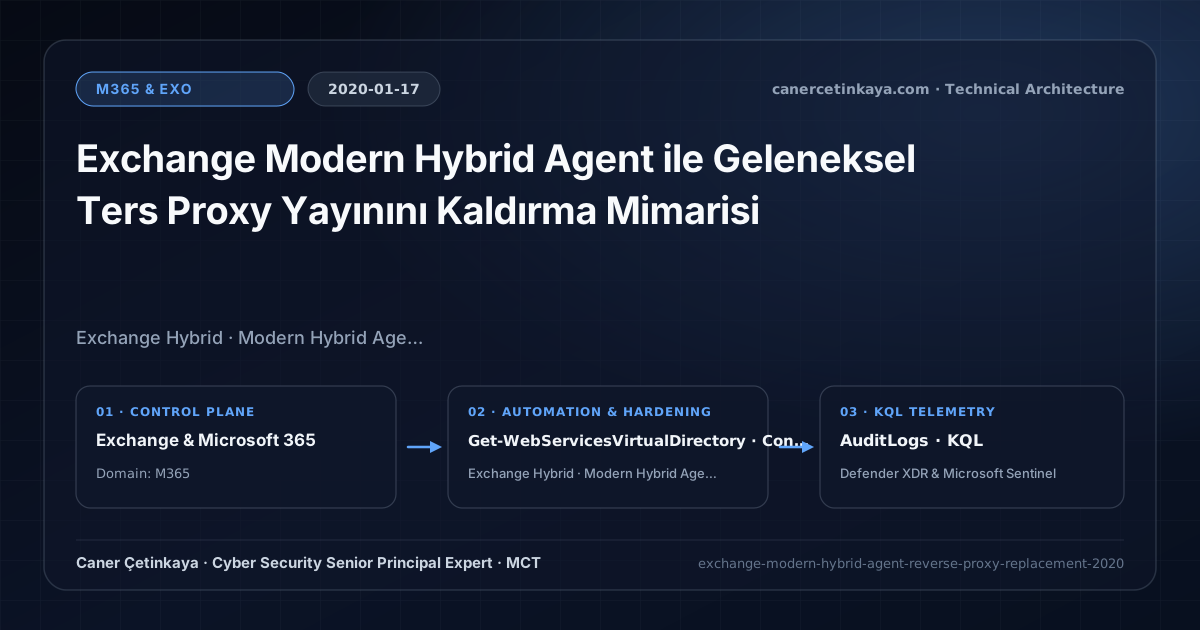
Executive Summary and Messaging Infrastructure Context
Traditional Exchange Hybrid deployments (Exchange 2016 HCW Migration) demanded exposing internal Client Access servers over inbound port 443 alongside public SAN SSL certificates and NAT rules so Exchange Online could reach MRSProxy—creating a persistent external attack surface and operational risk. The Exchange Modern Hybrid Agent eliminates inbound firewall openings by anchoring mailbox move connectivity atop outbound Azure AD Application Proxy tunnels.
From an architectural evolution standpoint, this foundational design connects directly to modern platform controls. Introduced to close inbound DMZ exposure for MRS migrations in 2020, the Exchange Modern Hybrid Agent pattern still serves modern Exchange Server Subscription Edition (SE) coexistences governed under Entra ID Identity Resilience.
Protocol Trust Boundaries, Authentication, and Design Principles
- Deploys as a lightweight Windows service inside the corporate LAN using outbound-only HTTPS (443) connections, erasing inbound MRSProxy firewall attack surface.
- Publishes an isolated tenant-specific cloud endpoint (*.msappproxy.net) via Azure AD Application Proxy, preventing internet scanners from probing on-premises Exchange virtual directories.
- Pairs with Exchange 2019 DAG and Hybrid Modern Authentication when cloud-first migrations dominate, though Classic Hybrid remains required for full Teams Calendar App coexistence.
- Messaging authentication (
SPF,DKIM,DMARC,ARC,MTA-STS,DANE) and scoped application access (RBAC for Applications) must eliminate legacyBasic Authdependencies and confine service principals to named mailbox scopes.
Prerequisites, DNS/Certificate Dependencies, and RBAC
- Licensing: Microsoft 365 E3/E5 or Office 365 E3/E5 with free Hybrid Edition licensing key.
- Infrastructure & RBAC: Exchange 2013 CU19+, 2016 CU8+, or 2019 running TLS 1.2, managed with least privilege via Exchange Organization Management and Application Administrator.
- Scope Check: Confirm Classic vs Modern topology requirements carefully if Microsoft Teams on-premises mailbox calendaring is required.
Technical Verification, Mail-Flow Auditing, and Controls
PowerShell Protocol and Mail-Flow Validation
Verifying internal MRSProxy enablement, Modern Hybrid migration endpoints, and Hybrid Agent service health:
- Execution Environment and Prerequisites: Requires ExchangeOnlineManagement.
- Least Privilege and Operation Separation: Run with scoped Exchange / Compliance / SharePoint Administrator (or View-Only / Security Reader for audit commands) privileges. All statements above are **read-only (
Get-*/Test-*/Search-*)** verification checks making no direct configuration edits; still validate module/network prerequisites in a test cohort first. - Security Control Mapped and Boundary Note: Verifies active policy state and guards against silent drift or mis-scoped rollouts without blind production changes.
# 1. Confirm MRSProxy is enabled on internal Exchange Web Services virtual directory
Get-WebServicesVirtualDirectory | Select-Object Server, Name, MRSProxyEnabled, InternalUrl

# 2. Validate Modern Hybrid Migration Endpoint and connectivity from Exchange Online
Connect-ExchangeOnline -UserPrincipalName "[email protected]"
Get-MigrationEndpoint | Select-Object Identity, EndpointType, RemoteServer, Status
Test-MigrationServerAvailability -ExchangeRemoteMove -Autodiscover -EmailAddress "[email protected]" -Credentials (Get-Credential)

# 3. Inspect Modern Hybrid Agent service state on local host
Get-Service -Name "MicrosoftHybridService*" -ErrorAction SilentlyContinue | Select-Object Name, Status, StartType
Messaging Telemetry and KQL Verification Query
KQL audit tracking Azure AD Application Proxy connector provisioning events for Hybrid Agent deployments:
// Execution Scope: Read-only hunting/audit query (Log Analytics Reader / Security Reader)
// Data Source: Microsoft Entra ID Diagnostic Settings -> Log Analytics / Microsoft Sentinel (AuditLogs)
AuditLogs
| where TimeGenerated > ago(14d)
| where LoggedByService in ("Application Proxy", "Core Directory")
| where TargetResources has "Hybrid" or OperationName has "connector"
| project TimeGenerated, OperationName, InitiatedBy, Result, TargetResources
| summarize ActionCount = count() by OperationName, Result
| order by ActionCount desc
Critical Architectural Assessment, Mail-Flow Risks, and Rollback Strategy
- Performing TLS Inspection on Agent Outbound Traffic: Decrypting traffic bound for *.msappproxy.net or *.servicebus.windows.net breaks certificate pinning and drops migration batches; whitelist SSL bypass.
- Installing Directly on Legacy Operating Systems: Host the Hybrid Agent on an updated Windows Server 2016/2019 member server rather than aging mailbox nodes for cleaner OS patching.
- Risks Mitigated vs. Residual Limitations:
Basic Authremoval,SPF/DKIM/DMARC/ARC/MTA-STS/DANE, andRBAC for Applicationsstop legacy password spray, direct-domain spoofing, SMTP downgrade attacks, and over-privileged Graph apps; they do not prevent fraud sent from legitimately compromised MFA accounts, lookalike cousin domains passing their own authentication, or misrouted external relays bypassing Exchange connectors. - New Dependencies and Production Failure Modes: Operations rely on accurate DNS hygiene (
DNSSEC,TLSA, the10-lookup SPF limit,Selector1/Selector2CNAMEs), valid SAN certificates on hybrid servers, and timelyApp-Onlycertificate rotation. EnforcingDMARC p=rejector decommissioning hybrid management hosts before inventoryingSigninLogsbreaks invoicing and recipient workflows. - Rollback and Pilot Validation Procedure: Drop DNS record TTLs (
300s) before authentication cutovers, holdDMARCatp=nonemonitoringRUAreports for at least21days, validateTest-ServicePrincipalAuthorizationprior to retiring legacy app policies, and keep hybrid config backups before server removal.
Verified Primary Sources & Open-Source Repositories
This architectural guide was cross-corroborated against the official advisories, Microsoft Learn docs, and open-source PowerShell / KQL repositories below.
Multi-Channel Distribution Summary (X & LinkedIn Draft)
Toggle X (Twitter) & LinkedIn sharing drafts
Multi-Channel Distribution Summary (X & LinkedIn Draft)
Toggle X (Twitter) & LinkedIn sharing draftsMigrate Exchange mailboxes to M365 over outbound-only tunnels without exposing inbound port 443 using Exchange Modern Hybrid Agent. #ExchangeOnline #ZeroTrust
2020 Hybrid Exchange architecture: eliminating public MRSProxy reverse proxies with Modern Hybrid Agent, outbound TLS bypass rules, and PowerShell tunnel validation.