Retiring Legacy SMTP AUTH with Exchange Online High Volume Email (HVE) and OAuth SMTP
Completing the elimination of Basic Auth SMTP AUTH in Exchange Online by migrating internal alerts to High Volume Email (HVE) and business apps to scoped Microsoft Graph `Mail.Send` / OAuth 2.0.
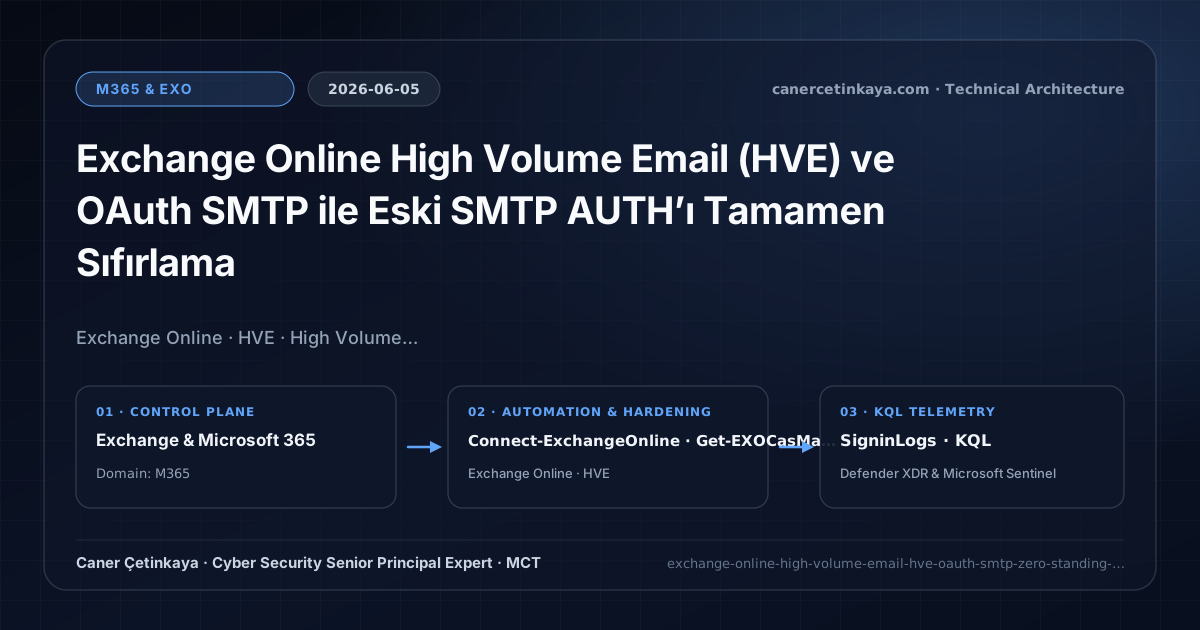
Executive Summary and Messaging Infrastructure Context
Long after POP, IMAP, and EWS Basic Authentication vanished in 2022, one legacy protocol persisted across printer firmware, monitoring bots, and batch invoicing engines: SMTP AUTH (smtp.office365.com:587). As Exchange Online moves to permanently close Basic Authentication over SMTP AUTH, engineering teams have crisp modern targets: High Volume Email (HVE) for high-rate internal notifications, OAuth 2.0 / Graph `Mail.Send` + RBAC for enterprise applications, and Azure Communication Services for external transactional volume.
From an architectural evolution standpoint, this foundational design connects directly to modern platform controls. Finishing the protocol cleanup launched during 2022’s Basic Auth Deprecation and powered by 2023’s Exchange RBAC for Applications, migrating off legacy SMTP AUTH eliminates the final tenant password-spray exposure in 2026.
Protocol Trust Boundaries, Authentication, and Design Principles
High Volume Email (HVE)exposes a dedicatedsmtp-hve.office365.comsubmission endpoint overcoming traditional 10,000-recipient/day user mailbox throttling ceilings for internal operational traffic.- Line-of-business applications pivot to Entra Service Principal OAuth 2.0 / Graph
Mail.Sendrestricted cleanly to dedicated sender mailboxes via Exchange RBAC for Applications. - Drives tenant-wide
SmtpClientAuthenticationDisabled = $trueenforcement globally without breaking legitimate multifunction copiers or batch jobs. - Messaging authentication (
SPF,DKIM,DMARC,ARC,MTA-STS,DANE) and scoped application access (RBAC for Applications) must eliminate legacyBasic Authdependencies and confine service principals to named mailbox scopes.
Prerequisites, DNS/Certificate Dependencies, and RBAC
- Licensing: HVE accounts and Exchange Online Graph API
Mail.Sendintegrate inside standard Exchange Online / Microsoft 365 plans subject to Microsoft’s published HVE throttling and commercial terms. - RBAC Access:
Exchange Administratorfor provisioning HVE accounts andApplication Administratorfor configuring least-privilege Graph mail sender apps. - Scanner Firmware Check: Confirm older office MFPs switch either to Direct Send (static-IP MX relay), an internal OAuth relay, or Azure Communication Services.
Technical Verification, Mail-Flow Auditing, and Controls
PowerShell Protocol and Mail-Flow Validation
Auditing lingering per-mailbox SMTP AUTH overrides, transport lock state, and HVE accounts in EXO PowerShell:
- Execution Environment and Prerequisites: Requires ExchangeOnlineManagement.
- Least Privilege and Operation Separation: Run with scoped Exchange / Compliance / SharePoint Administrator (or View-Only / Security Reader for audit commands) privileges. All statements above are **read-only (
Get-*/Test-*/Search-*)** verification checks making no direct configuration edits; still validate module/network prerequisites in a test cohort first. - Security Control Mapped and Boundary Note: Verifies active policy state and guards against silent drift or mis-scoped rollouts without blind production changes.
# 1. Connect to Exchange Online PowerShell
Connect-ExchangeOnline -UserPrincipalName "[email protected]"

# 2. Identify any remaining mailboxes with legacy SMTP AUTH left enabled
Get-EXOCasMailbox -ResultSize Unlimited |
  Where-Object { $_.SmtpClientAuthenticationDisabled -eq $false } |
  Select-Object DisplayName, PrimarySmtpAddress, SmtpClientAuthenticationDisabled

# 3. Verify tenant global SMTP AUTH block and existing HVE accounts
Get-TransportConfig | Select-Object SmtpClientAuthenticationDisabled
Get-MailUser -HVEAccount | Select-Object DisplayName, PrimarySmtpAddress
Messaging Telemetry and KQL Verification Query
KQL query auditing every active Authenticated SMTP caller and source IP prior to final retirement:
// Execution Scope: Read-only hunting/audit query (Log Analytics Reader / Security Reader)
// Data Source: Microsoft Entra ID Diagnostic Settings -> Log Analytics / Microsoft Sentinel (SigninLogs / AuditLogs)
SigninLogs
| where TimeGenerated > ago(30d)
| where ClientAppUsed == "Authenticated SMTP"
| summarize Attempts = count(), Success = countif(toint(Status.errorCode) == 0), LastSeen = max(TimeGenerated) by UserPrincipalName, IPAddress, AppDisplayName
| order by Attempts desc
Critical Architectural Assessment, Mail-Flow Risks, and Rollback Strategy
- Routing External Customer Emails Through HVE: HVE enforces strict internal focus; route external transactional customer notifications via Azure Communication Services Email or verified external mail providers.
- Forgetting
ManagementScopeLocks When Migrating Apps to GraphMail.Send: Always scope GraphApplication Mail.Sendpermissions strictly to the dedicated service mailbox rather than leaving tenant-wide impersonation active. - Risks Mitigated vs. Residual Limitations:
Basic Authremoval,SPF/DKIM/DMARC/ARC/MTA-STS/DANE, andRBAC for Applicationsstop legacy password spray, direct-domain spoofing, SMTP downgrade attacks, and over-privileged Graph apps; they do not prevent fraud sent from legitimately compromised MFA accounts, lookalike cousin domains passing their own authentication, or misrouted external relays bypassing Exchange connectors. - New Dependencies and Production Failure Modes: Operations rely on accurate DNS hygiene (
DNSSEC,TLSA, the10-lookup SPF limit,Selector1/Selector2CNAMEs), valid SAN certificates on hybrid servers, and timelyApp-Onlycertificate rotation. EnforcingDMARC p=rejector decommissioning hybrid management hosts before inventoryingSigninLogsbreaks invoicing and recipient workflows. - Rollback and Pilot Validation Procedure: Drop DNS record TTLs (
300s) before authentication cutovers, holdDMARCatp=nonemonitoringRUAreports for at least21days, validateTest-ServicePrincipalAuthorizationprior to retiring legacy app policies, and keep hybrid config backups before server removal.
Verified Primary Sources & Open-Source Repositories
This architectural guide was cross-corroborated against the official advisories, Microsoft Learn docs, and open-source PowerShell / KQL repositories below.
Multi-Channel Distribution Summary (X & LinkedIn Draft)
Toggle X (Twitter) & LinkedIn sharing drafts
Multi-Channel Distribution Summary (X & LinkedIn Draft)
Toggle X (Twitter) & LinkedIn sharing draftsClosing the final Basic Auth loophole with Exchange Online High Volume Email (HVE) and OAuth Graph Mail.Send. #ExchangeOnline #HVE #OAuthSMTP
Finishing the Basic Auth Retirement: Separating internal HVE relays, scoped Graph Mail.Send apps, and external ACS email to kill SMTP AUTH permanently.