Modernizing Enterprise SCEP with Microsoft Intune Cloud PKI (Retiring NDES)
Eliminating fragile on-premises NDES and Intune Certificate Connector servers by deploying 802.1X Wi-Fi, VPN, and Entra CBA certificates directly from Microsoft Intune Cloud PKI.
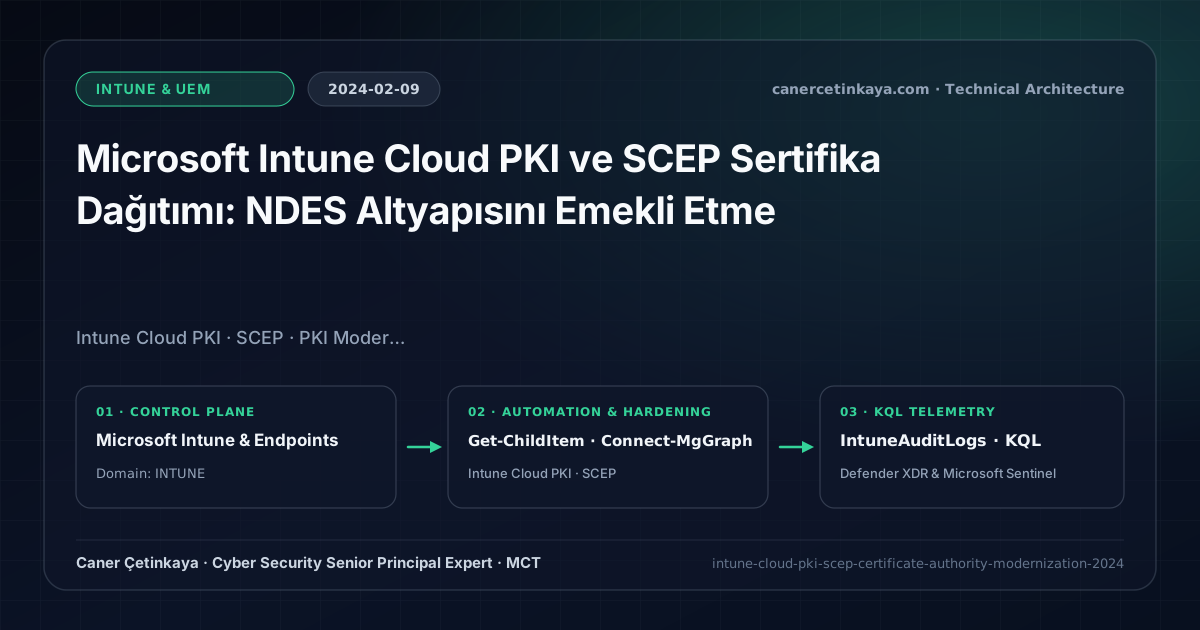
Executive Summary and Endpoint Hardening Context
For years, the hardest operational hurdle in any Microsoft Intune project wasn’t MDM enrollment—it was wiring SCEP certificates for 802.1X Wi-Fi and VPN via on-premises AD CS, DMZ NDES servers, Intune Certificate Connectors, and reverse proxies. Released in early 2024 inside Intune Suite, Microsoft Cloud PKI delivers turnkey cloud-hosted Root and Issuing CAs provisioned in minutes.
From an architectural evolution standpoint, this foundational design connects directly to modern platform controls. Launching in early 2024 as a clean cloud replacement for NDES infrastructures exposed to AD CS ESC1–ESC8 risks, Intune Cloud PKI forms the certificate backbone for Cloud-Native Entra Joined Migrations.
Hardware and Kernel Trust Boundaries and Design Principles
- Supports either an isolated
Intune Managed Two-Tier CA(Root + Issuing in Azure) orBring Your Own CA (BYOCA)anchored to your existing corporate Root CA. - Intune SCEP profiles communicate directly with Intune Cloud PKI endpoints without exposing DMZ NDES servers or firewall holes; CRL distribution stays cloud-managed.
- Unlocks zero-touch 802.1X EAP-TLS Wi-Fi/wired NAC authentication and passwordless VPN tunnels across Windows, macOS, iOS, and Android.
BitLocker,Credential Guard,HVCI/VBS,App Control(WDAC),Cloud PKI, andWindows LAPSmust align withTPM 2.0/UEFI Secure Bootreadiness and resolve legacyGPO/customOMA-URIprecedence conflicts across pilot rings.
Prerequisites, MDM Conflict Resolution, and RBAC Boundaries
- Licensing: Microsoft Intune Suite or standalone
Microsoft Cloud PKIadd-on entitlement. - RBAC Delegation:
Intune Service Administratoror granular Intune Cloud PKI management permissions. - RADIUS/NAC Reachability: On-premises NPS, Cisco ISE, or Aruba ClearPass servers must trust the Cloud PKI chain and reach Cloud PKI
CRL / AIAendpoints over HTTPS.
Technical Verification, Compliance, and Policy Controls
PowerShell Endpoint Posture and Configuration Check
Inspecting delivered SCEP client authentication certificates locally and querying Intune SCEP profiles via Graph:
- Execution Environment and Prerequisites: Requires Microsoft.Graph.
- Least Privilege and Operation Separation: Run with scoped Least-privilege Graph `.Read.All` scopes (delegated admin role only for writes) privileges. All statements above are **read-only (
Get-*/Test-*/Search-*)** verification checks making no direct configuration edits; still validate module/network prerequisites in a test cohort first. - Security Control Mapped and Boundary Note: Verifies active policy state and guards against silent drift or mis-scoped rollouts without blind production changes.
# 1. Verify SCEP client authentication certificates across LocalMachine and CurrentUser stores
Get-ChildItem -Path Cert:\LocalMachine\My, Cert:\CurrentUser\My |
  Where-Object { $_.EnhancedKeyUsageList.ObjectId -contains "1.3.6.1.5.5.7.3.2" } |
  Select-Object Subject, Issuer, NotAfter, Thumbprint

# 2. Verify Trusted Root CA trust store installation
Get-ChildItem -Path Cert:\LocalMachine\Root | Where-Object { $_.Subject -like "*Cloud*PKI*" -or $_.Subject -like "*SCEP*" } |
  Select-Object Subject, NotAfter

# 3. Query SCEP / Cloud PKI configuration policies via Microsoft Graph
Connect-MgGraph -Scopes "DeviceManagementConfiguration.Read.All"
Invoke-MgGraphRequest -Method GET -Uri 'https://graph.microsoft.com/beta/deviceManagement/configurationPolicies?$filter=contains(name,''SCEP'')' |
  Select-Object -ExpandProperty value | Select-Object id, name
Device Health Telemetry and KQL Verification Query
KQL query auditing Intune Cloud PKI and SCEP device configuration deployments in IntuneAuditLogs:
// Execution Scope: Read-only hunting/audit query (Log Analytics Reader / Security Reader)
// Data Source: Microsoft Intune Diagnostic Settings -> Log Analytics / Microsoft Sentinel (IntuneAuditLogs)
IntuneAuditLogs
| where TimeGenerated > ago(30d)
| where OperationName has_any ("CloudPKI", "Certificate", "SCEP")
| extend ActorUPN = tostring(todynamic(Properties).Actor.UPN)
| project TimeGenerated, OperationName, Identity, ActorUPN, ResultType, Properties
| summarize Ops = count() by OperationName, ResultType
| order by Ops desc
Critical Architectural Assessment, Rollout Risks, and Rollback Strategy
- Forgetting to Update RADIUS/NAC Trust Stores Before Swapping SCEP Profiles: Endpoints presenting fresh Cloud PKI client certificates get rejected off corporate Wi-Fi until NPS/ISE trusts the new Issuing CA and CRL URL.
- Deploying SCEP Profiles Without Deploying Trusted Root/Intermediate Profiles: Always bundle Trusted Certificate profiles alongside SCEP delivery on target devices.
- Risks Mitigated vs. Residual Limitations:
BitLocker,Credential Guard,HVCI/VBS,App Control/WDAC,Cloud PKI, andWindows LAPSdefeat offline disk extraction,LSASScredential theft, unsigned kernel drivers (BYOVD), and shared-adminPass-the-Hashpivoting; however, they do not prevent post-login abuse using signed system binaries (LOLBins) when App Control/ASR isn't enforced, nor do they protect legacy hardware lackingTPM 2.0/Secure Boot. - New Dependencies and Production Failure Modes: Endpoint reliability depends on
TPM 2.0/UEFI readiness, deterministicMDMWinsOverGPprecedence, and verified key escrow (BitLockerEntra registration andLAPSEvent ID 10025). EnforcingWDAC/AppLockerwithout audit logs or togglingHVCIonto incompatible drivers triggers boot loops (BSOD) or immediate helpdesk lockouts. - Rollback and Pilot Validation Procedure: Roll out every Windows security baseline through
IT Canary -> Pilot -> BroadIntune rings, verify escrow recovery keys before retiring legacy tools, and revert breaking policies via Intune group exclusions orAuditmode fallback without stripping core disk encryption.
Verified Primary Sources & Open-Source Repositories
This architectural guide was cross-corroborated against the official advisories, Microsoft Learn docs, and open-source PowerShell / KQL repositories below.
Multi-Channel Distribution Summary (X & LinkedIn Draft)
Toggle X (Twitter) & LinkedIn sharing drafts
Multi-Channel Distribution Summary (X & LinkedIn Draft)
Toggle X (Twitter) & LinkedIn sharing draftsRetiring legacy NDES servers cleanly with Microsoft Intune Cloud PKI and zero-touch SCEP certificate delivery. #Intune #CloudPKI #SCEP
Modernizing Enterprise PKI: Replacing complex DMZ NDES servers with Intune Cloud PKI for 802.1X Wi-Fi, VPN, and Entra CBA.