Microsoft Agent 365 FinOps and Observability (Ignite 2026): Cost Management, Agent Map, and Azure Monitor Trace Export
Architectural review of Microsoft Agent 365 Ignite 2026 FinOps and telemetry capabilities: Business Analytics, spend limits, Agent Map duplicate detection, Core Usage Insights, and Azure Monitor trace export.
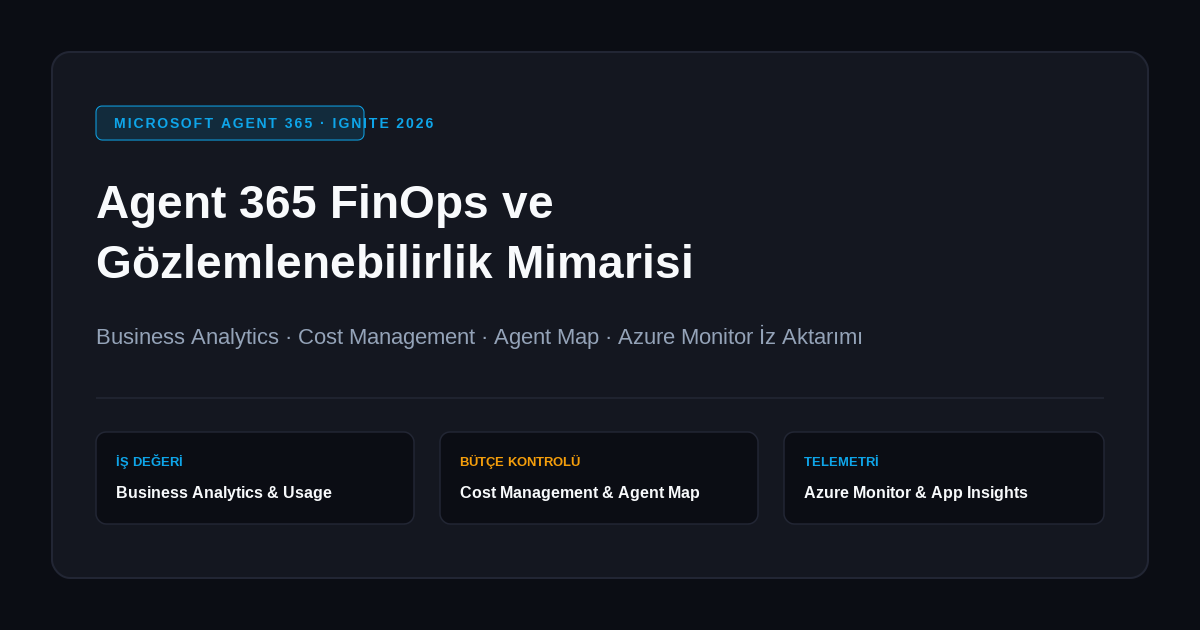
Enterprise AI agent adoption quickly becomes a financial and operational governance challenge alongside security. When five teams independently deploy overlapping agents for the same workflow, token spend climbs unpredictably while redundant identities and tool permissions expand the attack surface.
At Microsoft Ignite 2026, Microsoft Agent 365 complements its Agent 365 Control Plane and Unified Dynamic Agent Risk layers with five FinOps, analytics, and observability capabilities.
Measuring Business Value: Business Analytics and Usage Insights
Security and technology leaders are under growing pressure to prove measurable return on AI investments. Two Ignite 2026 reporting capabilities address this gap:
- Agent 365 Business Analytics (`Frontier`): Surfaces adoption trends, estimated hours saved, and projected business value across departments in a unified executive view.
- Usage Insights for Core Users (`GA`): Tracks active usage across core enterprise users, helping administrators spot dormant agents that still hold active credentials and should be retired.
From an architectural perspective, estimated hours saved should be treated as directional telemetry rather than standalone audit proof; cross-check these figures against operational SLAs and service desk baselines.
Curbing Agent Sprawl and Token Spend: Agent Map and Cost Management
- Agent Map Use Cases (`Preview`): Maps usage patterns across the tenant to surface duplicate agents solving the same problem. Consolidating redundant agents shrinks both operational maintenance and permission sprawl.
- Agent 365 Cost Management (`Announced`): Introduces per-user, per-agent, and per-model spend thresholds and alerts so runaway agent loops or unexpected high-cost model routing are caught before month-end billing shocks occur.
Continuous Observability: Export Agent Activity to Azure Monitor
- Export Agent Activity (`Announced`): Streams runtime agent traces, tool calls, and failure records continuously into Azure Monitor and Application Insights.
- Unified operational telemetry: SOC analysts, platform engineers, and FinOps teams can query the same auditable telemetry stream instead of reconciling disconnected SaaS dashboards.
Limitations, Prerequisites, and Rollback Plan
- What it prevents and what it does not: This layer provides budget visibility, duplicate detection, and centralized telemetry, but it does not block prompt injection or unauthorized data access on its own. It is not a substitute for Microsoft Entra Agent ID, Purview AI DLP, or Defender runtime protection.
- Prerequisites and telemetry cost: Streaming continuous agent traces into Azure Monitor incurs Log Analytics ingestion and retention costs. Teams must define data minimization, retention windows, and PII scrubbing policies before broad enablement. Verify regional availability and licensing for
Frontier,Preview, andAnnouncedfeatures in official Agent 365 release notes prior to rollout. - Phased rollout and rollback plan: Start by enabling alert-only spend thresholds and Azure Monitor trace export for a single pilot business unit after recording baseline Log Analytics ingestion volume. If ingestion costs spike or sensitive prompt payload leakage is observed in traces, pause the Export Agent Activity connector immediately, revert cost rules to alert-only mode, and confirm uninterrupted agent workflows.
Architectural Takeaway
Mature agent governance pairs security controls with financial accountability and engineering telemetry. Starting immediately with Usage Insights (GA) to prune dormant agents while staging pilot rollouts for Agent Map, Cost Management, and Azure Monitor trace export gives organizations a disciplined path to scale AI agents sustainably.
Verified Primary Sources & Open-Source Repositories
This architectural guide was cross-corroborated against the official advisories, Microsoft Learn docs, and open-source PowerShell / KQL repositories below.
Multi-Channel Distribution Summary (X & LinkedIn Draft)
Toggle X (Twitter) & LinkedIn sharing drafts
Multi-Channel Distribution Summary (X & LinkedIn Draft)
Toggle X (Twitter) & LinkedIn sharing draftsSecuring AI agents is only half the job—measuring ROI and controlling spend is the other half. Ignite 2026 Agent 365 adds Business Analytics, Cost Management, Agent Map, and Azure Monitor trace export. #Agent365 #FinOps #Ignite2026
When multiple teams build overlapping AI agents, token budgets and attack surfaces grow silently together. Here is an architectural review of Microsoft Ignite 2026 Agent 365 FinOps, Business Analytics, Agent Map, and Azure Monitor observability.
Related Architecture Articles
All AI Security & Gov →Microsoft Agent 365 Control Plane (Ignite 2026): Multi-Cloud Discovery, Tools Registry, MCP Governance, and Secretless Federation
Architectural deep dive into Microsoft Agent 365 at Ignite 2026: multi-cloud and local agent discovery, Tools Registry (GA), MCP Server governance via Azure AI Gateway/LiteLLM, multi-tenant management, and Secretless federation.
Microsoft Edge for Business Managed Agent Browser and AI Transparency Initiative (Ignite 2026)
Turning the enterprise browser into a verifiable trust boundary: architectural review of Edge for Business managed agent windows (PuP), Akamai/Spin.AI extension risk scoring and page isolation, and the AI Transparency Initiative.
Unified Dynamic Agent Risk and Runtime Defense (Ignite 2026): Defender Runtime Protection, Action Center, and Partner Signals
Architectural review of Defender local agent runtime protection (GA Windows), identity-based agent attack disruption, multi-cloud agent posture, Unified Dynamic Agent Risk, and partner signals.
Stopping a 2027 Attack in 72 Hours: The Complete Microsoft Ignite 2026 Security Architecture Guide (127 Innovations)
Master architectural guide unifying all 127 Microsoft Ignite 2026 security announcements into a 9-layer enterprise defense model and linking all 28 deep-dive articles in the series.