Windows Defender ATP and Exploit Guard Attack Surface Reduction (ASR) Rules
Stopping Office macro child processes and LSASS credential theft behaviorally using Windows Defender Exploit Guard ASR rules across Audit and Block phases.
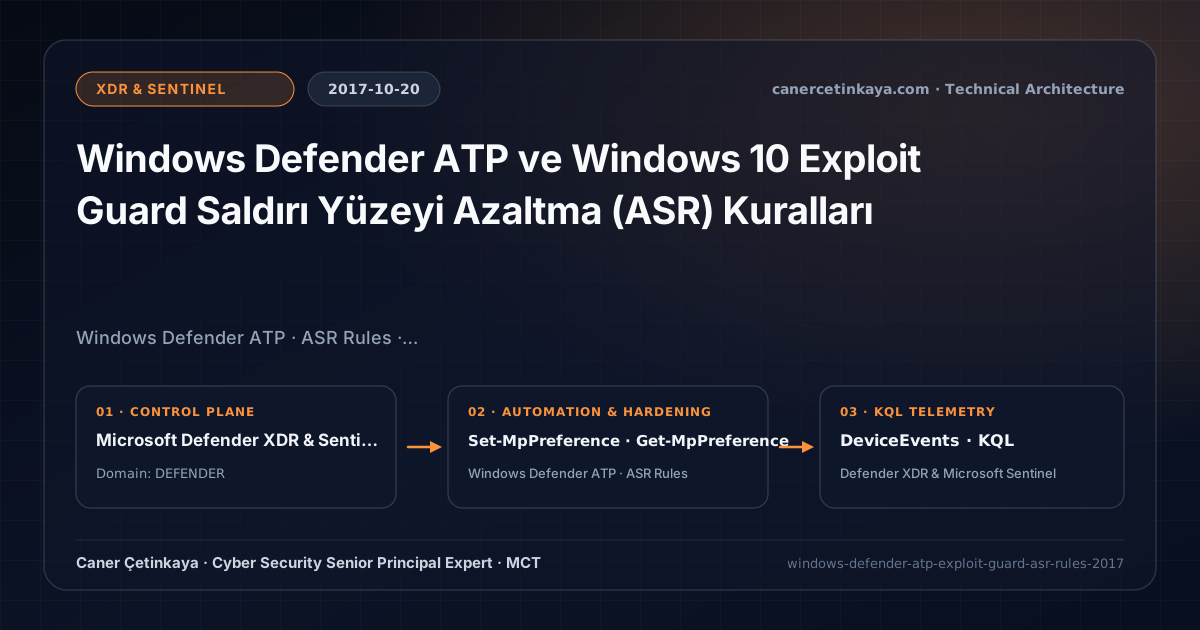
Executive Summary and Detection and Response Context
Modern phishing and ransomware kill chains routinely weaponize Office macros that spawn powershell.exe or cmd.exe as stealth child processes. Traditional file signatures fail against living-off-the-land execution because the underlying interpreter binaries are signed by Microsoft. Windows 10 Exploit Guard Attack Surface Reduction (ASR) rules eliminate these dangerous execution behaviors preemptively before payload staging.
From an architectural evolution standpoint, this foundational design connects directly to modern platform controls. Exploit Guard ASR rules introduced in Windows 10 1709 have matured into cloud-managed Microsoft Defender for Endpoint protections and Intune and Purview Endpoint Security.
Detection Boundaries, Telemetry Pipelines, and Design Principles
- Prevents Word, Excel, and PowerPoint from spawning child interpreters or writing executable payloads.
- Blocks unauthorized memory reads targeting
lsass.exe(9e6c4e1f-7d60-472f-ba1a-a39ef669e4b2). - Halts email-borne executable execution and obfuscated script launches automatically.
- Endpoint
EDR,ASRrules, andTamper Protectionmust remain intact beneath automatedXDR/Sentinelresponse playbooks, gating destructive containment actions over critical infrastructure with analyst review.
Prerequisites, Sensor/Workspace Dependencies, and RBAC
- Licensing: Windows 10 Enterprise E3+ for enforcement; Windows Defender ATP / Microsoft 365 E5 Security for centralized hunting telemetry.
- Dependency: Microsoft Defender Antivirus must serve as primary AV with Cloud-Delivered Protection active.
- RBAC: Intune Endpoint Security Manager or Defender Security Administrator.
Technical Verification, Endpoint/SIEM Audits, and Controls
PowerShell Posture Check and Staged Pilot Validation
Configure and audit active ASR rule GUID enforcement using PowerShell:
- Execution Environment and Prerequisites: Requires Local administrator / Windows endpoint host.
- Least Privilege and Operation Separation: Run with least-privilege inspection or scoped administrative permissions. This block pairs **read-only (
Get-*/Search-*) posture queries with state-changing (New-*/Set-*/Enable-*)** examples; execute mutating steps strictly under change control in a pilot ring (using-WhatIfwhere supported) before broad rollout. - Security Control Mapped and Boundary Note: Verifies active policy state and guards against silent drift or mis-scoped rollouts without blind production changes.
# Configure Exploit Guard ASR rules (Block = Enabled, Audit = AuditMode)
Set-MpPreference -AttackSurfaceReductionRules_Ids d4f940ab-401b-4efc-aadc-ad5f3c50688a, 3b576869-a4ec-4529-8536-b80a7769e899 -AttackSurfaceReductionRules_Actions Enabled
Set-MpPreference -AttackSurfaceReductionRules_Ids 9e6c4e1f-7d60-472f-ba1a-a39ef669e4b2 -AttackSurfaceReductionRules_Actions AuditMode

# Audit configured rule IDs and action codes
$mp = Get-MpPreference
for ($i = 0; $i -lt $mp.AttackSurfaceReductionRules_Ids.Count; $i++) {
    [PSCustomObject]@{
        RuleId = $mp.AttackSurfaceReductionRules_Ids[$i]
        Action = $mp.AttackSurfaceReductionRules_Actions[$i]
    }
} | Format-Table -AutoSize
Defender XDR and Sentinel KQL Hunting Query
KQL hunting query monitoring ASR audit and block detections in Defender telemetry:
// Execution Scope: Read-only hunting/audit query (Log Analytics Reader / Security Reader)
// Data Source: Microsoft Defender XDR Advanced Hunting / Sentinel MDE Connector (DeviceEvents)
DeviceEvents
| where Timestamp > ago(14d)
| where ActionType startswith "Asr"
| project Timestamp, DeviceName, ActionType, FileName, FolderPath, InitiatingProcessFileName, InitiatingProcessCommandLine
| summarize TriggerCount = count(), SampleDevices = make_set(DeviceName, 5) by ActionType, InitiatingProcessFileName, FileName
| order by TriggerCount desc
Critical Architectural Assessment, Response Risks, and Rollback Strategy
- Blocking LSASS Without Auditing: Legacy backup agents may probe LSASS handles and require scoped path exclusions.
- Running Third-Party AV as Primary: ASR engines remain dormant if Windows Defender runs in passive mode without EDR configuration.
- Broad Path Exclusions: Wildcard folder exclusions strip protection across entire application directories.
- Risks Mitigated vs. Residual Limitations:
MDE EDR,ASRrules,Live Response, andSentinel/XDRSOAR playbooks compress detection-to-containment windows and halt script/memory injection; they do not protect un-onboarded assets, sub-OS firmware compromises without hardware root-of-trust, or telemetry blind spots duringLog Analyticsingestion throttling. - New Dependencies and Production Failure Modes: Efficacy hinges on continuous sensor check-ins, active
Tamper Protection, and properly scopedLogic Appsmanaged identities. Forcing aggressiveASRrules directly intoBlockwithoutAudittuning breaks signed business macros, custom ERP tools, and developer build pipelines. - Rollback and Pilot Validation Procedure: Run new
ASRrules inAuditmode across 14–30 days inspectingDeviceEvents(ActionType startswith "Asr"); roll back breaking rules per device ring via Intune orSet-MpPreference(AuditMode) and disable misbehavingSentinelplaybooks while keeping detection rules alive.
Verified Primary Sources & Open-Source Repositories
This architectural guide was cross-corroborated against the official advisories, Microsoft Learn docs, and open-source PowerShell / KQL repositories below.
Multi-Channel Distribution Summary (X & LinkedIn Draft)
Toggle X (Twitter) & LinkedIn sharing drafts
Multi-Channel Distribution Summary (X & LinkedIn Draft)
Toggle X (Twitter) & LinkedIn sharing draftsPublished the 2017 Windows Defender ATP Exploit Guard ASR guide to stop Office child processes and LSASS dumping behaviorally. #WDATP #ASRRules
Move from file signatures to behavioral defense with Windows Defender Exploit Guard ASR rules, Audit-to-Block rollout steps, and KQL hunting.