AD FS Extranet Smart Lockout and Web Application Proxy (WAP) Hardening Architecture
A 2018 hybrid identity engineering guide on deploying AD FS Extranet Smart Lockout and WAP edge hardening to neutralize password spray attacks without triggering Active Directory account lockouts.
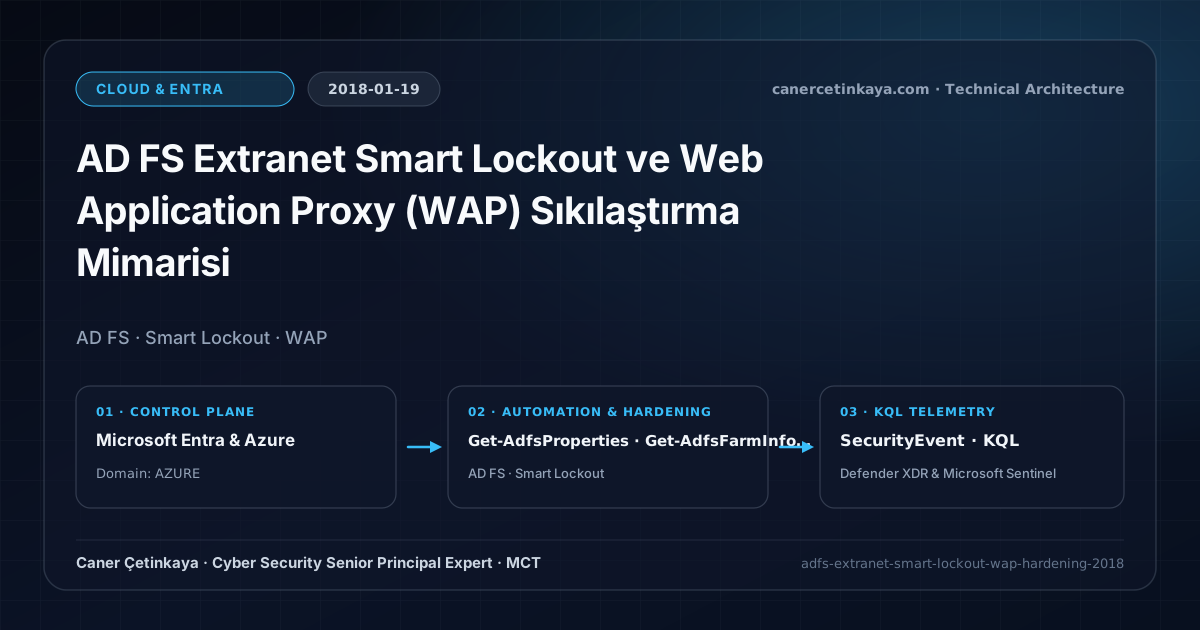
Executive Summary and Federation Threat Context
Legacy AD FS extranet lockout architectures introduced a severe Denial-of-Service attack vector: adversaries launching distributed password spray campaigns from external botnets deliberately exceeded lockout counters, locking legitimate employees out of on-premises Active Directory. Introduced for Windows Server 2016 and 2019 AD FS farms, Extranet Smart Lockout separates familiar IP history from unknown attackers so business continuity remains intact while suspicious requests are dropped at the federation edge.
From an architectural evolution standpoint, this foundational design connects directly to modern platform controls. While AD FS Extranet Smart Lockout mitigated edge brute-force exposure in 2018, modern organizations migrate federation dependencies toward Microsoft Entra ID via Azure AD Connect PHS, PTA, and Seamless SSO and native Entra Smart Lockout.
Trust Boundaries and Federation Architecture Principles
- Extranet Smart Lockout tracks familiar user IP locations inside the AD FS WID/SQL store, blocking unknown brute-force attempts before incrementing Active Directory badPwdCount.
- Web Application Proxy (WAP) servers residing in the DMZ should only expose modern passive/OAuth endpoints while blocking internal management and legacy basic-auth listeners.
- Combining federation hardening with Azure AD Conditional Access and Baseline MFA enforces Zero Trust device and risk evaluation on cloud-facing tokens.
- Token-signing certificate lifecycles, extranet smart lockout thresholds, and custom
Relying Partyclaims must be audited before shifting authentication from on-premises AD FS farms to cloudPHS/PTAorAuthNextensions.
Prerequisites, RBAC Boundaries, and Migration Dependencies
- Platform & Licensing: Windows Server 2016 AD FS (KB4088787+) or Windows Server 2019 AD FS Farm; cloud risk scoring requires Azure AD P1/P2 (EMS E3/E5).
- RBAC Matrix: Restrict AD FS farm management to dedicated Identity Administrators using least privilege instead of broad Domain Admin membership.
- Network Prerequisite: Ensure load balancers forward true client source IPs cleanly to WAP so Smart Lockout does not classify the proxy VIP as the sole caller.
Technical Verification, Identity Telemetry, and Controls
PowerShell Read-Only Audit and Pilot Validation
Configuring AD FS Smart Lockout (LogOnly validation followed by Enforced mode) via PowerShell:
- Execution Environment and Prerequisites: Requires ActiveDirectory / RSAT / AD Sync / AD FS management host.
- Least Privilege and Operation Separation: Run with least-privilege inspection or scoped administrative permissions. This block pairs **read-only (
Get-*/Search-*) posture queries with state-changing (New-*/Set-*/Enable-*)** examples; execute mutating steps strictly under change control in a pilot ring (using-WhatIfwhere supported) before broad rollout. - Security Control Mapped and Boundary Note: Verifies active policy state and guards against silent drift or mis-scoped rollouts without blind production changes.
# 1. Inspect current AD FS properties and farm behavior level
Get-AdfsProperties | Select-Object EnableExtranetLockout, ExtranetLockoutMode, ExtranetLockoutThreshold, ExtranetObservationWindow
Get-AdfsFarmInformation | Select-Object CurrentFarmBehavior, FarmNodes

# 2. Deploy in LogOnly mode initially to measure baseline false positives
$SmartLockoutParams = @{
  EnableExtranetLockout     = $true
  ExtranetLockoutMode       = "ADFSSmartLockoutLogOnly"
  ExtranetLockoutThreshold  = 5
  ExtranetObservationWindow = (New-TimeSpan -Minutes 30)
}
Set-AdfsProperties @SmartLockoutParams

# 3. Switch to ADFSSmartLockoutEnforced after baseline audit and disable legacy WS-Trust basic auth
Set-AdfsProperties -ExtranetLockoutMode ADFSSmartLockoutEnforced
Disable-AdfsEndpoint -TargetAddressPath "/adfs/services/trust/2005/usernamemixed"
Security Telemetry and KQL Verification Query
KQL hunt detecting distributed AD FS password spray activity across Event IDs 1203, 516, and 4625:
// Execution Scope: Read-only hunting/audit query (Log Analytics Reader / Security Reader)
// Data Source: Azure Monitor Agent (AMA) Windows Security Events -> Log Analytics / Sentinel (SecurityEvent)
SecurityEvent
| where TimeGenerated > ago(7d)
| where EventID in (1203, 516, 4625)
| where ProcessName has "Microsoft.IdentityServer" or TargetUserName != ""
| extend CallerIp = coalesce(IpAddress, extract(@"Caller IP:\s*([0-9\.]+)", 1, EventData))
| summarize FailedAttempts = count(), TargetedAccounts = dcount(TargetUserName) by CallerIp, bin(TimeGenerated, 15m)
| where TargetedAccounts >= 5 or FailedAttempts >= 25
| order by FailedAttempts desc
Critical Architectural Assessment, Cutover Risks, and Rollback Strategy
- Inverted Threshold Values: If Active Directory Domain Password Policy Account Lockout Threshold is lower than or equal to AD FS ExtranetLockoutThreshold, AD accounts will still lock during attacks.
- Load Balancer NAT Blindness: Deploying Smart Lockout behind an L4/SSL-offloading balancer without preserving source IP causes mass lockouts affecting all remote staff simultaneously.
- Risks Mitigated vs. Residual Limitations: Federation hardening and staged migration into cloud
PHS/PTAreduce extranet spray exposure against AD FS, mitigateGolden SAMLreliance, and lower on-premises certificate outage risk; however, they do not mitigateAiTMsession-cookie theft against weak MFA flows, unmigrated customSAMLrelying parties left behind during partial cuts, or lateral movement within legacy on-premisesKerberos/NTLMapplications. - New Dependencies and Production Failure Modes: Transitions rely directly on healthy
Entra ConnectPHS/PTApipelines, cleanImmutableIDmatching, and TLS 1.2+ alignment across AD FS/WAP farms. Retiring federation before translating custom AD FS claim transforms causes immediate SSO redirect loops for enterprise apps. - Rollback and Pilot Validation Procedure: Validate staged rollout batches on a bounded pilot security group first; if claim mismatches disrupt business apps, exclude the group via staged-rollout policies or keep AD FS nodes warm in standby until relying-party sign-in telemetry runs error-free.
Verified Primary Sources & Open-Source Repositories
This architectural guide was cross-corroborated against the official advisories, Microsoft Learn docs, and open-source PowerShell / KQL repositories below.
Multi-Channel Distribution Summary (X & LinkedIn Draft)
Toggle X (Twitter) & LinkedIn sharing drafts
Multi-Channel Distribution Summary (X & LinkedIn Draft)
Toggle X (Twitter) & LinkedIn sharing draftsPublished our 2018 Hybrid Identity architecture guide on hardening AD FS and WAP with Extranet Smart Lockout to defeat password spray DoS attacks. #ADFS #ZeroTrust #IdentitySecurity
Deep dive into AD FS Extranet Smart Lockout architecture (LogOnly to Enforced), WAP legacy endpoint reduction, and Sentinel KQL spray detection.