Azure Confidential AI, Clean Rooms, and Project Nova (Ignite 2026): Vera Rubin NVL72, TDX Connect, and Zero-Knowledge Proofs
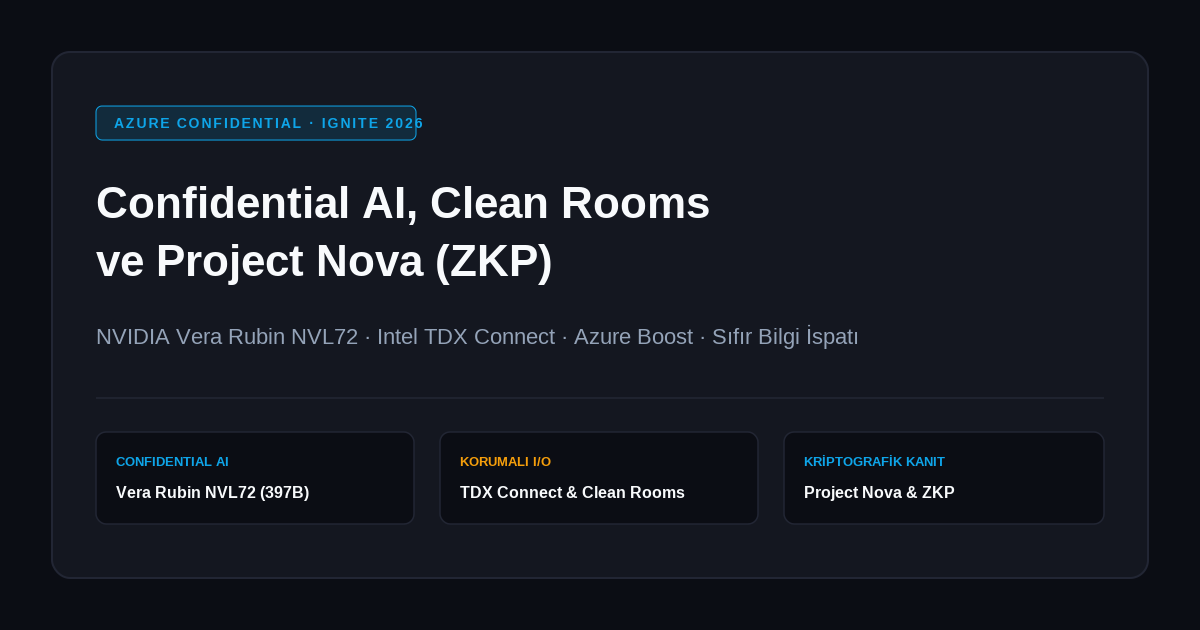
Hardware-rooted trust and cryptographic proof architecture: NVIDIA Vera Rubin NVL72 (397B) Confidential AI, Intel TDX Connect with Azure Boost, Azure Confidential Clean Rooms, and Project Nova zero-knowledge proofs.
Encrypting data at rest and in transit has been standard cloud hygiene for over a decade, yet sensitive data is historically decrypted in memory during AI inference or multi-party analytics. For regulated financial, healthcare, and public-sector workloads, protecting data in use—even from the cloud operator—is a foundational requirement.
At Microsoft Ignite 2026, Azure Confidential Computing extended hardware-rooted trust boundaries beyond host CPUs into rack-scale AI accelerators, high-throughput protected I/O, multi-party clean rooms, and zero-knowledge proofs (ZKPs).
Hardware-Rooted AI Trust: NVIDIA Vera Rubin NVL72 and Intel TDX Connect
- Confidential AI on NVIDIA Vera Rubin NVL72 (`Technology Showcase / Preview`): Microsoft showcased confidential bare-metal AI execution running a 397B-parameter model across four Rubin GPUs with unified CPU and GPU hardware attestation, protecting both proprietary model weights and sensitive prompts inside an encrypted boundary.
- Intel TDX Connect and Azure Boost Confidential Device (`Technology Showcase`): Extends confidential trust boundaries to attached GPUs and I/O devices, demonstrating encrypted network throughput up to 400 Gbps so hardware confidentiality does not bottleneck high-bandwidth AI pipelines.
Multi-Party Collaboration and Cryptographic Proof: Clean Rooms and Project Nova
- Azure Confidential Clean Rooms (`Limited Preview`): Enables multiple organizations to run joint analytics on sensitive datasets without exposing raw records to peer participants or Azure operators. Decryption keys are released only when mutually approved code passes cryptographic attestation.
- Project Nova (`Demo`): Applies Zero-Knowledge Proofs (ZKPs) to prove that financial transactions satisfy pre-agreed compliance conditions without revealing underlying account balances or raw customer records.
Limitations, Prerequisites, and Rollback Plan
- Maturity boundary (critical caveat): None of these four capabilities are Generally Available (
GA) yet; they spanLimited Preview,Technology Showcase, andDemostages. Verify official Azure Confidential Computing roadmaps and regional availability before committing production timelines. For production-ready confidential infrastructure available today, see Azure Confidential Infrastructure Architecture (Turin v7, TDX v6, AKS). - What it prevents and what it does not: Hardware confidential computing protects memory contents against host-level or operator inspection, but it is not a substitute for application-layer authorization, IAM least privilege, secure key management, or defenses against model output leakage.
- Pilot and rollback plan: Evaluate Confidential Clean Rooms and preview confidential GPU environments strictly with synthetic or anonymized datasets inside an isolated Azure subscription. Keep attestation policies and Managed HSM / customer-managed key (CMK) release policies under version control; if attestation or key-release errors disrupt a pilot, fail back to standard isolated Azure node pools and verify key policy integrity before retrying.
Architectural Takeaway
Ignite 2026 marks a clear architectural shift from contractual trust in cloud operators toward verifiable hardware attestation and cryptographic proof. The most practical step for architects today is building operational maturity around Managed HSM key-release policies and attestation verification on existing workloads while preparing regulated multi-party analytics use cases for Clean Rooms pilots.
Verified Primary Sources & Open-Source Repositories
This architectural guide was cross-corroborated against the official advisories, Microsoft Learn docs, and open-source PowerShell / KQL repositories below.
Multi-Channel Distribution Summary (X & LinkedIn Draft)
Toggle X (Twitter) & LinkedIn sharing drafts
Multi-Channel Distribution Summary (X & LinkedIn Draft)
Toggle X (Twitter) & LinkedIn sharing draftsProtecting data not just at rest and in transit, but in GPU memory during AI inference: Ignite 2026 Azure Confidential AI (NVIDIA Vera Rubin NVL72 397B), Intel TDX Connect, Clean Rooms, and Project Nova (ZKP). #Azure #ConfidentialComputing #Ignite2026
In regulated industries, data-in-use confidentiality is the primary blocker for multi-party analytics and sensitive AI workloads. Here is an architectural look at NVIDIA Vera Rubin NVL72 Confidential AI, Clean Rooms, and Project Nova (ZKP) from Ignite 2026.
Related Architecture Articles
All Microsoft Azure →Azure Confidential Infrastructure Architecture (Ignite 2026): AMD Turin v7, Intel TDX v6, Confidential AKS, Azure Local, and Backup
Eight Ignite 2026 Azure Confidential Computing infrastructure milestones bringing hardware confidentiality into mainstream production: AMD Turin v7, Intel TDX v6, Azure Local, Intel TDX AKS Worker Nodes (GA), Azure Migrate, Azure Backup, and Confidential Data Disk Encryption.
Microsoft Entra Ignite 2026: High Assurance Credentials, PIM Expansion, Backup Premium, and Tenant Governance
Architectural review of Microsoft Ignite 2026 Entra resilience updates: High Assurance Credentials, PIM for Azure/Arc VMs and agents, 30-day Backup and Recovery Premium, and cross-tenant governance.
Global Secure Access MCP Firewall, Adaptive Access, Secure BYOD Browser, and MCP Server for Enterprise (Ignite 2026)
Architectural review of Global Secure Access MCP Firewall for agents, risk-aware Adaptive Access, Edge+GSA secure browser for BYOD, and GA MCP Server for Enterprise.
Microsoft Entra External ID 2026 Updates (Ignite 2026): JavaScript Custom UX, Native Auth API v2, and TOTP Customer Security
Architectural review of Microsoft Entra External ID Ignite 2026 CIAM updates: branded JavaScript-capable HTML templates, Native Auth API v2, AI Agent Toolkit, multiple first-factor sign-in, TOTP MFA, and self-service account APIs.