Azure Confidential Infrastructure Architecture (Ignite 2026): AMD Turin v7, Intel TDX v6, Confidential AKS, Azure Local, and Backup
Eight Ignite 2026 Azure Confidential Computing infrastructure milestones bringing hardware confidentiality into mainstream production: AMD Turin v7, Intel TDX v6, Azure Local, Intel TDX AKS Worker Nodes (GA), Azure Migrate, Azure Backup, and Confidential Data Disk Encryption.
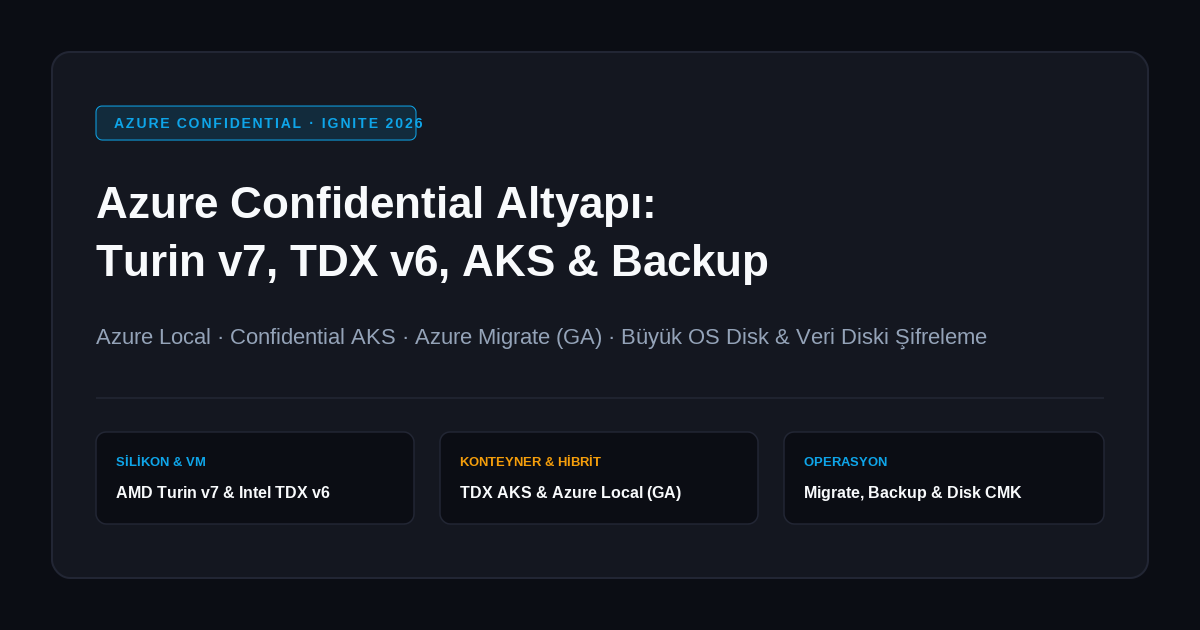
Confidential computing historically remained confined to specialized pilots due to performance overhead, OS disk size ceilings, missing backup support, and limited Kubernetes integration. For cloud architects, mainstream adoption depends on day-two operational parity across migration, backup, hybrid deployments, and container orchestration.
At Microsoft Ignite 2026, Azure Confidential Computing delivered eight infrastructure milestones spanning next-generation AMD and Intel silicon, cloud-native Kubernetes nodes, hybrid Azure Local clusters, and production migration and backup tooling.
Next-Generation Silicon: AMD Turin v7 and Intel TDX v6
- AMD "Turin" v7 Confidential VMs (`Gated Preview`): Built on 5th-generation AMD EPYC processors across six series (including DCasv7 and ECasv7) with Azure Boost, MANA networking, and Secure AVIC for high-performance general-purpose and memory-optimized workloads.
- Intel TDX v6 Platform Improvements (`Announced`): Adds NVMe remote storage, posted interrupts, local sealing, and live migration capabilities required for resilient enterprise workloads.
Containers and Hybrid Edge: Confidential AKS and Azure Local
- Confidential AKS Worker Nodes on Intel TDX (`GA / Preview`): Generally Available (
GA) on Azure Container Linux and in preview on Ubuntu 26.04, alongside ongoing engineering for AKS Kata CoCo Confidential Containers and Azure Confidential Enclaves. - Confidential Computing on Azure Local (`GA / Public Preview`): AMD SEV-SNP support is now
GAand Intel TDX is inPublic Preview, extending hardware-encrypted memory to sovereign and edge infrastructure.
Removing Day-Two Blockers: Migrate, Backup, and Disk Encryption
- Azure Migrate and Large OS Disk Encryption (`GA`): Direct migration of existing workloads to Confidential VMs via Azure Migrate and customer-managed key (CMK) encryption for OS disks larger than 127 GB are both Generally Available (
GA). - Azure Backup for Confidential VMs (`Public Preview`): Adds native backup support for v6 OS-disk-encrypted Confidential VMs.
- Confidential Data Disk Encryption (`Private Preview`): Encrypts in-VM data disks with attested CMK key release so data disks unlock only after hardware attestation succeeds.
Limitations, Prerequisites, and Rollback Plan
- What it prevents and what it does not: Confidential VMs and AKS nodes isolate in-use memory from host and hypervisor inspection, but they are not a substitute for guest OS patching, Kubernetes RBAC least privilege, Network Security Groups (NSGs), or application-layer security.
- Prerequisites and regional constraints: Attested CMK encryption requires Azure Key Vault Managed HSM or compatible Key Vault Premium policies. Gated Preview (
Turin v7) and Private Preview (Data Disk Encryption) capabilities carry regional quota and allowlist prerequisites. - Phased rollout and rollback plan: Retain pre-migration snapshots and standard VM/AKS node pools before migrating workloads via Azure Migrate. Validate performance, attestation, and backup restore workflows in a staging subscription first. If latency regressions or key-release failures occur, shift traffic back to standard node pools and verify restore SLAs against documented backups.
Architectural Takeaway
With Intel TDX AKS (GA), Azure Local AMD SEV-SNP (GA), Azure Migrate (GA), and large OS disk encryption (GA), Azure Confidential Computing now satisfies core enterprise operational requirements. Cloud teams preparing for Confidential AI, Clean Rooms, and Project Nova can begin production hardening today with GA Confidential AKS and Azure Migrate workflows.
Verified Primary Sources & Open-Source Repositories
This architectural guide was cross-corroborated against the official advisories, Microsoft Learn docs, and open-source PowerShell / KQL repositories below.
Multi-Channel Distribution Summary (X & LinkedIn Draft)
Toggle X (Twitter) & LinkedIn sharing drafts
Multi-Channel Distribution Summary (X & LinkedIn Draft)
Toggle X (Twitter) & LinkedIn sharing draftsConfidential Computing moves into mainstream Azure production: Ignite 2026 delivers Intel TDX AKS (GA), Azure Local AMD SEV-SNP (GA), Azure Migrate + >127 GB OS Disk Encryption (GA), AMD Turin v7, and Azure Backup (PuP). #Azure #ConfidentialComputing #Ignite2026
Migration friction, OS disk limits, backup gaps, and Kubernetes support previously kept Confidential Computing in niche pilots. Here is an architectural breakdown of the eight Azure Ignite 2026 infrastructure updates removing those blockers.
Related Architecture Articles
All Microsoft Azure →Azure Confidential AI, Clean Rooms, and Project Nova (Ignite 2026): Vera Rubin NVL72, TDX Connect, and Zero-Knowledge Proofs
Hardware-rooted trust and cryptographic proof architecture: NVIDIA Vera Rubin NVL72 (397B) Confidential AI, Intel TDX Connect with Azure Boost, Azure Confidential Clean Rooms, and Project Nova zero-knowledge proofs.
Microsoft Entra Ignite 2026: High Assurance Credentials, PIM Expansion, Backup Premium, and Tenant Governance
Architectural review of Microsoft Ignite 2026 Entra resilience updates: High Assurance Credentials, PIM for Azure/Arc VMs and agents, 30-day Backup and Recovery Premium, and cross-tenant governance.
Global Secure Access MCP Firewall, Adaptive Access, Secure BYOD Browser, and MCP Server for Enterprise (Ignite 2026)
Architectural review of Global Secure Access MCP Firewall for agents, risk-aware Adaptive Access, Edge+GSA secure browser for BYOD, and GA MCP Server for Enterprise.
Microsoft Entra External ID 2026 Updates (Ignite 2026): JavaScript Custom UX, Native Auth API v2, and TOTP Customer Security
Architectural review of Microsoft Entra External ID Ignite 2026 CIAM updates: branded JavaScript-capable HTML templates, Native Auth API v2, AI Agent Toolkit, multiple first-factor sign-in, TOTP MFA, and self-service account APIs.