Microsoft Entra External ID 2026 Updates (Ignite 2026): JavaScript Custom UX, Native Auth API v2, and TOTP Customer Security
Architectural review of Microsoft Entra External ID Ignite 2026 CIAM updates: branded JavaScript-capable HTML templates, Native Auth API v2, AI Agent Toolkit, multiple first-factor sign-in, TOTP MFA, and self-service account APIs.
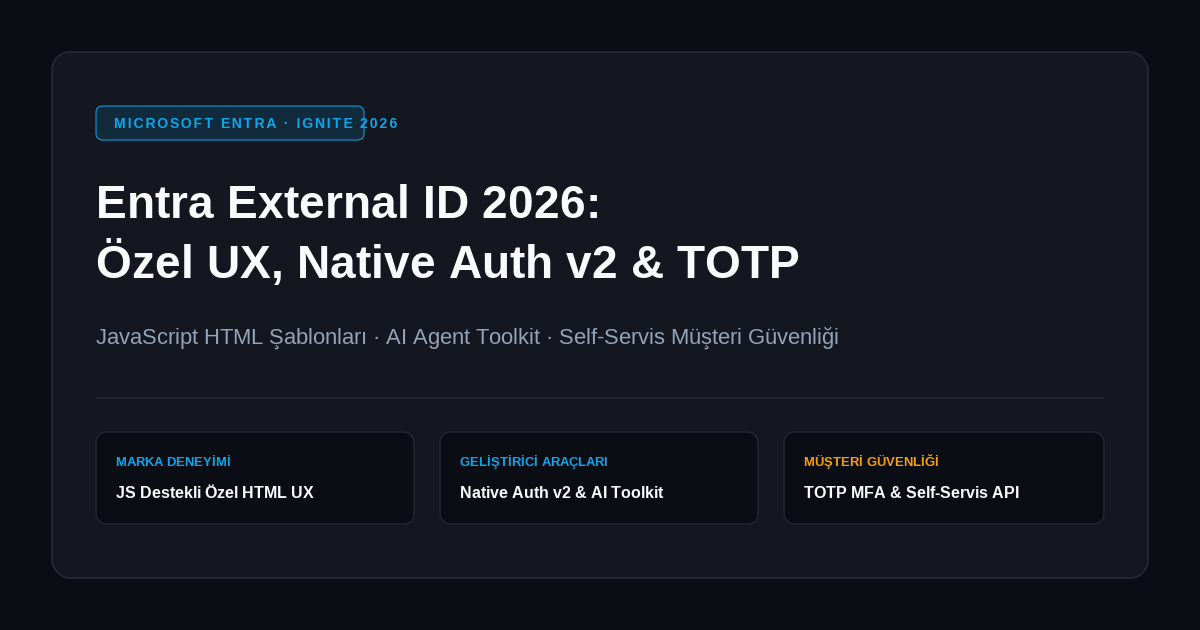
Customer Identity and Access Management (CIAM) programs have long balanced a structural tension: product teams want fully branded, redirect-free authentication experiences, while security architects want to avoid the vulnerabilities of custom-built authentication flows.
At Microsoft Ignite 2026, Microsoft Entra External ID addressed both sides through three Public Preview updates that also remove major migration blockers for organizations transitioning from Azure AD B2C.
Branded and JavaScript-Capable Custom UX
- Custom HTML templates with JavaScript support (`Public Preview`, full rollout December 7, 2026): Organizations can move beyond basic logo and color customization to deploy bespoke HTML and JavaScript sign-in and sign-up experiences aligned with corporate design systems.
- Security architecture caveat: Enabling custom JavaScript expands the client-side attack surface. Security teams must prohibit third-party marketing trackers on authentication pages and enforce strict Content Security Policy (CSP), Subresource Integrity (SRI), and XSS reviews before production release.
Developer Tooling: Native Auth API v2 and AI Agent Toolkit
- Native Auth API v2 and updated SDKs (`Public Preview`): Simplifies building redirect-free, in-app sign-in journeys for native mobile apps and single-page applications (SPAs).
- AI Agent Toolkit (`Public Preview`): Accelerates CIAM configuration and integration inside AI-assisted developer workflows, reducing boilerplate errors during onboarding.
Customer Account Security: Multiple First Factors, TOTP, and Self-Service APIs
- Multiple first-factor options and TOTP (`Public Preview`): Adds flexible sign-in choices alongside authenticator-based Time-based One-Time Password (TOTP) MFA, reducing reliance on SMS codes vulnerable to SIM-swapping attacks.
- Self-service account management APIs (`Public Preview`): Enables customers to manage profile attributes and authentication methods securely inside the app, lowering support center overhead.
Limitations, Prerequisites, and Rollback Plan
- What it prevents and what it does not: TOTP MFA and managed CIAM flows mitigate credential stuffing and account takeover risks, but they are not a substitute for Web Application Firewall (WAF) rules, bot mitigation, API rate limiting, or backend authorization checks.
- Prerequisites and preview scope: All three updates are in
Public Preview(with custom UX reaching full preview availability on December 7, 2026). Confirm production SLA coverage and regional support in official Entra External ID documentation before cutting over high-volume customer traffic. - Phased rollout and rollback plan: Validate custom HTML/JS templates and Native Auth API v2 flows in a dedicated staging CIAM tenant while keeping standard branded templates and API v1 configurations under version control. If sign-in conversion drops or client compatibility issues surface, disable the custom JavaScript template to revert immediately to standard Entra External ID branding and verify registration and login success rates.
Architectural Takeaway
Ignite 2026 closes the largest feature gaps in Microsoft Entra External ID by combining full brand control, redirect-free Native Auth v2, and stronger TOTP customer security. Teams planning Azure AD B2C migrations should pilot the custom UX and Native Auth API v2 updates after December 7, 2026 to validate their 2027 cutover architecture.
Verified Primary Sources & Open-Source Repositories
This architectural guide was cross-corroborated against the official advisories, Microsoft Learn docs, and open-source PowerShell / KQL repositories below.
Multi-Channel Distribution Summary (X & LinkedIn Draft)
Toggle X (Twitter) & LinkedIn sharing drafts
Multi-Channel Distribution Summary (X & LinkedIn Draft)
Toggle X (Twitter) & LinkedIn sharing draftsKey blockers for Azure AD B2C to Entra External ID migrations are falling: Ignite 2026 brings JavaScript custom HTML UX (full Dec 7), Native Auth API v2, AI Agent Toolkit, and TOTP MFA. #MicrosoftEntra #CIAM #Ignite2026
Customer Identity and Access Management (CIAM) demands both brand precision and strong account security. Here is an architectural breakdown of Microsoft Ignite 2026 Entra External ID updates covering custom UX, Native Auth API v2, and TOTP MFA.
Related Architecture Articles
All Microsoft Azure →Microsoft Entra Ignite 2026: High Assurance Credentials, PIM Expansion, Backup Premium, and Tenant Governance
Architectural review of Microsoft Ignite 2026 Entra resilience updates: High Assurance Credentials, PIM for Azure/Arc VMs and agents, 30-day Backup and Recovery Premium, and cross-tenant governance.
Global Secure Access MCP Firewall, Adaptive Access, Secure BYOD Browser, and MCP Server for Enterprise (Ignite 2026)
Architectural review of Global Secure Access MCP Firewall for agents, risk-aware Adaptive Access, Edge+GSA secure browser for BYOD, and GA MCP Server for Enterprise.
Microsoft Entra Agent ID and Action-Time Conditional Access (Ignite 2026): 60 Local Agents, Dynamic Controls, and 60-Day Lifecycle
Architectural breakdown of Entra Agent ID for 60 local agent types and Autopilot agents, Conditional Access for assistive agents, action-time Dynamic Controls, and 60-day inactive agent disablement.
Azure Confidential Infrastructure Architecture (Ignite 2026): AMD Turin v7, Intel TDX v6, Confidential AKS, Azure Local, and Backup
Eight Ignite 2026 Azure Confidential Computing infrastructure milestones bringing hardware confidentiality into mainstream production: AMD Turin v7, Intel TDX v6, Azure Local, Intel TDX AKS Worker Nodes (GA), Azure Migrate, Azure Backup, and Confidential Data Disk Encryption.