Threat Hunting with Defender for Endpoint Deception Lures and Sentinel Watchlists
Deploying zero-infrastructure Defender for Endpoint Deception decoys and lures paired with Microsoft Sentinel Watchlists for near-zero false-positive attacker detection.
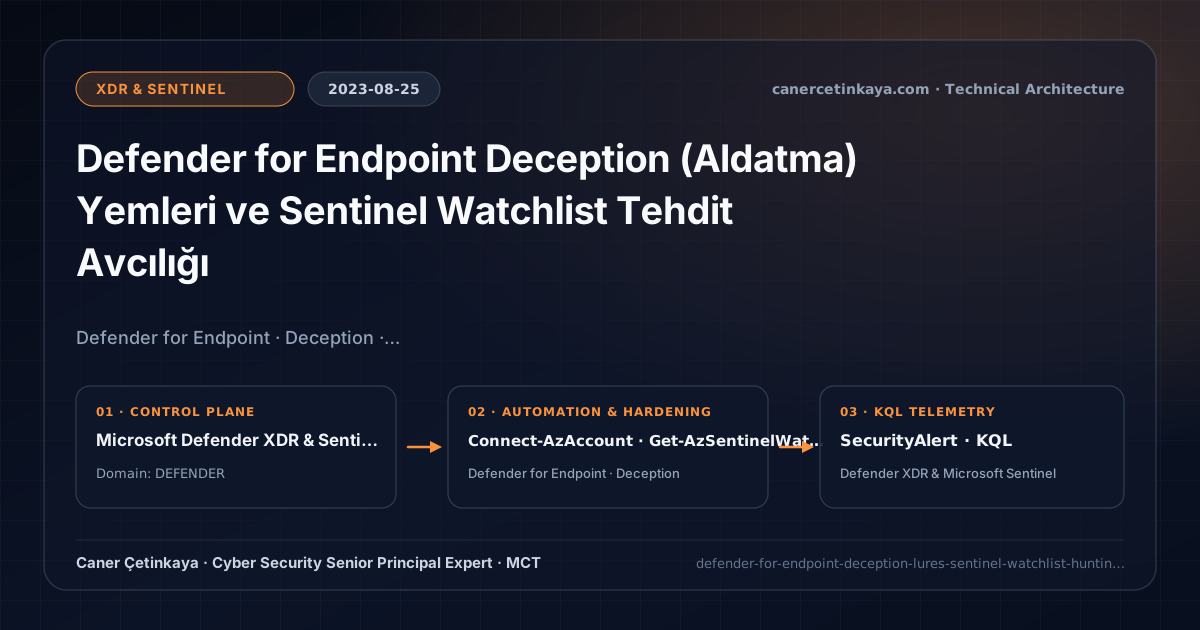
Executive Summary and Detection and Response Context
Skilled adversaries blend into corporate environments using Living-off-the-Land binaries (LOLBins) to evade signature detections. Yet the moment an attacker queries a planted service credential, clicks a realistic decoy .rdp file, or attempts lateral reconnaissance against a fake host, they generate an unmistakable zero-false-positive signal. Built directly into Defender for Endpoint Plan 2, native Deception Capabilities turn ordinary endpoints into active tripwires.
From an architectural evolution standpoint, this foundational design connects directly to modern platform controls. Eliminating dedicated honeypot appliances when built into Defender for Endpoint in 2023, native Deception lures pair seamlessly with Defender Identity KQL Threat Hunting and Automatic Attack Disruption to halt lateral discovery early.
Detection Boundaries, Telemetry Pipelines, and Design Principles
Automated Deceptiondeploys realistic decoys (fake credentials, planted documents, and network lures) across designated MDE device groups without external honeypot servers.- Any unauthorized read, logon attempt, or process interaction with a deception lure emits a high-confidence Defender alert capable of triggering Automatic Attack Disruption.
- Combining planted lure names inside a
Microsoft Sentinel Watchlistempowers cross-table KQL hunting acrossDeviceLogonEvents,SecurityEvent, andIdentityLogonEvents. - Drastically lowers Mean Time to Detect (MTTD) during MITRE ATT&CK Discovery (
TA0007) and Credential Access (TA0006) phases under Assume Breach posture.
Prerequisites, Sensor/Workspace Dependencies, and RBAC
- Licensing: Microsoft Defender for Endpoint Plan 2 (included in M365 E5) plus Microsoft Sentinel for Watchlist automation.
- RBAC Access: Defender XDR
Security Administratorto configure Deception rules andMicrosoft Sentinel Contributorto manage Watchlists. - Operational Coordination: Exclude deception lures or inform vulnerability scanning owners so scheduled scanners don’t trigger noise.
Technical Verification, Endpoint/SIEM Audits, and Controls
PowerShell Posture Check and Staged Pilot Validation
Inspecting Sentinel Watchlists via Az.SecurityInsights PowerShell and confirming MDE Sense agent status:
- Execution Environment and Prerequisites: Requires Az.*.
- Least Privilege and Operation Separation: Run with scoped Azure Reader (audit) / Contributor (state changes) privileges. All statements above are **read-only (
Get-*/Test-*/Search-*)** verification checks making no direct configuration edits; still validate module/network prerequisites in a test cohort first. - Security Control Mapped and Boundary Note: Verifies active policy state and guards against silent drift or mis-scoped rollouts without blind production changes.
# 1. List active Microsoft Sentinel Watchlists (Az.SecurityInsights)
Connect-AzAccount
Get-AzSentinelWatchlist -ResourceGroupName "rg-secops-prod" -WorkspaceName "law-sentinel-prod" |
  Select-Object Name, DisplayName, ItemsSearchKey, NumberOfLinesToSkip

# 2. Verify Microsoft Defender for Endpoint (Sense) agent running state on endpoint
Get-Service -Name "Sense", "WinDefend" | Select-Object Name, Status, StartType
Defender XDR and Sentinel KQL Hunting Query
KQL query correlating Defender Deception alerts with Watchlist decoy account logon activity:
// Execution Scope: Read-only hunting/audit query (Log Analytics Reader / Security Reader)
// Data Source: SecurityAlert table -> Defender XDR Advanced Hunting or Log Analytics / Sentinel workspace
let DecoyAccounts = _GetWatchlist('DecoyIdentitiesWatchlist') | project AccountName = tolower(tostring(SearchKey));
SecurityAlert
| where TimeGenerated > ago(14d)
| where ProductName == "Microsoft Defender for Endpoint"
| where AlertName has_any ("Deception", "decoy", "lure", "honeytoken")
| project TimeGenerated, AlertName, AlertSeverity, CompromisedEntity, Entities
| union (
    DeviceLogonEvents
    | where Timestamp > ago(14d)
    | where tolower(AccountName) in (DecoyAccounts)
    | project TimeGenerated = Timestamp, AlertName = "Watchlist-DecoyAccount-LogonAttempt", AlertSeverity = "High", CompromisedEntity = DeviceName, Entities = AccountName
)
Critical Architectural Assessment, Response Risks, and Rollback Strategy
- Planting Unrealistic Decoy Filenames: Generic strings like
FakePasswords.txttip off human operators; tailor lures around genuine departmental naming standards. - Leaving Sentinel Watchlists Unsynchronized: Static manually uploaded CSV Watchlists decay quickly; tie updates to Logic Apps or automated security baselines.
- Risks Mitigated vs. Residual Limitations:
MDE EDR,ASRrules,Live Response, andSentinel/XDRSOAR playbooks compress detection-to-containment windows and halt script/memory injection; they do not protect un-onboarded assets, sub-OS firmware compromises without hardware root-of-trust, or telemetry blind spots duringLog Analyticsingestion throttling. - New Dependencies and Production Failure Modes: Efficacy hinges on continuous sensor check-ins, active
Tamper Protection, and properly scopedLogic Appsmanaged identities. Forcing aggressiveASRrules directly intoBlockwithoutAudittuning breaks signed business macros, custom ERP tools, and developer build pipelines. - Rollback and Pilot Validation Procedure: Run new
ASRrules inAuditmode across 14–30 days inspectingDeviceEvents(ActionType startswith "Asr"); roll back breaking rules per device ring via Intune orSet-MpPreference(AuditMode) and disable misbehavingSentinelplaybooks while keeping detection rules alive.
Verified Primary Sources & Open-Source Repositories
This architectural guide was cross-corroborated against the official advisories, Microsoft Learn docs, and open-source PowerShell / KQL repositories below.
Multi-Channel Distribution Summary (X & LinkedIn Draft)
Toggle X (Twitter) & LinkedIn sharing drafts
Multi-Channel Distribution Summary (X & LinkedIn Draft)
Toggle X (Twitter) & LinkedIn sharing draftsCatching Living-off-the-Land attackers early with Defender for Endpoint Deception lures and Sentinel Watchlists. #DefenderForEndpoint #Sentinel #ThreatHunting
Active Cyber Deception Without Extra Infrastructure: Designing realistic MDE Deception lures and uniting them with Sentinel Watchlists for deterministic detections.