Real-Time Ransomware Interruption via Microsoft Defender XDR Automatic Attack Disruption
Combining signals across Defender for Endpoint, Defender for Identity, Defender for Office 365, and Cloud Apps to contain compromised identities and hosts autonomously before domain-wide ransomware encryption.
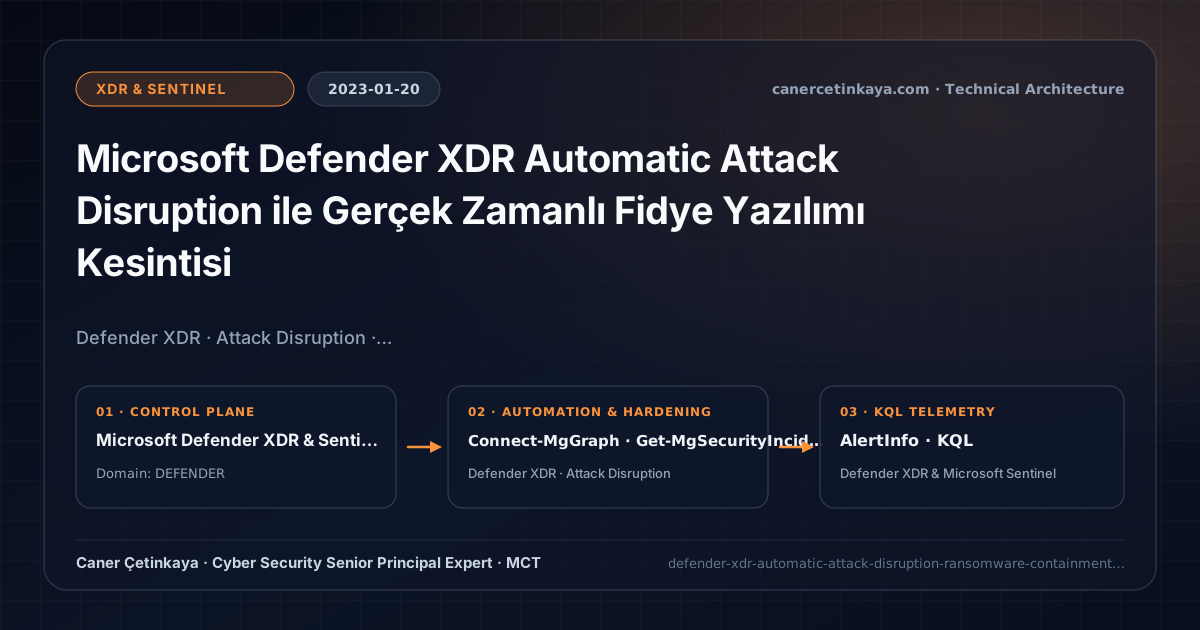
Executive Summary and Architectural Context
Mean time to domain compromise during human-operated ransomware and AiTM campaigns dropped below an hour, leaving manual SOC triage queues structurally unable to contain fast lateral movement. Built upon Unified Microsoft 365 Defender Correlation, Automatic Attack Disruption fuses high-confidence cross-domain signals across MDE, MDI, MDO, and MDA to suspend compromised accounts and isolate infected hosts autonomously before operators can deploy encryption payloads.
This automated containment layer now acts as the first line of machine-speed defense feeding Entra ID Hard-Delete & XDR Response and Zero-Day Collaboration Mitigation.
Threat Model, Trust Boundaries, and Design Principles
- Dual-Plane Identity Containment: Disables compromised Active Directory (
userAccountControl) and Entra ID identities simultaneously while revoking active refresh tokens, halting Business Email Compromise (BEC) and credential replay across hybrid boundaries. - Host Isolation and Unmanaged Neighbor Shielding: Isolates affected endpoints via Defender for Endpoint (
SMB,RDP,RPCcontainment while preserving management reachability) and directsDefender for Identitysensors to block incoming traffic from unmanaged infected hosts toward healthy domain-joined servers. - Multi-Sensor Signal Dependency: Full ransomware,
BEC, andAiTMcontainment coverage requires active correlated telemetry acrossMDE P2,MDI,MDO P2, andDefender for Cloud Appsinside the unified Defender portal. - Least-Privilege AD Delegation: Rather than granting
Domain Adminsto the MDIgMSA, delegateWriteProperty/ disable-account rights strictly over standard user OUs so Tier-0 administrators and emergency accounts sit outside blast radius.
Prerequisites, RBAC, and Environment Dependencies
- Licensing: Microsoft 365 E5 (combining Defender for Endpoint P2, Defender for Identity, Defender for Office 365 P2, and Defender for Cloud Apps).
- RBAC and Directory Delegation:
Security Reader/Security Operatorfor read-only inspection,Security Administratorfor portal changes, activeAATPSensorservices on Domain Controllers, and a delegatedgMSAholding scoped AD disable-user rights. - Portal Control State: Confirm
Automatic Attack Disruptionremains enabled under Defender XDRSettings -> Microsoft Defender XDR -> Automated investigation.
Verification, Telemetry, and Security Controls
PowerShell Assessment of Incidents, Sensor API Connectivity, and AD gMSA Delegation
- Execution Environment and Prerequisites: Run Microsoft Graph incident checks from a management workstation (
Microsoft.Graph.Securitymodule); runAATPSensor,Test-MDISensorApiConnection(DefenderForIdentitymodule), and Active Directory ACL checks on a Domain Controller or RSAT-equipped admin host. - Least Privilege and Read-Only Separation: All commands below are read-only inspection (
SecurityIncident.Read.All,SecurityActions.Read.All, and DC/AD read access) and make no directory modifications. - Security Control Mapped: Confirms autonomous disruption incidents, verifies MDI cloud API reachability (
*.sensorapi.atp.azure.com), and proves the MDIgMSAactually holdsWritePropertyrights on target user OUs. Always validate delegation boundaries on a pilot OU first.
# Prerequisite: Microsoft.Graph.Security, DefenderForIdentity, and ActiveDirectory modules installed.
# Read-only verification script — does not modify production accounts or policies.

# 1. Retrieve open high-severity Defender XDR incidents via Microsoft Graph
Connect-MgGraph -Scopes "SecurityIncident.Read.All", "SecurityActions.Read.All"
Get-MgSecurityIncident -Filter "severity eq 'high' and status ne 'resolved'" |
  Select-Object Id, DisplayName, Severity, Status, CreatedDateTime

# 2. Verify Defender for Identity sensor service health and cloud API connectivity on a Domain Controller
Get-Service -Name "AATPSensor" -ErrorAction SilentlyContinue | Select-Object Name, Status, StartType
if (Get-Command Test-MDISensorApiConnection -ErrorAction SilentlyContinue) {
    Test-MDISensorApiConnection
}

# 3. Inspect MDI gMSA existence and scoped WriteProperty delegation on non-Tier-0 user OUs
$GmsaName = "gmsa-mdi-actions"
$TargetOuDn = "OU=CorporateUsers,DC=contoso,DC=com"
Get-ADServiceAccount -Identity $GmsaName -ErrorAction SilentlyContinue | Select-Object Name, Enabled, SamAccountName
(Get-Acl "AD:$TargetOuDn").Access |
  Where-Object { $_.IdentityReference -match $GmsaName -and $_.ActiveDirectoryRights -match "WriteProperty" } |
  Select-Object IdentityReference, ActiveDirectoryRights, AccessControlType
Defender XDR KQL Containment Telemetry
// Execution Scope: Read-only hunting query (Microsoft Defender XDR Advanced Hunting; requires Security Reader role)
// Data Source: AlertInfo and AlertEvidence tables across correlated MDE/MDI/MDO/MDA workloads
AlertInfo
| where Timestamp > ago(30d)
| where DetectionSource == "AutomatedInvestigation" or Title has_any ("Attack disruption", "contained", "disabled")
| join kind=inner (
    AlertEvidence
    | where Timestamp > ago(30d)
) on AlertId
| project Timestamp, Title, Severity, EntityType, AccountUpn, DeviceName, RemoteIP
| order by Timestamp desc
Critical Architectural Assessment, Production Risks, and Rollback Strategy
- Risks Mitigated vs. Residual Risk Boundary:
Automatic Attack Disruptioncompresses ransomware lateral-spread windows from hours to seconds when correlated across Microsoft Defender sensors; however, it does not prevent encryption originating from unmonitored Linux/ESXi appliances or unmanaged storage targets, low-signal reconnaissance failing to reach multi-product correlation thresholds, or data loss lacking immutable offline backups. - New Dependencies and Production Failure Modes: Enforcement relies directly on continuous cross-workload telemetry (
MDE+MDI+MDO+MDA),HTTPS/443connectivity from Domain Controllers to*.sensorapi.atp.azure.com, and Active Directory replication timing. OmittingMDI gMSAdisable-user delegation lets attackers pivot across adjacent servers even after host isolation, whereas overly broad delegation risks disrupting shared service accounts during an edge-case false positive. - Rollback and Pilot Recovery Procedure: If autonomous containment falsely suspends a business-critical account or host, do not disable
Automatic Attack Disruptiontenant-wide; immediately release the specific entity through Microsoft Defender XDR Action Center -> History (or the entity card's `Release from containment` / `Undo` control) and restore AD sign-in (Enable-ADAccount) where required. Validate Tier-0 and Break-Glass exclusion posture in tabletop drills before relying on unattended production response.
Verified Primary Sources & Open-Source Repositories
This architectural guide was cross-corroborated against the official advisories, Microsoft Learn docs, and open-source PowerShell / KQL repositories below.
Multi-Channel Distribution Summary (X & LinkedIn Draft)
Toggle X (Twitter) & LinkedIn sharing drafts
Multi-Channel Distribution Summary (X & LinkedIn Draft)
Toggle X (Twitter) & LinkedIn sharing draftsStopping ransomware and AiTM attacks at machine speed with Microsoft Defender XDR Automatic Attack Disruption. #DefenderXDR #Ransomware #ZeroTrust
Autonomous Defense at Machine Speed: Deploying Defender XDR Automatic Attack Disruption, least-privilege MDI gMSA AD containment rights, residual gaps, and Action Center rollback.