Hunting Golden Tickets, Silver Tickets, and LDAP Reconnaissance with Defender for Identity
A 2021 Identity Threat Detection and Response (ITDR) blueprint using Microsoft Defender for Identity sensors to uncover forged KRBTGT Golden Tickets, Silver Tickets, and BloodHound LDAP/SAM-R reconnaissance.
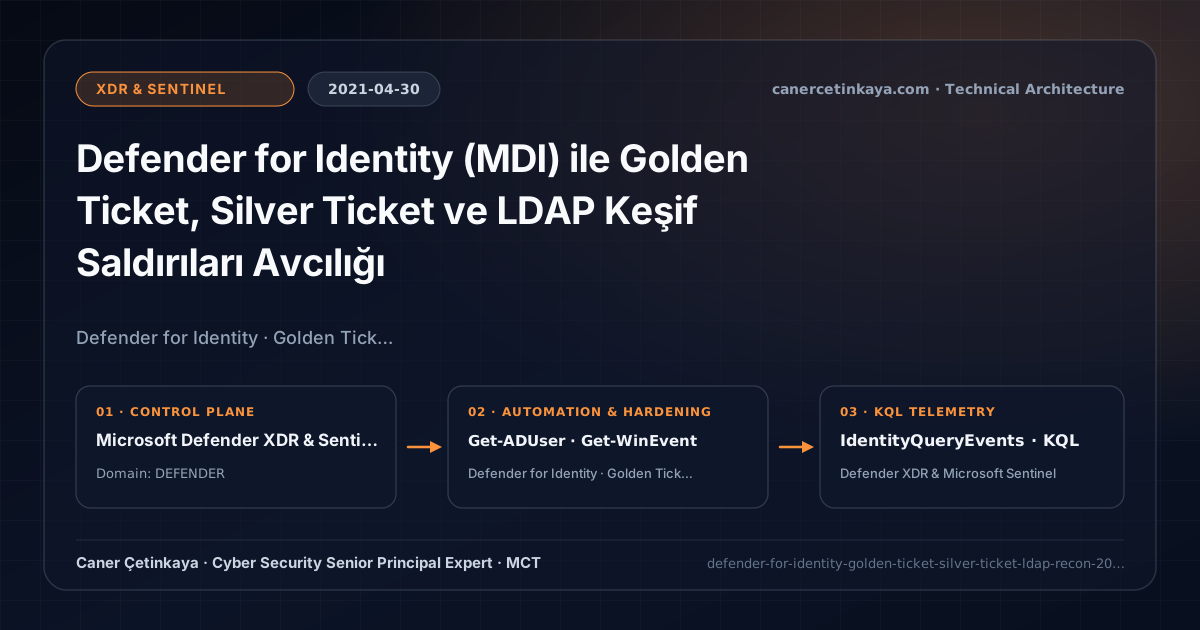
Executive Summary and Active Directory Threat Context
Once an attacker compromises the Active Directory krbtgt key via DCSync, they can mint persistent Golden Tickets valid for years—or forge targeted Silver Tickets directly against specific SQL/SMB service accounts without touching the KDC. Because forged tickets bypass normal password expirations and blend into standard Kerberos traffic, organizations rely on Microsoft Defender for Identity (MDI) sensors to spot ticket lifetime anomalies, weak RC4 downgrades, and automated BloodHound LDAP sweeps.
From an architectural evolution standpoint, this foundational design connects directly to modern platform controls. Renamed from Azure ATP to Microsoft Defender for Identity (MDI) by 2021, this Tier-0 sensor fabric evolved into modular Sensor v3.x agents driving Defender Identity KQL Threat Hunting across unified XDR.
Sensor Boundaries, Protocol Auditing, and Design Principles
- MDI sensors (deployed across all Domain Controllers) detect Golden Ticket tampering (MITRE T1558.001) via anomalous TGT lifetimes (>10h) and encryption mismatches.
- Silver Ticket detections surface forged TGS submissions lacking valid KDC PAC signatures or exhibiting impossible ticket issuance sequences.
- Reconnaissance rules catch BloodHound/SharpHound SAM-R sweeps, DNS zone enumeration, and heavy
adminCount=1/ SPN LDAP queries early in the kill chain. - Identity sensors on Domain Controllers and
Entra Connecthosts depend on tuned Advanced Windows Audit Policies and strict resource sizing so deep Kerberos/LDAP/NTLM inspection never degrades DC responsiveness.
Prerequisites, Domain Controller Dependencies, and RBAC
- Licensing: Microsoft Defender for Identity (EMS E5, Microsoft 365 E5, or M365 E5 Security).
- Sensor & Audit Readiness: Deploy MDI sensors on every Domain Controller with Kerberos/SAM-R audit GPOs active and configure a scoped gMSA Action Account.
- Telemetry Feed: Enable Microsoft 365 Defender portal sync for
IdentityLogonEventsandIdentityQueryEvents.
Technical Verification, ADCS/Protocol Posture, and Controls
PowerShell Sensor Health and Hardening Audit
Auditing Active Directory krbtgt PasswordLastSet age and privileged group changes via PowerShell:
- Execution Environment and Prerequisites: Requires ActiveDirectory / RSAT / AD Sync / AD FS management host, Local administrator / Windows endpoint host.
- Least Privilege and Operation Separation: Run with least-privilege inspection or scoped administrative permissions. All statements above are **read-only (
Get-*/Test-*/Search-*)** verification checks making no direct configuration edits; still validate module/network prerequisites in a test cohort first. - Security Control Mapped and Boundary Note: Verifies active policy state and guards against silent drift or mis-scoped rollouts without blind production changes.
# 1. Inspect krbtgt password rotation age and supported Kerberos encryption types
Get-ADUser -Identity "krbtgt" -Properties PasswordLastSet, msDS-SupportedEncryptionTypes |
  Select-Object SamAccountName, PasswordLastSet, msDS-SupportedEncryptionTypes

# 2. Check Tier-0 Domain/Enterprise Admins membership changes over last 7 days
Get-WinEvent -FilterHashtable @{LogName="Security"; Id=4728,4732,4756; StartTime=(Get-Date).AddDays(-7)} -ErrorAction SilentlyContinue |
  Select-Object -First 20 TimeCreated, Id, Message
Identity Threat Telemetry and KQL Verification Query
KQL threat hunt inspecting IdentityQueryEvents and IdentityLogonEvents for BloodHound LDAP/SAM-R recon:
// Execution Scope: Read-only hunting/audit query (Log Analytics Reader / Security Reader)
// Data Source: Microsoft Defender for Identity -> Defender XDR Advanced Hunting (IdentityQueryEvents)
union IdentityQueryEvents, IdentityLogonEvents
| where Timestamp > ago(7d)
| where ActionType in ("LDAP query", "SAMR query", "LogonFailed") or LogonType == "Kerberos"
| where Query has_any ("adminCount=1", "servicePrincipalName", "Domain Admins") or FailureReason != ""
| project Timestamp, ActionType, DeviceName, IPAddress, AccountName, Query, FailureReason
| summarize EventCount = count() by ActionType, DeviceName, AccountName
| where EventCount >= 10
| order by EventCount desc
Critical Architectural Assessment, Production Risks, and Rollback Strategy
- Ignoring Noisy IT Inventory Scanners in Exclusions: Unfiltered vulnerability scanners issuing bulk LDAP queries drown genuine BloodHound alerts unless scoped accurately.
- Using Over-Privileged Domain Admin Action Accounts: Provision a dedicated Group Managed Service Account (gMSA) holding strictly scoped OU user-disable permissions.
- Risks Mitigated vs. Residual Limitations: MDI sensors and
ADCS(ESC1/ESC8) remediation detect and disruptGolden Ticket,DCSync, LDAP reconnaissance, and certificate-template escalation; however, they do not inspect pure cloud-only Entra token replay, legacy apps broken if NTLM/web-enrollment endpoints are removed prematurely, or DCs lacking Windows Advanced Audit policies. - New Dependencies and Production Failure Modes: Fidelity depends on configured DC
Securityaudit SACLs, sensor sizing margins on busy Domain Controllers, outbound*.sensorapi.atp.azure.comHTTPS connectivity forv3, and verified ADCS client inventories before locking downESC8HTTP endpoints. - Rollback and Pilot Validation Procedure: Stage
NTLMand weak-protocol cleanup through Windows audit-only logging (8004/4022events) first; keep GPO rollback snapshots for AD hardening changes and upgradev2 -> v3sensors one non-FSMO DC at a time.
Verified Primary Sources & Open-Source Repositories
This architectural guide was cross-corroborated against the official advisories, Microsoft Learn docs, and open-source PowerShell / KQL repositories below.
Multi-Channel Distribution Summary (X & LinkedIn Draft)
Toggle X (Twitter) & LinkedIn sharing drafts
Multi-Channel Distribution Summary (X & LinkedIn Draft)
Toggle X (Twitter) & LinkedIn sharing draftsCatch forged Golden/Silver Tickets and BloodHound LDAP reconnaissance across Domain Controllers using Microsoft Defender for Identity. #ITDR #DefenderForIdentity
Active Directory resilience in 2021: detecting Kerberos Golden/Silver Ticket anomalies with MDI, enforcing double krbtgt resets, and hunting LDAP recon in KQL.