Eliminating Local Admin Rights with Microsoft Intune Endpoint Privilege Management (EPM)
Architecting Intune Suite Endpoint Privilege Management (EPM) to keep Windows users as standard non-admins while allowing certificate-verified just-in-time application elevation.
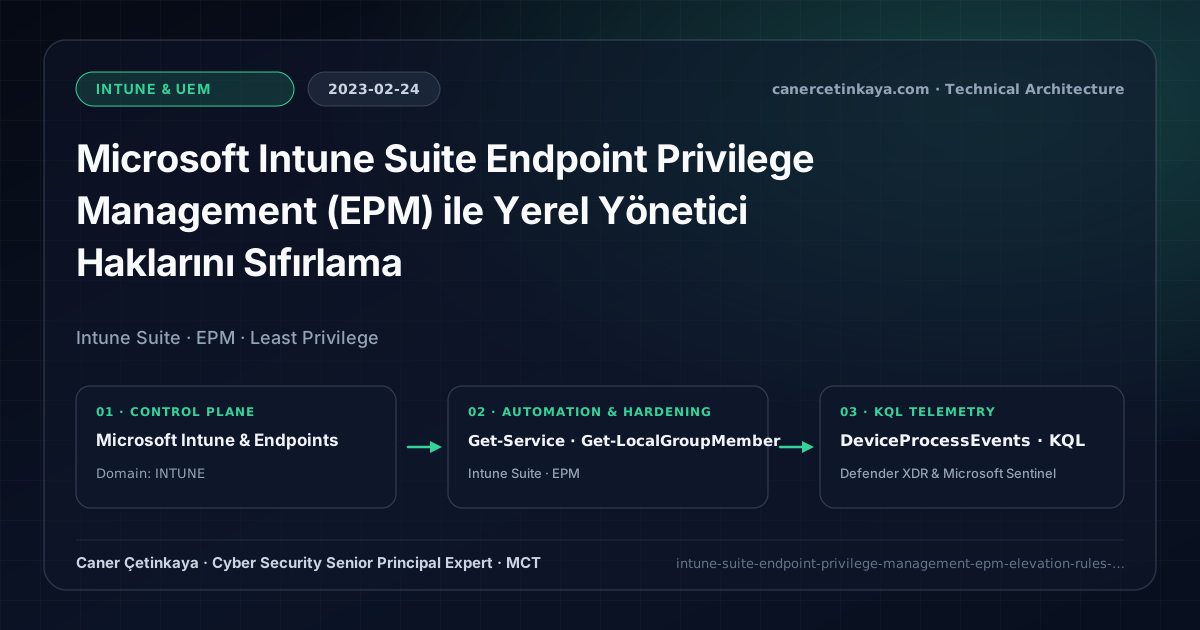
Executive Summary and Endpoint Hardening Context
For decades, organizations handed out permanent local Administrators membership simply so staff could update printer drivers, VPN tools, or specialized line-of-business software—rendering UAC and Defender ASR Rules far easier for malware to bypass. Microsoft Intune Endpoint Privilege Management (EPM) resolved this trade-off in 2023 by operating users strictly as standard accounts while granting controlled Run with elevated access rights on a per-binary basis.
From an architectural evolution standpoint, this foundational design connects directly to modern platform controls. Introducing native Intune privilege removal in 2023 without third-party agents, EPM works alongside Windows 11 22H2 VBS/Credential Guard to shrink ransomware blast radii across managed endpoints.
Hardware and Kernel Trust Boundaries and Design Principles
Elevation Settings Policyactivates the EPM client extension across Windows 10/11 endpoints, establishes default denial behavior, and collects standard-user UAC telemetry.Elevation Rules Policyconstrains elevated execution using SHA-256 hashes, uploaded code-signing certificate chains, and strict version bounds.Support Approvedworkflows integrate seamlessly inside the Intune Admin Center, letting IT technicians approve one-off troubleshooting utilities without disclosing LAPS secrets.BitLocker,Credential Guard,HVCI/VBS,App Control(WDAC),Cloud PKI, andWindows LAPSmust align withTPM 2.0/UEFI Secure Bootreadiness and resolve legacyGPO/customOMA-URIprecedence conflicts across pilot rings.
Prerequisites, MDM Conflict Resolution, and RBAC Boundaries
- Licensing: Microsoft Intune Suite or standalone
Microsoft Intune Endpoint Privilege Managementadd-on atop Intune Plan 1 + Windows 10/11 Enterprise/Education. - RBAC Role: Intune
Endpoint Security Manageror dedicated least-privilege EPM elevation approver roles. - Security Boundary: Any elevated installer launching interactive child utilities (
cmd.exe,powershell.exe) breaks least privilege unlessChild Process Behaviorstays tightly restricted.
Technical Verification, Compliance, and Policy Controls
PowerShell Endpoint Posture and Configuration Check
Auditing local Administrators membership, EPM service health, and client operational events on a Windows endpoint:
- Execution Environment and Prerequisites: Requires Local administrator / Windows endpoint host.
- Least Privilege and Operation Separation: Run with least-privilege inspection or scoped administrative permissions. All statements above are **read-only (
Get-*/Test-*/Search-*)** verification checks making no direct configuration edits; still validate module/network prerequisites in a test cohort first. - Security Control Mapped and Boundary Note: Verifies active policy state and guards against silent drift or mis-scoped rollouts without blind production changes.
# 1. Verify Intune Management Extension and EPM agent service status
Get-Service -Name "Microsoft.Management.Services.IntuneWindowsAgent", "EpmAgent*" -ErrorAction SilentlyContinue |
  Select-Object Name, Status, StartType

# 2. Audit persistent members inside the local Administrators group
Get-LocalGroupMember -Group "Administrators" | Select-Object Name, ObjectClass, PrincipalSource

# 3. Inspect recent local EPM elevation operational logs
Get-WinEvent -LogName "Microsoft-Windows-EpmClient/Operational" -MaxEvents 20 -ErrorAction SilentlyContinue |
  Select-Object TimeCreated, Id, LevelDisplayName, Message
Device Health Telemetry and KQL Verification Query
KQL query in Defender for Endpoint tracking EPM-elevated processes and auditing child process behavior:
// Execution Scope: Read-only hunting/audit query (Log Analytics Reader / Security Reader)
// Data Source: Microsoft Defender XDR Advanced Hunting / Sentinel MDE Connector (DeviceProcessEvents)
DeviceProcessEvents
| where Timestamp > ago(14d)
| where ProcessIntegrityLevel == "High" and InitiatingProcessFileName has "Epm"
| project Timestamp, DeviceName, AccountName, FileName, FolderPath, ProcessCommandLine, InitiatingProcessCommandLine
| summarize ElevatedRuns = count() by FileName, AccountName, DeviceName
| order by ElevatedRuns desc
Critical Architectural Assessment, Rollout Risks, and Rollback Strategy
- Writing Broad File Path Rules Without Certificates or Hashes: Matching arbitrary filenames inside user-writable folders (
%USERPROFILE%) invites trivial binary replacement attacks. - Stripping Local Admin Before Auditing Elevation Demand: Roll out EPM in telemetry-collection mode first to inventory required utilities before removing existing local admin groups.
- Risks Mitigated vs. Residual Limitations:
BitLocker,Credential Guard,HVCI/VBS,App Control/WDAC,Cloud PKI, andWindows LAPSdefeat offline disk extraction,LSASScredential theft, unsigned kernel drivers (BYOVD), and shared-adminPass-the-Hashpivoting; however, they do not prevent post-login abuse using signed system binaries (LOLBins) when App Control/ASR isn't enforced, nor do they protect legacy hardware lackingTPM 2.0/Secure Boot. - New Dependencies and Production Failure Modes: Endpoint reliability depends on
TPM 2.0/UEFI readiness, deterministicMDMWinsOverGPprecedence, and verified key escrow (BitLockerEntra registration andLAPSEvent ID 10025). EnforcingWDAC/AppLockerwithout audit logs or togglingHVCIonto incompatible drivers triggers boot loops (BSOD) or immediate helpdesk lockouts. - Rollback and Pilot Validation Procedure: Roll out every Windows security baseline through
IT Canary -> Pilot -> BroadIntune rings, verify escrow recovery keys before retiring legacy tools, and revert breaking policies via Intune group exclusions orAuditmode fallback without stripping core disk encryption.
Verified Primary Sources & Open-Source Repositories
This architectural guide was cross-corroborated against the official advisories, Microsoft Learn docs, and open-source PowerShell / KQL repositories below.
Multi-Channel Distribution Summary (X & LinkedIn Draft)
Toggle X (Twitter) & LinkedIn sharing drafts
Multi-Channel Distribution Summary (X & LinkedIn Draft)
Toggle X (Twitter) & LinkedIn sharing draftsEliminating persistent local admin rights cleanly with Intune Endpoint Privilege Management (EPM) and certificate-pinned rules. #Intune #EPM #ZeroTrust
Achieving True Endpoint Least Privilege: Implementing Intune EPM elevation rules, preventing child-process shell escapes, and decommissioning legacy local admin groups.