Shadow IT Discovery and Conditional Access Session Control with Microsoft Cloud App Security (MCAS)
A 2018 Cloud Access Security Broker (CASB) architecture leveraging Microsoft Cloud App Security (MCAS) to map Shadow IT usage via firewall logs and block corporate downloads on unmanaged BYOD endpoints.
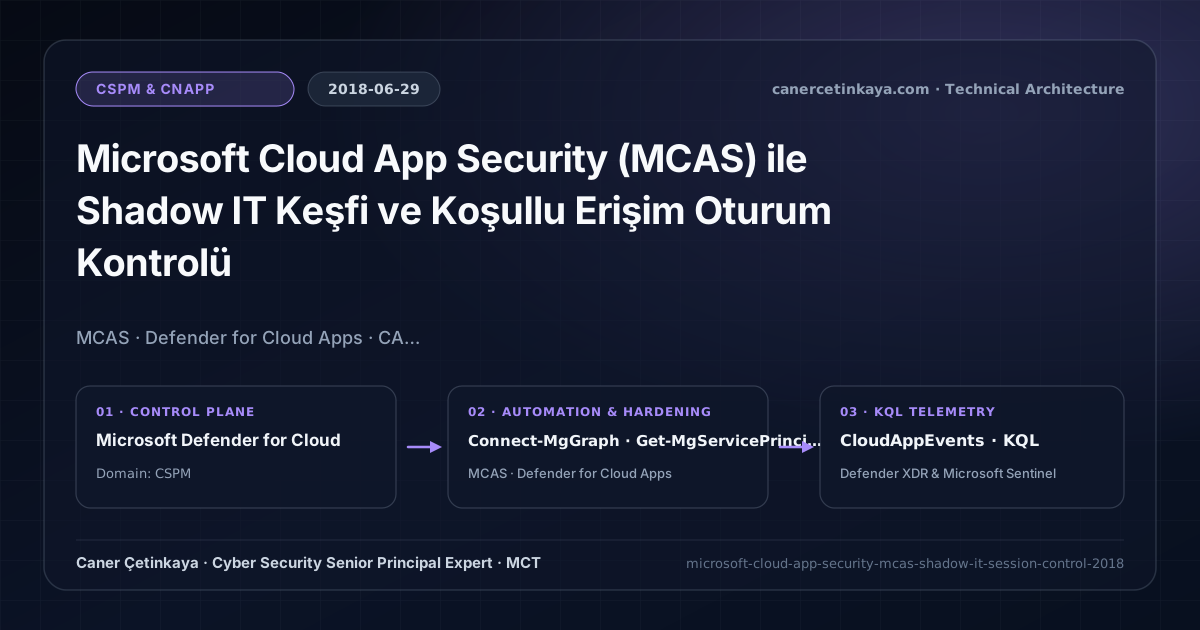
Executive Summary and Cloud Posture Context
As enterprise workloads move into Exchange Online and SharePoint, staff routinely bypass IT governance by uploading sensitive client exports to unsanctioned cloud storage platforms. Port-level firewall blocking alone fails whenever employees sign in from personal home browsers or unmanaged devices. Microsoft Cloud App Security (MCAS) solves both visibility and enforcement gaps through continuous Shadow IT log scoring and real-time Conditional Access App Control reverse-proxy sessions.
From an architectural evolution standpoint, this foundational design connects directly to modern platform controls. Pioneered in 2018 as Microsoft Cloud App Security (MCAS), this CASB platform is today Microsoft Defender for Cloud Apps—powering SaaS Security Posture Management (SSPM) alongside Purview and Intune AI data leakage prevention.
Detection Boundaries, Asset Scope, and Design Principles
- Cloud Discovery ingests firewall and proxy streams (Palo Alto, Fortinet, Check Point, Zscaler) through automated log collectors, scoring over 16,000 cloud apps on security and compliance.
- Conditional Access App Control intercepts federated browser flows routed from Azure AD Conditional Access to block downloads or apply encryption on the fly.
- OAuth App Governance surfaces risky third-party applications holding Mail.Read or Files.ReadWrite.All grants so SecOps can revoke over-privileged consents rapidly.
- Cloud and SaaS posture engines (
CSPM/SSPM), attack-path graphs, and OAuth governance must tie directly to concrete privilege reduction and IaC/PR gates rather than accumulating unactioned alert queues.
Prerequisites, Connector Coverage, and RBAC Separation
- Licensing: Microsoft 365 E5, EMS E5, or standalone Microsoft Cloud App Security paired with Azure AD P1 for Conditional Access steering.
- Infrastructure & RBAC: Continuous Log Collector host (Syslog/FTP container) and Cloud App Security Administrator permissions aligned with least privilege.
- Connector Prerequisite: Activate native Office 365 and Azure API connectors inside the MCAS Security Extensions pane.
Technical Verification, Posture Score, and OAuth Audits
PowerShell Cloud and SaaS Posture Assessment
Auditing integrated OAuth enterprise applications via Microsoft Graph prior to MCAS governance enforcement:
- Execution Environment and Prerequisites: Requires Microsoft.Graph.
- Least Privilege and Operation Separation: Run with scoped Least-privilege Graph `.Read.All` scopes (delegated admin role only for writes) privileges. All statements above are **read-only (
Get-*/Test-*/Search-*)** verification checks making no direct configuration edits; still validate module/network prerequisites in a test cohort first. - Security Control Mapped and Boundary Note: Verifies active policy state and guards against silent drift or mis-scoped rollouts without blind production changes.
# 1. Inspect integrated cloud apps registered in Microsoft Entra ID for OAuth governance review
Connect-MgGraph -Scopes "Application.Read.All"
Get-MgServicePrincipal -All |
  Where-Object { $_.Tags -contains "WindowsAzureActiveDirectoryIntegratedApp" } |
  Select-Object DisplayName, AppId, PublisherName |
  Select-Object -First 25

# 2. Check Docker-based MCAS continuous discovery log collector container status on Linux host
# docker ps --filter "name=mcas-collector" --format "table {{.Names}} {{.Status}} {{.Ports}}"
Cloud Security Telemetry and KQL Query
KQL hunt querying CloudAppEvents for blocked downloads and risky third-party OAuth consents:
// Execution Scope: Read-only hunting/audit query (Log Analytics Reader / Security Reader)
// Data Source: Microsoft Defender for Cloud Apps -> Defender XDR Advanced Hunting / Sentinel (CloudAppEvents)
CloudAppEvents
| where Timestamp > ago(7d)
| where ActionType in ("FileDownloaded", "Consent to application", "BlockDownload")
| extend IsUnmanaged = tostring(RawEventData.IsCompliant) == "false"
| where ActionType == "BlockDownload" or ActionType == "Consent to application"
| project Timestamp, AccountDisplayName, Application, ActionType, IPAddress, CountryCode, IsUnmanaged
| summarize EventCount = count() by Application, ActionType, AccountDisplayName
| order by EventCount desc
Critical Architectural Assessment, Production Risks, and Rollback Strategy
- Relying on One-Time CSV Uploads: Manual log snapshots go stale immediately; configure an automated Docker Log Collector for daily Shadow IT anomaly alerting.
- Blocking Viewing Instead of Downloads: Denying full web access forces users onto shadow workarounds; enforcing browser-based Block Download keeps SaaS apps usable safely.
- Risks Mitigated vs. Residual Limitations:
Defender CSPM, attack-path graphs,FIM, andShadow AIOAuth governance curb public cloud exposure, drift on sensitive host files, and illicit consent grants; however, they do not stop zero-day runtime exploits before patches/detections arrive, logic bugs in custom SaaS apps, or credential abuse on accounts outside connector RBAC scope. - New Dependencies and Production Failure Modes: Coverage relies on active multi-cloud read connectors (
AWS/GCP), endpoint/VM agents, andApp GovernanceAPI feeds. Blindly enabling automatic OAuth revocation or strict PR/deployment gates can interrupt authorized vendor workflows or release pipelines. - Rollback and Pilot Validation Procedure: Operate OAuth app governance and IaC admission gates in audit/alert mode before activating enforcement; export
Get-MgOauth2PermissionGrantbaselines and retain Defender policy exemptions to reinstate inadvertently paused integrations.
Verified Primary Sources & Open-Source Repositories
This architectural guide was cross-corroborated against the official advisories, Microsoft Learn docs, and open-source PowerShell / KQL repositories below.
Multi-Channel Distribution Summary (X & LinkedIn Draft)
Toggle X (Twitter) & LinkedIn sharing drafts
Multi-Channel Distribution Summary (X & LinkedIn Draft)
Toggle X (Twitter) & LinkedIn sharing draftsPublished our 2018 CASB blueprint covering MCAS (Defender for Cloud Apps) Shadow IT discovery, OAuth risk review, and BYOD session proxy controls. #CASB #ZeroTrust
How enterprises uncover Shadow IT from firewall telemetry and enforce browser Block-Download policies on unmanaged devices using MCAS Conditional Access App Control.