Enterprise AI Agent Guardrails with Azure AI Foundry, Foundry Local, and Purview DSPM for AI
Preventing data leakage and cross-user prompt exposure across custom enterprise agents and local edge models using Azure AI Foundry guardrails, OBO RAG ACLs, and Purview DSPM for AI.
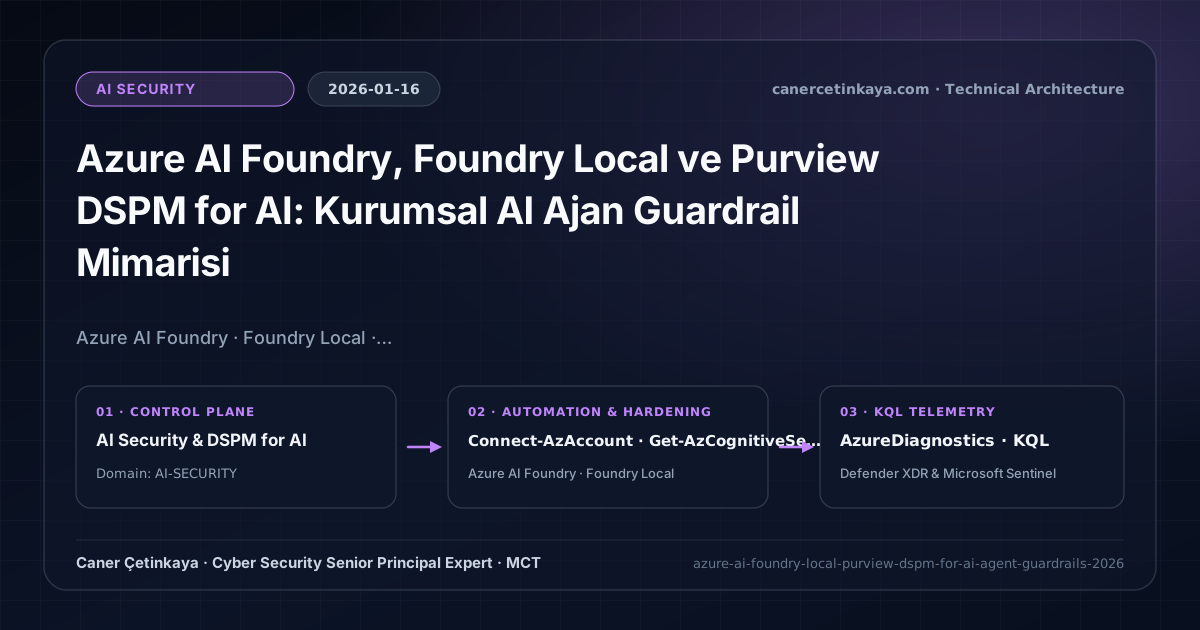
Executive Summary and AI Security Context
By 2026, enterprises run far more than SaaS Microsoft 365 Copilot—engineering teams ship autonomous workflow agents inside Azure AI Foundry wired to enterprise RAG search indexes while deploying Foundry Local models straight onto developer workstations. Without strict prompt shields, document-level authorization, and telemetry governance, custom agents create instant cross-department data leakage paths. Integrating Microsoft Purview DSPM for AI closes visibility and control gaps over custom and local AI.
From an architectural evolution standpoint, this foundational design connects directly to modern platform controls. Scaling 2023’s Azure OpenAI Private Endpoint blueprint into autonomous multi-agent ecosystems in 2026 unites Purview DSPM for AI directly with AI Coding Agents Hardening and Purview & Copilot Security.
Data Boundaries, Permission Inheritance, and Design Principles
Purview DSPM for AIcaptures custom Azure AI Foundry prompts, tool payloads, and sensitive information exposure alerts alongside Microsoft 365 Copilot telemetry under one Data Security Posture view.Prompt ShieldsandTask Adherencedetectors stop indirect prompt injections hidden in fetched web pages or emails from triggering destructive agent tool executions.Foundry Localkeeps sensitive defense and financial prompts strictly inside hardware NPU/GPU boundaries with zero cloud transmission while governed by BitLocker and Intune Endpoint DLP.- Maps cleanly onto NIST AI RMF governance, EU AI Act logging traceability, and Microsoft Sovereign Cloud isolation.
Prerequisites, Network/Licensing Scope, and RBAC Requirements
- Licensing & Infrastructure: Azure Subscription hosting Azure AI Foundry + AI Content Safety, paired with Purview DSPM for AI (core Copilot capabilities included in M365 E5; pay-as-you-go Purview meters cover custom Azure AI resources).
- Identity & RBAC: Scoped Entra Service Principals / Agent IDs,
Azure AI Search Document-Level ACLs, and separatedData Security AI Adminoversight. - Tool Execution Gate: Restrict autonomous agent tools to Read-Only by default; enforce
Human-in-the-Loopconfirmation gates on state-changing API calls.
Technical Verification, Model Access Audits, and Controls
PowerShell AI Security Configuration Validation
Auditing Azure AI Foundry / Cognitive Services key-isolation posture and Log Analytics diagnostic routing in Az PowerShell:
- Execution Environment and Prerequisites: Requires Az.*.
- Least Privilege and Operation Separation: Run with scoped Azure Reader (audit) / Contributor (state changes) privileges. All statements above are **read-only (
Get-*/Test-*/Search-*)** verification checks making no direct configuration edits; still validate module/network prerequisites in a test cohort first. - Security Control Mapped and Boundary Note: Verifies active policy state and guards against silent drift or mis-scoped rollouts without blind production changes.
# 1. Audit network isolation and DisableLocalAuth posture across Azure AI accounts
Connect-AzAccount
Get-AzCognitiveServicesAccount | Select-Object AccountName, Kind, ResourceGroupName, PublicNetworkAccess, DisableLocalAuth

# 2. Verify Log Analytics diagnostic forwarding for AI security telemetry
$Account = Get-AzCognitiveServicesAccount | Select-Object -First 1
if ($Account) {
  Get-AzDiagnosticSetting -ResourceId $Account.Id | Select-Object Name, WorkspaceId
}
AI Security Telemetry and KQL Verification Query
KQL query auditing Azure AI Prompt Shield rejections, jailbreak blocks, and unauthorized access attempts:
// Execution Scope: Read-only hunting/audit query (Log Analytics Reader / Security Reader)
// Data Source: Azure Resource Diagnostic Settings -> Log Analytics / Microsoft Sentinel (AzureDiagnostics)
AzureDiagnostics
| where TimeGenerated > ago(14d)
| where ResourceProvider == "MICROSOFT.COGNITIVESERVICES"
| where OperationName has_any ("ChatCompletions", "Assistants", "ContentSafety", "Agent")
| where toint(ResultSignature) in (400, 401, 403) or ResultDescription has_any ("content_filter", "jailbreak", "shield")
| project TimeGenerated, Resource, OperationName, ResultSignature, CallerIPAddress, ResultDescription
| summarize BlockedEvents = count() by Resource, OperationName, ResultSignature
| order by BlockedEvents desc
Critical Architectural Assessment, Oversharing Risks, and Rollback Strategy
- Indexing Restricted HR and Public Documents Under a Shared Reader Token: Never query flattened vector embeddings without passing the active user’s Entra group/ACL filter.
- Leaving Local Developer AI Model Caches Unprotected: Apply Intune BitLocker and Endpoint DLP rules across engineering laptops running Foundry Local or local coding agents.
- Risks Mitigated vs. Residual Limitations:
Private Endpoints,Managed Identity, content safety filters, and SharePoint oversharing (SAM) guards stop leaked AI API keys and limit unintended Copilot grounding across over-shared sites; yet they cannot prevent authorized users from querying sensitive data they legitimately holdReadaccess to (without Purview DLP/label boundaries) or guard against subtle reasoning hallucinations. - New Dependencies and Production Failure Modes: Architecture relies on
DisableLocalAuthreadiness,Private DNSalignment,SharePoint Advanced Managementsite flags, andSecurity CopilotSCUallocation. Flipping local key auth off prematurely or applyingRestricted SharePoint Searchglobally breaks legacy bots and org-wide search. - Rollback and Pilot Validation Procedure: Stage private AI access and SharePoint
RCD/RACcontrols on non-production subscriptions and pilot SharePoint sites first; roll back disruption safely via scopedSet-SPOSiteorUpdate-AzCognitiveServicesAccountchanges rather than re-exposing public endpoints.
Verified Primary Sources & Open-Source Repositories
This architectural guide was cross-corroborated against the official advisories, Microsoft Learn docs, and open-source PowerShell / KQL repositories below.
Multi-Channel Distribution Summary (X & LinkedIn Draft)
Toggle X (Twitter) & LinkedIn sharing drafts
Multi-Channel Distribution Summary (X & LinkedIn Draft)
Toggle X (Twitter) & LinkedIn sharing draftsSecuring custom enterprise agents and local edge models with Azure AI Foundry + Purview DSPM for AI guardrails. #AzureAIFoundry #Purview #AISecurity
Governing Autonomous AI Agents: Enforcing On-Behalf-Of RAG ACLs, Prompt Shields against indirect injection, and unified Purview DSPM for AI auditing.