Shadow GenAI Discovery, App Blocking, and OAuth Revocation with Defender for Cloud Apps
Identifying unsanctioned generative AI tools via Defender Cloud Discovery, enforcing remote blocking through Defender for Endpoint Network Protection, and blocking rogue AI meeting bot OAuth consents.
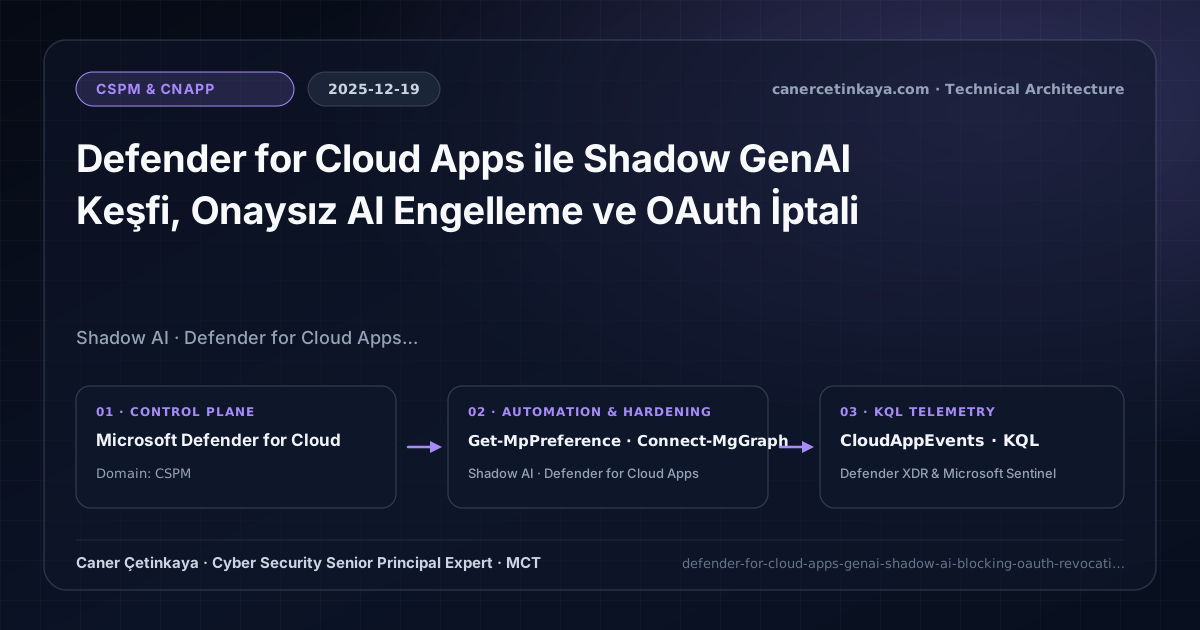
Executive Summary and Cloud Posture Context
Even after rolling out licensed Microsoft 365 Copilot seats, staff routinely paste proprietary code, customer contracts, and financial data into hundreds of unvetted free generative AI portals and Chrome extensions (Shadow AI). Traditional perimeter firewalls cannot monitor roaming home endpoints—making Defender for Cloud Apps Cloud Discovery integrated with MDE Network Protection essential to enforce consistent GenAI governance everywhere.
From an architectural evolution standpoint, this foundational design connects directly to modern platform controls. Evolving MCAS Shadow IT and SSPM/App Governance onto 1,000+ cataloged Generative AI apps in late 2025 pairs natively with Purview Browser DLP AI Protection and Purview DSPM for AI.
Detection Boundaries, Asset Scope, and Design Principles
Cloud Discovery Generative AI Catalogcontinuously scores 1,000+ AI portals based on encryption, SOC 2/GDPR compliance, IP retention, and prompt model-training posture.Enforce App AccesspropagatesUnsanctionedapp tags from Defender for Cloud Apps down to Windows/macOS endpoints via MDE Network Protection—halting access over home Wi-Fi or corporate VPNs without proxy pac hacks.OAuth App Governanceblocks employees from granting unauthorized Microsoft 365 permissions (Calendars.Read,OnlineMeetings.Read) to external third-party AI note-taking bots.- Cloud and SaaS posture engines (
CSPM/SSPM), attack-path graphs, and OAuth governance must tie directly to concrete privilege reduction and IaC/PR gates rather than accumulating unactioned alert queues.
Prerequisites, Connector Coverage, and RBAC Separation
- Licensing: Microsoft Defender for Cloud Apps paired with Microsoft Defender for Endpoint P1/P2 (bundled together in Microsoft 365 E5).
- Integration & RBAC: Enable
Enforce app accessinside Defender Settings -> Cloud Apps -> Defender for Endpoint, set MDE Network Protection toEnabled (Block), and govern permissions asSecurity Administrator. - Inspection Note: Network Protection blocks whole domains across Edge/Chrome/Firefox, whereas prompt-level redaction requires managed Edge paired with Purview Browser DLP.
Technical Verification, Posture Score, and OAuth Audits
PowerShell Cloud and SaaS Posture Assessment
Auditing endpoint MDE Network Protection enforcement and Entra ID user OAuth consent settings via Graph:
- Execution Environment and Prerequisites: Requires Microsoft.Graph, Local administrator / Windows endpoint host.
- Least Privilege and Operation Separation: Run with scoped Least-privilege Graph `.Read.All` scopes (delegated admin role only for writes) privileges. All statements above are **read-only (
Get-*/Test-*/Search-*)** verification checks making no direct configuration edits; still validate module/network prerequisites in a test cohort first. - Security Control Mapped and Boundary Note: Verifies active policy state and guards against silent drift or mis-scoped rollouts without blind production changes.
# 1. Verify Defender for Endpoint Network Protection is enforcing Block mode (1=Enabled/Block)
(Get-MpPreference).EnableNetworkProtection

# 2. Check Entra ID default user OAuth consent policy via Microsoft Graph
Connect-MgGraph -Scopes "Policy.Read.All", "Application.Read.All"
$AuthPolicy = Get-MgPolicyAuthorizationPolicy
$AuthPolicy.DefaultUserRolePermissions | Select-Object PermissionGrantPoliciesAssigned

# 3. Audit active OAuth2 delegated permission grants in the directory
Get-MgOauth2PermissionGrant -All | Select-Object -First 20 ClientId, ConsentType, Scope
Cloud Security Telemetry and KQL Query
KQL query hunting Generative AI SaaS access and OAuth consent actions inside Defender CloudAppEvents:
// Execution Scope: Read-only hunting/audit query (Log Analytics Reader / Security Reader)
// Data Source: Microsoft Defender for Cloud Apps -> Defender XDR Advanced Hunting / Sentinel (CloudAppEvents)
CloudAppEvents
| where Timestamp > ago(14d)
| where Application has_any ("OpenAI", "ChatGPT", "Claude", "Perplexity", "DeepSeek", "Otter", "Generative") or ActionType has "Consent"
| project Timestamp, Application, AccountDisplayName, ActionType, IPAddress, UserAgent
| summarize Hits = count(), Users = dcount(AccountDisplayName) by Application, ActionType
| order by Hits desc
Critical Architectural Assessment, Production Risks, and Rollback Strategy
- Leaving MDE Network Protection in Audit-Only Mode: Tagging an AI domain
Unsanctionedinside Cloud Discovery emits alerts without halting uploads until endpointEnableNetworkProtection = 1is enforced. - Ignoring Entra User OAuth Consent Settings: External AI meeting transcription bots operate cloud-to-cloud outside firewall boundaries—enable Admin Consent Workflows immediately.
- Risks Mitigated vs. Residual Limitations:
Defender CSPM, attack-path graphs,FIM, andShadow AIOAuth governance curb public cloud exposure, drift on sensitive host files, and illicit consent grants; however, they do not stop zero-day runtime exploits before patches/detections arrive, logic bugs in custom SaaS apps, or credential abuse on accounts outside connector RBAC scope. - New Dependencies and Production Failure Modes: Coverage relies on active multi-cloud read connectors (
AWS/GCP), endpoint/VM agents, andApp GovernanceAPI feeds. Blindly enabling automatic OAuth revocation or strict PR/deployment gates can interrupt authorized vendor workflows or release pipelines. - Rollback and Pilot Validation Procedure: Operate OAuth app governance and IaC admission gates in audit/alert mode before activating enforcement; export
Get-MgOauth2PermissionGrantbaselines and retain Defender policy exemptions to reinstate inadvertently paused integrations.
Verified Primary Sources & Open-Source Repositories
This architectural guide was cross-corroborated against the official advisories, Microsoft Learn docs, and open-source PowerShell / KQL repositories below.
Multi-Channel Distribution Summary (X & LinkedIn Draft)
Toggle X (Twitter) & LinkedIn sharing drafts
Multi-Channel Distribution Summary (X & LinkedIn Draft)
Toggle X (Twitter) & LinkedIn sharing draftsControlling Shadow GenAI tools on roaming endpoints with Defender for Cloud Apps + MDE Network Protection and OAuth consent lockdowns. #ShadowAI #DefenderForCloudApps #GenAI
Governing Shadow AI: Scoring 1,000+ GenAI tools in Cloud Discovery, blocking high-risk uploaders at the MDE network layer, and cutting off unauthorized AI meeting bots.