Hunting Illicit Consent Grants with MCAS OAuth App Governance and Admin Consent Workflows
A 2021 cloud SaaS defense guide eliminating MFA-bypassing OAuth Illicit Consent Grant attacks using strict Azure AD Admin Consent Workflows, MCAS App Governance policies, and Graph API permission auditing.
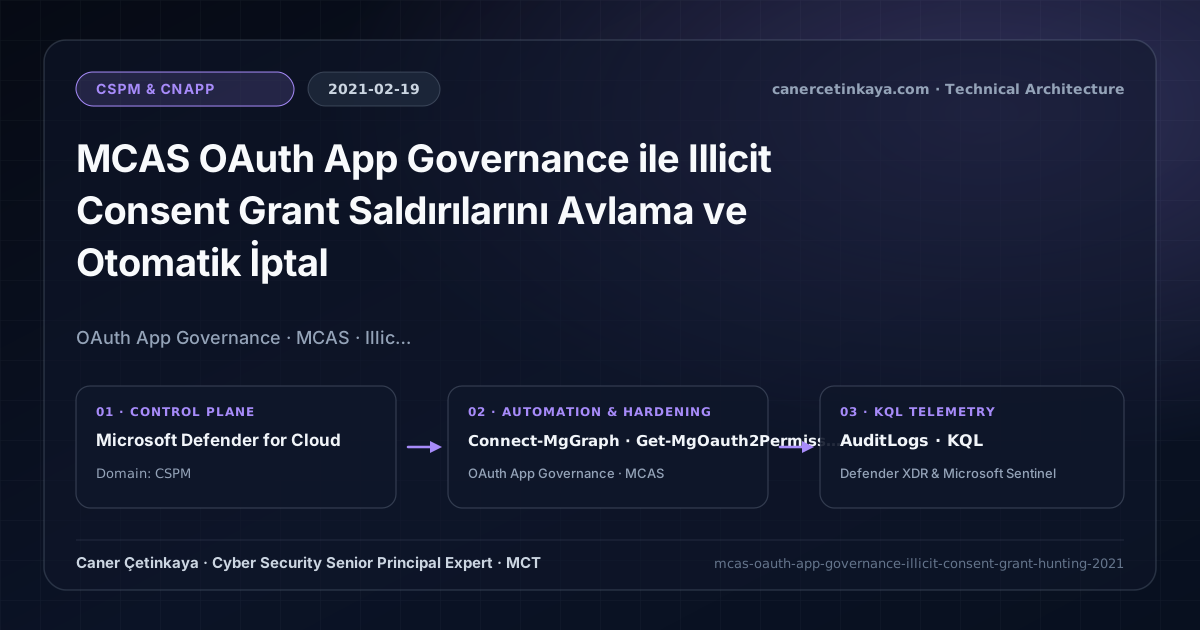
Executive Summary and Cloud Posture Context
As enterprises enforce FIDO2 passwordless authentication and strict MFA, threat actors shift away from credential theft toward Illicit Consent Grant attacks. By tricking a single employee into clicking Accept on a malicious third-party OAuth app, attackers gain persistent Mail.ReadWrite or Files.ReadWrite.All Graph tokens that exfiltrate mailboxes silently without ever re-triggering MFA.
From an architectural evolution standpoint, this foundational design connects directly to modern platform controls. Introduced as an MCAS add-on in 2021 to neutralize illicit OAuth tokens, App Governance is now built natively into Microsoft Defender for Cloud Apps and Microsoft Defender XDR—extending automated revocation to GenAI SaaS integrations.
Detection Boundaries, Asset Scope, and Design Principles
- Restricting Azure AD User Consent forces risky OAuth requests through an auditable Admin Consent Workflow reviewed by least-privilege administrators.
- MCAS (Defender for Cloud Apps) App Governance monitors granted apps for over-privileged scopes, verified-publisher status, and abnormal Graph download bursts.
- Automated OAuth remediation policies suspend malicious Service Principals and revoke active tokens immediately on anomalous behavior.
- Cloud and SaaS posture engines (
CSPM/SSPM), attack-path graphs, and OAuth governance must tie directly to concrete privilege reduction and IaC/PR gates rather than accumulating unactioned alert queues.
Prerequisites, Connector Coverage, and RBAC Separation
- Licensing: Restricting User Consent and enabling Admin Consent Workflows operate on Azure AD Free+; automated OAuth App Governance leverages Microsoft 365 E5 / EMS E5 / MCAS.
- RBAC Matrix: Assign Cloud Application Administrator or Application Administrator rather than Global Administrator to review and approve consent requests.
- Connector Setup: Verify active Azure AD and Office 365 connectors inside the Cloud App Security portal.
Technical Verification, Posture Score, and OAuth Audits
PowerShell Cloud and SaaS Posture Assessment
Auditing active OAuth2 Permission Grants holding Mail, Files, or Directory scopes via Microsoft Graph PowerShell:
- Execution Environment and Prerequisites: Requires Microsoft.Graph.
- Least Privilege and Operation Separation: Run with scoped Least-privilege Graph `.Read.All` scopes (delegated admin role only for writes) privileges. All statements above are **read-only (
Get-*/Test-*/Search-*)** verification checks making no direct configuration edits; still validate module/network prerequisites in a test cohort first. - Security Control Mapped and Boundary Note: Verifies active policy state and guards against silent drift or mis-scoped rollouts without blind production changes.
# Audit active OAuth2 Permission Grants holding Mail, Files, or Directory scopes
Connect-MgGraph -Scopes "DelegatedPermissionGrant.Read.All", "Application.Read.All"
Get-MgOauth2PermissionGrant -All |
  Where-Object { $_.Scope -match "Mail\.|Files\.|Directory\." } |
  ForEach-Object {
    $sp = Get-MgServicePrincipal -ServicePrincipalId $_.ClientId -ErrorAction SilentlyContinue
    [PSCustomObject]@{ AppName = $sp.DisplayName; ClientId = $_.ClientId; ConsentType = $_.ConsentType; Scope = $_.Scope }
  } | Format-Table -AutoSize
Cloud Security Telemetry and KQL Query
KQL threat hunt surfacing recent OAuth application consents and Service Principal permission escalations:
// Execution Scope: Read-only hunting/audit query (Log Analytics Reader / Security Reader)
// Data Source: Microsoft Entra ID Diagnostic Settings -> Log Analytics / Microsoft Sentinel (AuditLogs)
AuditLogs
| where TimeGenerated > ago(14d)
| where OperationName in ("Consent to application", "Add OAuth2PermissionGrant", "Add app role assignment to service principal")
| extend TargetApp = tostring(TargetResources[0].displayName)
| project TimeGenerated, OperationName, InitiatedBy, TargetApp, Result
| summarize GrantCount = count() by TargetApp, OperationName, Result
| order by GrantCount desc
Critical Architectural Assessment, Production Risks, and Rollback Strategy
- Blocking User Consent Without Assigning Admin Reviewers: Leaving reviewer lists empty traps legitimate business software requests in unmonitored queues.
- Trusting Lookalike App Display Names: Attackers impersonate trusted brands across unverified publishers; always inspect Redirect URIs and Publisher Verification badges.
- Risks Mitigated vs. Residual Limitations:
Defender CSPM, attack-path graphs,FIM, andShadow AIOAuth governance curb public cloud exposure, drift on sensitive host files, and illicit consent grants; however, they do not stop zero-day runtime exploits before patches/detections arrive, logic bugs in custom SaaS apps, or credential abuse on accounts outside connector RBAC scope. - New Dependencies and Production Failure Modes: Coverage relies on active multi-cloud read connectors (
AWS/GCP), endpoint/VM agents, andApp GovernanceAPI feeds. Blindly enabling automatic OAuth revocation or strict PR/deployment gates can interrupt authorized vendor workflows or release pipelines. - Rollback and Pilot Validation Procedure: Operate OAuth app governance and IaC admission gates in audit/alert mode before activating enforcement; export
Get-MgOauth2PermissionGrantbaselines and retain Defender policy exemptions to reinstate inadvertently paused integrations.
Verified Primary Sources & Open-Source Repositories
This architectural guide was cross-corroborated against the official advisories, Microsoft Learn docs, and open-source PowerShell / KQL repositories below.
Multi-Channel Distribution Summary (X & LinkedIn Draft)
Toggle X (Twitter) & LinkedIn sharing drafts
Multi-Channel Distribution Summary (X & LinkedIn Draft)
Toggle X (Twitter) & LinkedIn sharing draftsStop MFA-bypassing Illicit Consent Grant attacks with Azure AD Admin Consent Workflows and MCAS App Governance. #OAuth #MCAS #EntraID
2021 Cloud App Security: auditing high-risk OAuth2PermissionGrants via PowerShell, governing Admin Consent requests, and automating rogue app suspension.