Microsoft Defender ISOC and Sentinel Unified SOC (Ignite 2026): 90-Day Retention, Ingest-Time Normalization, and Multi-Cloud UEBA
Architectural breakdown of Microsoft Defender ISOC (Ignite 2026): Sentinel opt-in, 90-day Defender retention, built-in data lake, ingest-time normalization, Detections as Code, and multi-cloud UEBA.
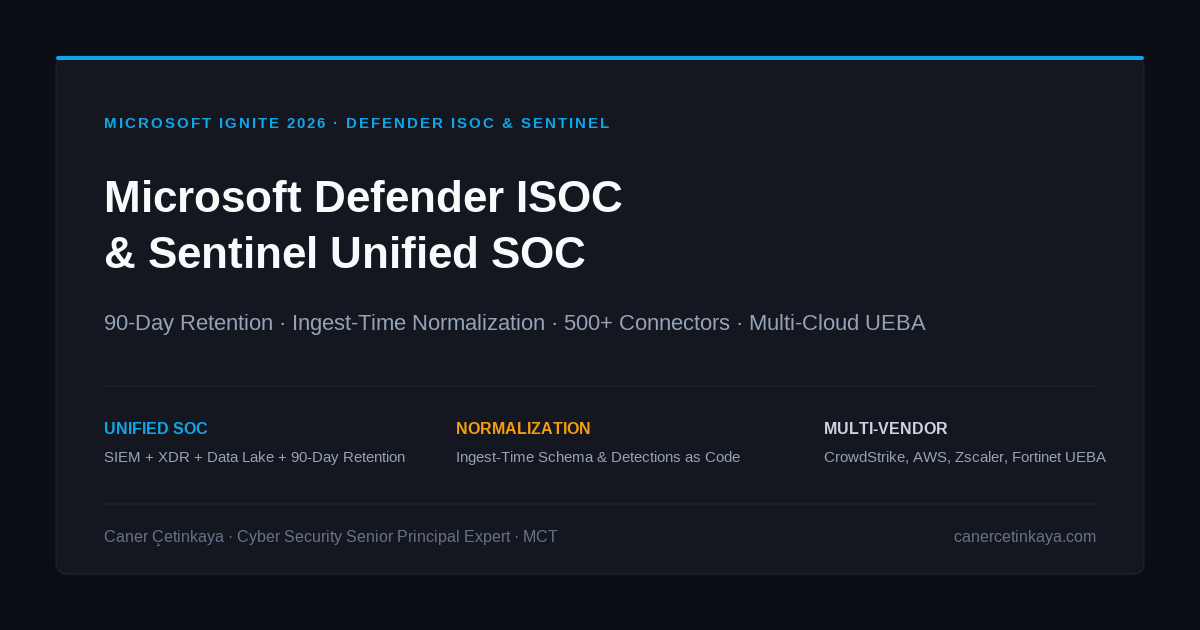
For years, enterprise SOCs paid an operational tax for maintaining separate SIEM and XDR consoles: analysts pivoted between Defender incidents and Sentinel rules while query-time parsers slowed down cross-vendor hunting.
At Microsoft Ignite 2026, Microsoft unveiled the Integrated Security Operations Center (ISOC) inside Microsoft Defender—merging SIEM, XDR, UEBA, threat intelligence, and automatic attack disruption onto a single data plane built for both human defenders and Microsoft Perception agents.
ISOC Opt-In and the 90-Day Retention Shift
Per Microsoft's Ignite 2026 announcements, the ISOC core is Generally Available (`GA`) while full SIEM features enter Public Preview. Starting November 17, 2026, existing Microsoft Sentinel customers with Microsoft 365 E5, E7, or Microsoft Defender Suite licenses can opt directly into ISOC:
- 90-day included Defender retention: Built-in retention for eligible Defender telemetry triples from 30 days to 90 days, materially improving retrospective threat hunting without immediate hot-tier storage overages.
- Built-in data lake and reduced ingestion rates: High-volume third-party logs benefit from native data-lake economics and streamlined ingestion pricing.
- SOC engineering built in: SOC Optimization, Content Hub, Detections as Code, and automation audit logs now live natively inside the unified ISOC workspace.
Why Ingest-Time Normalization Matters
Traditional SIEMs normalize heterogeneous vendor logs at query time—penalizing complex KQL performance and complicating agentic investigations. Entering Public Preview in December 2026, Ingest-Time Normalization uses Microsoft-managed parsers to standardize selected telemetry as it arrives, making detections, hunting queries, and Perception workflows faster and reusable across sources.
Multi-Vendor Coverage: 500+ Connectors, CrowdStrike, and UEBA
Ignite 2026 makes clear that Defender ISOC is designed for heterogeneous enterprise estates:
- 500+ connectors: Including Edge for Business, Purview Information Protection, Wiz, Salesforce, and OpenAI audit logs.
- CrowdStrike alert promotion: CrowdStrike detections are now promoted directly into native Defender alerts for unified incident correlation.
- Expanded UEBA: Behavioral analytics now extend across AWS GuardDuty, Check Point, Zscaler, and Fortinet.
- Defender TI Zero-Day & Emerging Threats (`Public Preview`): Industry- and region-filtered zero-day tags, a dedicated widget, and email alerts help SOCs focus on relevant zero-days immediately.
Architectural Limitations, Prerequisites, and Rollback
Before opting production workspaces into ISOC, architects should enforce clear guardrails:
- Licensing prerequisites: Confirm Microsoft 365 E5, E7, or Defender Suite eligibility for 90-day retention and model third-party ingestion volumes via SOC Optimization before scaling connectors.
- Preview validation: Because full SIEM features and ingest-time normalization are in
Public Preview, run mission-critical custom Sentinel analytic rules in parallel against normalized and raw tables before retiring legacy queries. - Not a replacement for preventive security: Unified visibility accelerates triage and hunting, but it does not replace endpoint hardening, patching, or Zero Trust access controls.
- Rollback and continuity plan: Export all existing Sentinel analytics, workbooks, and automation rules into a Git-backed
Detections as Coderepository prior to opt-in. If normalized schemas introduce unexpected alert gaps, revert affected detections to raw-table queries in parallel to preserve SOC coverage.
With 90-day included retention, ingest-time normalization, and multi-vendor UEBA, Microsoft Defender ISOC establishes the unified telemetry backbone modern enterprise SOCs need for both human analysts and AI agents.
Primary Sources
Verified Primary Sources & Open-Source Repositories
This architectural guide was cross-corroborated against the official advisories, Microsoft Learn docs, and open-source PowerShell / KQL repositories below.
Multi-Channel Distribution Summary (X & LinkedIn Draft)
Toggle X (Twitter) & LinkedIn sharing drafts
Multi-Channel Distribution Summary (X & LinkedIn Draft)
Toggle X (Twitter) & LinkedIn sharing draftsThe SIEM vs. XDR boundary is fading: Microsoft Defender ISOC at Ignite 2026 brings 90-day included retention, ingest-time normalization, Detections as Code, and CrowdStrike/AWS/Zscaler/Fortinet UEBA. Full breakdown live. #MicrosoftSentinel #DefenderXDR #Ignite2026
Microsoft Ignite 2026 introduces the Integrated Security Operations Center (ISOC) inside Defender—giving eligible Sentinel customers 90-day included Defender retention, a built-in data lake, and ingest-time normalization. Here is what architects need to know before opting in.
Related Architecture Articles
All Microsoft Defender →Microsoft Perception (GA) Architecture: Closed-Loop Agentic SOC with Red, Blue, and Green Team Agents
Architectural deep dive into Microsoft Perception (GA at Ignite 2026): how Red, Blue, and Green Team AI agents collaborate inside Microsoft Defender, plus human approval gates, limitations, and safe SOC rollout.
Microsoft Perception Ecosystem: API/MCP Integration, Third-Party Signals, CTEM, and Security FinOps
Architectural review of Microsoft Perception's open ecosystem (APIs, MCP Server, AWS/Okta/Salesforce signals), native Defender workflow triggers, AI Readiness Initiatives CTEM, and Cost Management.
Unified SecOps Portal: Integrating Microsoft Sentinel and Defender XDR in One Console
Converging SIEM, XDR, SOAR, and UEBA operations by onboarding Microsoft Sentinel into the unified Microsoft Defender portal (`security.microsoft.com`) for cross-domain KQL hunting.
Frontline Defenses Against 2027 Attack Vectors: ClickFix Clipboard Monitor, Vulnerability Shielding, and Teams Deepfake Detection
Architectural review of four Microsoft Ignite 2026 Defender frontline defenses: DefenderSessionHelper.exe ClickFix clipboard protection, pre-patch Vulnerability Shielding, Teams malicious QR blurring, and certified meeting deepfake detection.