Microsoft Perception Ecosystem: API/MCP Integration, Third-Party Signals, CTEM, and Security FinOps
Architectural review of Microsoft Perception's open ecosystem (APIs, MCP Server, AWS/Okta/Salesforce signals), native Defender workflow triggers, AI Readiness Initiatives CTEM, and Cost Management.
Virtually no enterprise security architecture runs on a single vendor. Even Microsoft-centric organizations routinely operate production workloads in AWS, identity workflows in Okta, CRM records in Salesforce, and ticketing in external ITSM platforms. At the same time, CFOs and CISOs expect predictable consumption governance before scaling AI agents across high-volume SOC telemetry.
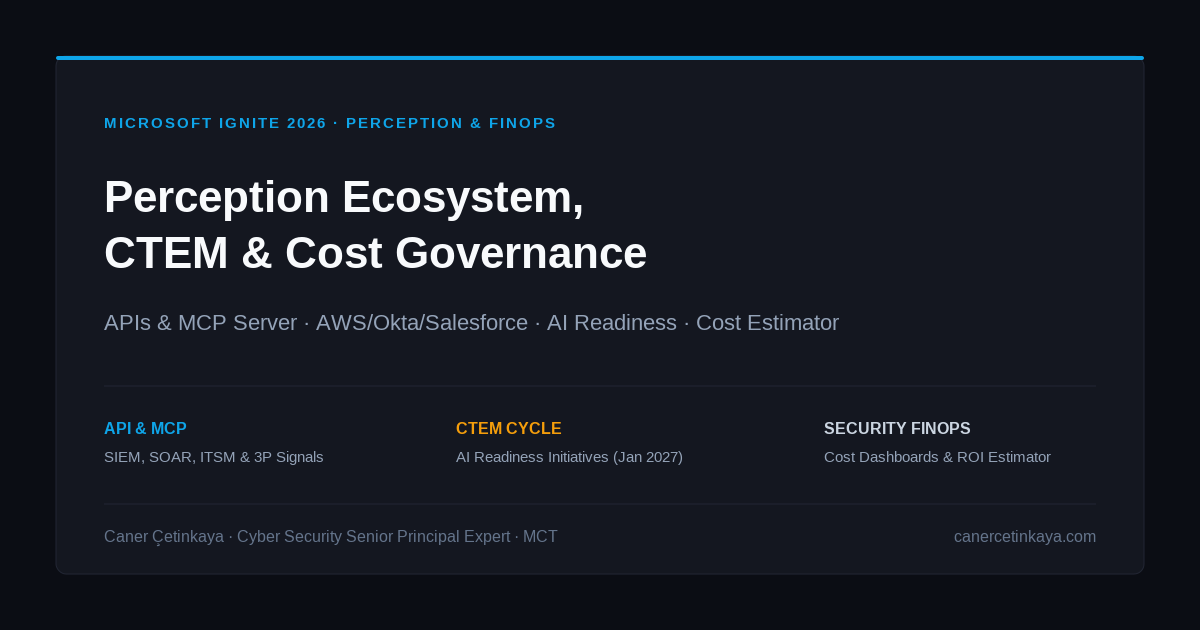
At Microsoft Ignite 2026, Microsoft addressed both realities across four ecosystem capabilities in Microsoft Perception: APIs and an MCP server with third-party signals, native Defender workflow integration, AI Readiness Initiatives (CTEM), and Perception Cost Management.
Open Ecosystem: APIs, MCP Server, and Third-Party Signals
Introduced in Public Preview, Perception's APIs and MCP server allow enterprises to integrate agentic security without abandoning existing investments:
- Multi-cloud and SaaS signal ingestion: Perception extends correlation and investigation beyond Microsoft telemetry to AWS, Okta, and Salesforce, keeping cross-cloud attack chains intact.
- External orchestration: Existing SIEM, SOAR, and ITSM tools can invoke Perception playbooks directly via APIs or Model Context Protocol (MCP).
- Native Defender integration (`Preview`): Analysts can launch playbooks directly from Defender alerts, incidents, cases, threat intelligence records, or posture recommendations—or bind them to custom automated triggers—without switching consoles.
Board-Level CTEM: AI Readiness Initiatives
Static security checklists rarely survive competing engineering priorities. Planned for Preview in January 2027, AI Readiness Initiatives operationalize Microsoft's Secure Now guidance into tracked, measured Continuous Threat Exposure Management (CTEM) plans—giving CISOs clear ownership, progress milestones, and measurable exposure reduction for board reporting.
Security FinOps: Cost Management and Cost Estimator
Unbounded AI token consumption is a legitimate concern for high-volume SOCs. Shipping alongside Perception's General Availability (GA), Cost Management dashboards and the Cost Estimator:
- Surface real-time agentic usage and spend across playbooks.
- Forecast budget impact before enabling new triggers or expanding third-party telemetry.
- Connect agentic security expenditure directly to tangible outcomes such as alert triage volume and exposure reduction.
Architectural Limitations, Guardrails, and Rollback Plan
- Least-privilege API/MCP scoping: When connecting external SOAR or ITSM tools via MCP/API, restrict initial tokens to read-only investigation and enrichment playbooks rather than high-impact remediation actions.
- Not a substitute for core controls: Multi-cloud Perception orchestration improves cross-platform visibility, but it does not replace native IAM hardening, EDR, or network segmentation inside AWS, Okta, or Salesforce.
- Guard against trigger loops: A noisy third-party alert rule (for example, a misconfigured AWS or Okta connector) firing automated playbooks can rapidly burn budget. Always pair automated triggers with rate caps and Cost Management budget alerts.
- Rollback plan: If an external integration causes unexpected spend spikes or noisy correlations, revoke or disable the offending MCP/API client credential, revert Defender automated triggers to manual launch, and verify stabilized consumption in the Cost Management dashboard.
Paired with Microsoft Perception's core Red, Blue, and Green Team loop, these four capabilities make an Agentic SOC interoperable across heterogeneous cloud estates and financially accountable to executive leadership.
Primary Sources
Verified Primary Sources & Open-Source Repositories
This architectural guide was cross-corroborated against the official advisories, Microsoft Learn docs, and open-source PowerShell / KQL repositories below.
Multi-Channel Distribution Summary (X & LinkedIn Draft)
Toggle X (Twitter) & LinkedIn sharing drafts
Multi-Channel Distribution Summary (X & LinkedIn Draft)
Toggle X (Twitter) & LinkedIn sharing draftsMicrosoft Perception goes multi-cloud and budget-accountable: AWS/Okta/Salesforce signals, API/MCP orchestration for SIEM/SOAR/ITSM, AI Readiness CTEM, and Cost Estimator. Full review live. #MicrosoftPerception #CTEM #Ignite2026
CISOs and CFOs ask two practical questions before adopting an Agentic SOC: does it integrate with our existing AWS, Okta, and ITSM stack, and can we predict its cost? Here is how Ignite 2026 Perception API/MCP, CTEM initiatives, and Cost Management answer both.
Related Architecture Articles
All Microsoft Defender →Microsoft Perception (GA) Architecture: Closed-Loop Agentic SOC with Red, Blue, and Green Team Agents
Architectural deep dive into Microsoft Perception (GA at Ignite 2026): how Red, Blue, and Green Team AI agents collaborate inside Microsoft Defender, plus human approval gates, limitations, and safe SOC rollout.
Microsoft Defender ISOC and Sentinel Unified SOC (Ignite 2026): 90-Day Retention, Ingest-Time Normalization, and Multi-Cloud UEBA
Architectural breakdown of Microsoft Defender ISOC (Ignite 2026): Sentinel opt-in, 90-day Defender retention, built-in data lake, ingest-time normalization, Detections as Code, and multi-cloud UEBA.
Frontline Defenses Against 2027 Attack Vectors: ClickFix Clipboard Monitor, Vulnerability Shielding, and Teams Deepfake Detection
Architectural review of four Microsoft Ignite 2026 Defender frontline defenses: DefenderSessionHelper.exe ClickFix clipboard protection, pre-patch Vulnerability Shielding, Teams malicious QR blurring, and certified meeting deepfake detection.
Microsoft Baseline Security Mode 2026 and On-Premises Security Initiative (Ignite 2026): Hybrid Hardening Architecture
Architectural review of Microsoft Baseline Security Mode 2026 (+24 settings across Intune, Purview, Dynamics 365 with simulation mode), On-Prem BSM for Exchange and SharePoint Server, On-Premises Security Initiative, and Secure Now.