Windows Isolation and the Post-Quantum Future (Ignite 2026): MXC Learning Mode, Local Micro VMs, Post-Quantum TLS, and Windows Server 2028
Architectural review of Windows OS isolation for local AI agents (MXC COM/IPC, MXC Learning Mode, Local Micro VMs) alongside Post-Quantum TLS in the Windows TLS stack and Windows Server 2028 Preview.
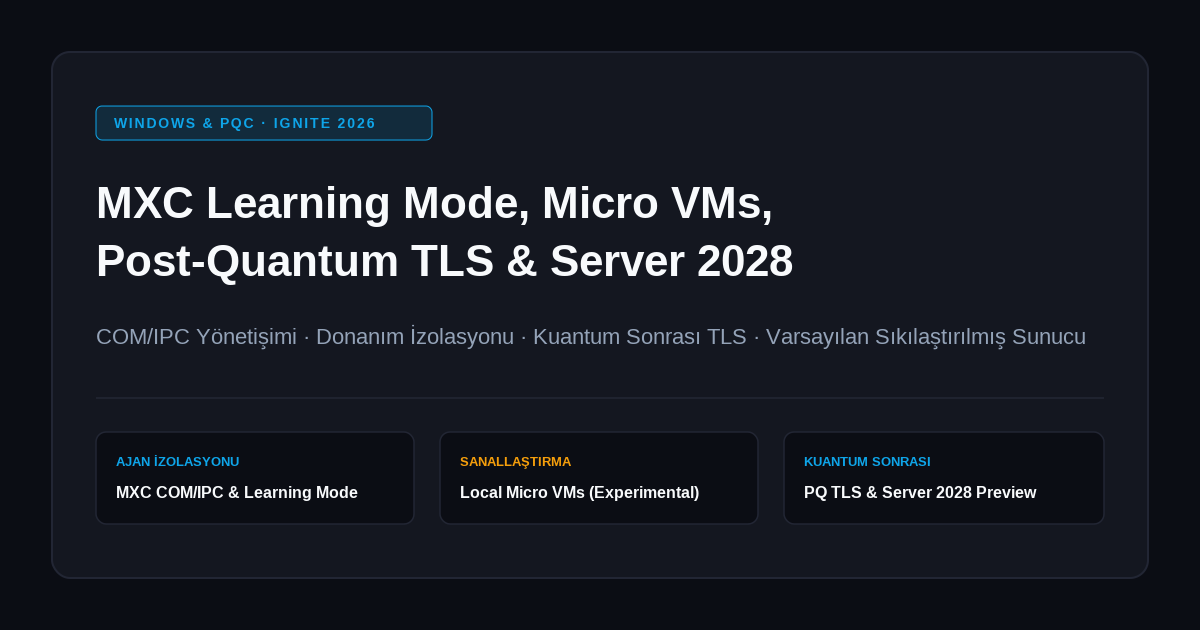
Enterprise security architects must plan across two horizons simultaneously: isolating local AI agents on developer and employee endpoints in the near term, and transitioning network cryptography against Harvest Now, Decrypt Later (HNDL) threats in the medium term.
At Microsoft Ignite 2026, Microsoft aligned both tracks across Microsoft Execution Containers (MXC) enhancements, MXC Learning Mode, Local Micro VMs, Windows Post-Quantum TLS, and Windows Server 2028 Preview.
Layered OS Isolation for Local Agents: MXC and Local Micro VMs
- Microsoft Execution Containers (MXC) expansion (`Preview / Private Preview`): Extends beyond basic file and network limits to govern COM and IPC calls, expanding ecosystem coverage across OpenAI Codex, Meta, and 20+ partners.
- MXC Learning Mode (`Preview`): Observes an agent's actual file, network, and process behavior before locking it down, generating least-privilege isolation policies without breaking legitimate developer workflows.
- Local Micro VMs (`Experimental`): Provides a hardware-virtualized isolation boundary for the highest-risk local code execution and autonomous agent workloads.
Post-Quantum Cryptography and Next-Generation Server Security
- Post-Quantum TLS in the Windows TLS stack (`Announced`): Introduces post-quantum key exchange protection natively in Windows TLS to mitigate Harvest Now, Decrypt Later (HNDL) interception of long-lived sensitive traffic.
- Windows Server 2028 (`Preview`): Establishes a hardened-by-default server baseline featuring Trusted Launch and built-in post-quantum cryptography support.
Limitations, Prerequisites, and Rollback Plan
- Maturity boundary: Every capability in this article is in
Preview,Private Preview,Announced, orExperimental(Local Micro VMs) status. For production rollouts today, start with Windows Platform Resilience (Endpoint Security Platform & Administrator Protection GA) while evaluating MXC and Post-Quantum TLS in lab environments. - What it prevents and what it does not: MXC and Local Micro VMs contain local agent blast radius on the host OS, while Post-Quantum TLS protects transport key exchange against future quantum decryption. They are not a substitute for Microsoft Entra Agent ID, Purview AI DLP, network segmentation, or application patching.
- Compatibility and rollback plan: Hybrid post-quantum TLS key exchange produces larger handshake payloads that can trigger packet fragmentation or drops on legacy firewalls, load balancers, and TLS-inspecting middleboxes. Record baseline TLS cipher suite policies and MXC profiles beforehand, and always launch MXC in Learning Mode first. If connectivity or app regressions appear, remove the test group from the Post-Quantum TLS policy to restore standard TLS 1.3 handshakes and verify service health.
Architectural Takeaway
Ignite 2026 moves local AI agent security past the binary choice of banning or ignoring developer tools through MXC Learning Mode and Local Micro VMs. Testing Post-Quantum TLS middlebox compatibility and Windows Server 2028 Preview in lab networks today gives enterprises a disciplined head start on 2027–2028 crypto-agility mandates.
Verified Primary Sources & Open-Source Repositories
This architectural guide was cross-corroborated against the official advisories, Microsoft Learn docs, and open-source PowerShell / KQL repositories below.
Multi-Channel Distribution Summary (X & LinkedIn Draft)
Toggle X (Twitter) & LinkedIn sharing drafts
Multi-Channel Distribution Summary (X & LinkedIn Draft)
Toggle X (Twitter) & LinkedIn sharing draftsLooking ahead to 2027-2028 Windows security: MXC COM/IPC + Learning Mode, hardware-isolated Local Micro VMs, Post-Quantum TLS in the Windows TLS stack, and hardened-by-default Windows Server 2028 Preview. #PQC #WindowsSecurity #Ignite2026
How do enterprises isolate local AI agents without breaking developer workflows while preparing transport security for the post-quantum era? Here is an architectural breakdown of MXC Learning Mode, Local Micro VMs, Post-Quantum TLS, and Windows Server 2028 Preview.
Related Architecture Articles
All Quantum & PQC →Microsoft Intune Ignite 2026: Governing Local AI Agents on Enterprise Endpoints (Agent 365, Software Compliance & MXC)
Architectural and operational guide to Microsoft Ignite 2026 local AI agent governance in Intune: Agent 365 discovery, Software Compliance Policy, Intune SDK MAM for AI apps, and Microsoft Execution Containers (MXC).
Post-Quantum Cryptography (PQC) Readiness: Mosca's Inequality, NIST Standards, RFC 10024, and Crypto-Agility
Enterprise crypto-agility against Harvest Now, Decrypt Later threats: finalized NIST FIPS 203/204/205 and IETF RFC 10024 vs. pending drafts, TLS 1.3 and TCP MSS middlebox realities, CBOM discovery, and rollout boundaries.
Windows Platform Resilience (Ignite 2026): User-Mode Endpoint Security Platform, Administrator Protection, and Baseline Protection
Structural evolution in Windows 11 security: moving security solutions out of kernel space with Endpoint Security Platform (GA), eliminating standing admin tokens via Administrator Protection (GA), Baseline Protection, and Passwordless sign-in refinements.
Azure Confidential Infrastructure Architecture (Ignite 2026): AMD Turin v7, Intel TDX v6, Confidential AKS, Azure Local, and Backup
Eight Ignite 2026 Azure Confidential Computing infrastructure milestones bringing hardware confidentiality into mainstream production: AMD Turin v7, Intel TDX v6, Azure Local, Intel TDX AKS Worker Nodes (GA), Azure Migrate, Azure Backup, and Confidential Data Disk Encryption.