Codename MDASH, MAI-Cyber-2-Flash, and Web App Pen Test Agent: Agentic AppSec at Ignite 2026
Architectural breakdown of Codename MDASH, the 1M-context MAI-Cyber-2-Flash cybersecurity model, and Microsoft Perception's Web App Pen Test Agent—from code scanning to runtime PoC validation and GitHub fixes.
Application security teams have wrestled with the same structural gap for years: static code scanners (SAST) flood pull requests with theoretical findings that developers learn to ignore, while annual manual penetration tests cannot keep pace with daily CI/CD releases.
At Microsoft Ignite 2026, Microsoft expanded Codename MDASH, unveiled the domain-specialized MAI-Cyber-2-Flash model, and introduced the Web App Pen Test Agent (Public Preview) under Microsoft Perception to bridge source-code analysis directly with runtime exploit validation and GitHub remediation.
What Codename MDASH and MAI-Cyber-2-Flash Change
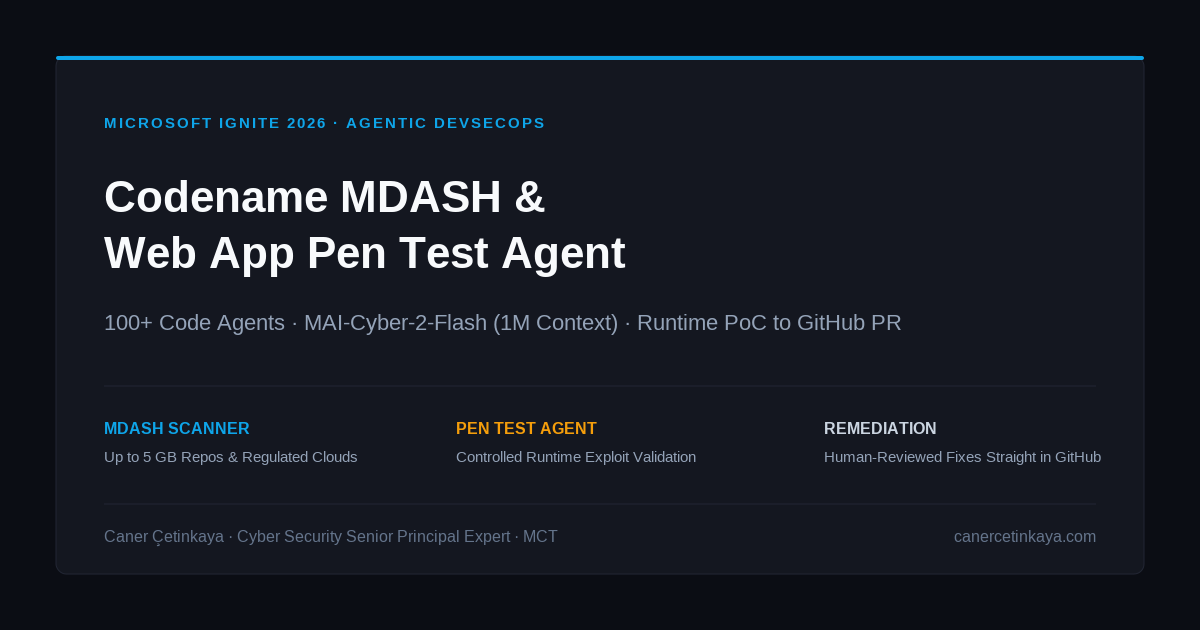
According to Microsoft's Ignite 2026 announcements, Codename MDASH (Public Preview) is a multi-agent, multi-model code scanner orchestrating more than 100 specialized agents:
- Enterprise repository scale and regulated clouds: Repository sharding and granular progress visibility expand coverage to repositories up to 5 GB as well as regulated cloud environments.
- Native developer surfaces: MDASH runs directly from the Microsoft Defender portal, the CLI, or CI/CD pipelines across GitHub Actions and Azure DevOps.
- MAI-Cyber-2-Flash economics: Purpose-built exclusively for Microsoft security products, MAI-Cyber-2-Flash (
Preview) combines a 1-million-token context window with a sparse Mixture-of-Experts architecture (~12B active parameters) for deep dependency and code auditing—delivering 86% lower output token costs as it replaces MAI Cyber 1.1 Flash in the MDASH MAI profile starting mid-December 2026.
From Code Finding to Runtime Proof: Web App Pen Test Agent
The decisive architectural shift happens when MDASH feeds findings directly into the Web App Pen Test Agent (`Public Preview`) inside Microsoft Perception Red Team:
- Red Team playbooks: The Run web pen test and Protect web app playbooks use MDASH repository insights to focus live testing on real authorization, API, business-logic, and injection surfaces.
- Proof over noise: By probing authorized web applications at runtime and producing concrete proofs-of-concept (PoCs), the agent separates genuinely exploitable flaws from dead-code SAST alerts.
- Actionable GitHub PRs: Rather than handing engineers a static PDF report, validated findings flow straight into GitHub as targeted code-fix proposals while Exposure Management tracks closure.
Architectural Limitations and Operational Risks
Enterprise AppSec leaders should enforce three non-negotiable guardrails and prerequisites:
- Never point live pen-test agents straight at production: Active runtime testing can trigger rate limits, corrupt test data, or trip WAF rules. Scope the Web App Pen Test Agent strictly to isolated
stagingorpre-prodtargets with explicit authorization and least-privilege permissions. - No blind auto-merging of AI fixes: AI-proposed security patches can introduce subtle business-logic regressions or break dependencies. Every GitHub PR must pass automated unit/integration verification suites and senior developer review before merge.
- Not a substitute for runtime defense: Agentic code scanning reduces shipped vulnerabilities, but it does not replace WAF rules, identity boundaries, EDR, or Defender runtime protections against zero-day supply-chain flaws.
Safe Pilot Rollout and Rollback Plan
- Scoped pilot: Start with least-privilege GitHub/Azure DevOps repository access on 2–3 high-priority web apps in staging.
- Success metrics: Track false-positive reduction versus legacy SAST, mean time to remediate (
MTTR) validated findings, and developer PR acceptance rates. - Rollback plan: If an accepted remediation PR causes functional regression, execute a standard Git
revertto restore the prior stable release, switch the CI/CD gate temporarily toadvisorymode, and verify application health checks before re-applying a revised fix.
Together, Codename MDASH, MAI-Cyber-2-Flash, and the Web App Pen Test Agent close the gap between static scanning and live penetration testing—giving engineering teams verified, patch-ready security outcomes at CI/CD speed.
Primary Sources
Verified Primary Sources & Open-Source Repositories
This architectural guide was cross-corroborated against the official advisories, Microsoft Learn docs, and open-source PowerShell / KQL repositories below.
Multi-Channel Distribution Summary (X & LinkedIn Draft)
Toggle X (Twitter) & LinkedIn sharing drafts
Multi-Channel Distribution Summary (X & LinkedIn Draft)
Toggle X (Twitter) & LinkedIn sharing drafts100+ code-scanning agents for 5 GB repos (Codename MDASH), 86% cheaper MAI-Cyber-2-Flash, and runtime validation straight to GitHub PRs via Web App Pen Test Agent. Ignite 2026 agentic AppSec guide live. #DevSecOps #MDASH #Ignite2026
Traditional SAST scanners bury developers in theoretical noise while annual pen tests lag behind CI/CD velocity. Here is an architectural review of Codename MDASH, MAI-Cyber-2-Flash, and the Web App Pen Test Agent from Microsoft Ignite 2026.
Related Architecture Articles
All DevSecOps →Microsoft Perception (GA) Architecture: Closed-Loop Agentic SOC with Red, Blue, and Green Team Agents
Architectural deep dive into Microsoft Perception (GA at Ignite 2026): how Red, Blue, and Green Team AI agents collaborate inside Microsoft Defender, plus human approval gates, limitations, and safe SOC rollout.
Microsoft Perception Ecosystem: API/MCP Integration, Third-Party Signals, CTEM, and Security FinOps
Architectural review of Microsoft Perception's open ecosystem (APIs, MCP Server, AWS/Okta/Salesforce signals), native Defender workflow triggers, AI Readiness Initiatives CTEM, and Cost Management.
Microsoft Intune Ignite 2026: Vulnerability Remediation Agent and Microsoft Perception for Exposure Reduction
Architectural and operational analysis of the Intune Vulnerability Remediation Agent (Limited Public Preview) under Microsoft Perception Green Team: Defender integration, human-in-the-loop playbooks, KQL verification, and rollback.
Microsoft Intune Ignite 2026: Microsoft Perception Plain-Language Investigations, Real-Time Inventory, and Remote Help Diagnostics
Operational and architectural guide to Microsoft Perception plain-language investigations in Intune (Limited Public Preview), Custom Reports, Properties Catalog registry/file inventory, and consent-based Remote Help Diagnostic Data Reports.