Purview Auto-Labeling, SharePoint SAM Restricted Discovery, and DKE: Full Data Sovereignty in 2026
Culminating the 2017–2026 data protection evolution by combining Purview Service-Side Auto-Labeling, SharePoint SAM Restricted Content Discovery, and Double Key Encryption for complete AI-era data sovereignty.
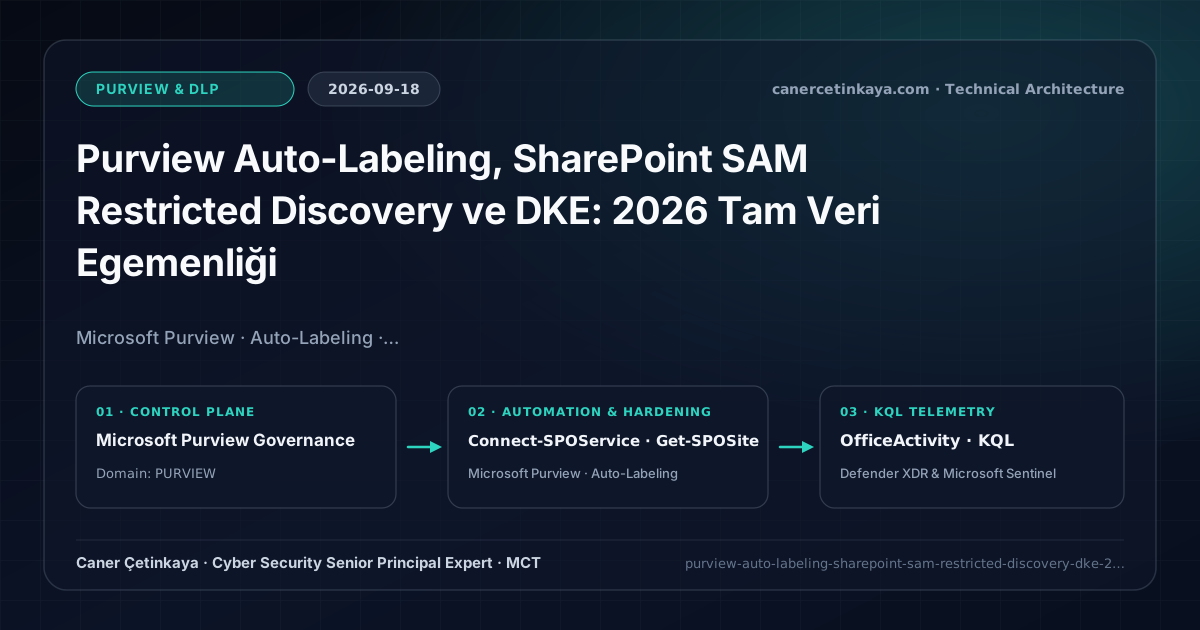
Executive Summary and Information Protection Context
Relying on individual users manually clicking "Classify as Confidential" inside Word failed to scale across petabytes of SharePoint data and rapid generative AI discovery. In 2026, uniting Microsoft Purview Service-Side Auto-Labeling, SharePoint Advanced Management (SAM) Restricted Content Discovery, and Double Key Encryption (DKE) delivers autonomous classification at rest, shields sensitive sites from broad org-wide Copilot discovery, and seals regulated Crown Jewels inside customer-controlled HSM keys.
From an architectural evolution standpoint, this foundational design connects directly to modern platform controls. Bringing the ten-year arc from 2017 Azure RMS Classic Labeling, 2021 MIP Built-In Labeling, and 2022 Double Key Encryption to completion alongside Purview, Intune & Copilot AI Security and Digital Sovereignty.
Cryptographic Boundaries, Label Taxonomy, and Design Principles
Service-Side Auto-Labeling (SIT + Trainable Classifiers)asynchronously scans Exchange, SharePoint, and OneDrive data at rest, applying encryption labels across contracts, IP, and PII without end-user clicks.SharePoint Restricted Content Discoveryprevents designated sensitive workspaces (HR, Legal, Board) from surfacing in broad tenant searches or Microsoft 365 Copilot results unless explicitly permitted.- Layers general enterprise protection through BYOK + Purview DLP for Copilot while carving out regulated sovereign secrets into Double Key Encryption (DKE).
- Sensitivity label taxonomy, built-in
MIPclient upgrades, andDKEhigh-availability endpoints must verify co-authoring compatibility and Super User recovery before rolling out mandatory encryption.
Prerequisites, Client/Key Dependencies, and RBAC
- Licensing: Microsoft 365 E5 (or Purview Information Protection P2) for Service-Side Auto-Labeling and Trainable Classifiers; SharePoint SAM / Copilot coverage for Restricted Content Discovery.
- RBAC Access: Separated
Compliance Administrator(Connect-IPPSSession) andSharePoint Administrator(Connect-SPOService). - Simulation Gate: Validate Auto-Labeling policies in Simulation Mode for 7–14 days until false positives drop cleanly below acceptable margins before enabling automated encryption.
Technical Verification, Labeling, and Encryption Controls
PowerShell Label Policy and File Status Validation
Auditing SharePoint site protections and Purview Service-Side Auto-Labeling policies via PowerShell:
- Execution Environment and Prerequisites: Requires ExchangeOnlineManagement (
Connect-IPPSSession), Microsoft.Online.SharePoint.PowerShell. - Least Privilege and Operation Separation: Run with scoped Exchange / Compliance / SharePoint Administrator (or View-Only / Security Reader for audit commands) privileges. All statements above are **read-only (
Get-*/Test-*/Search-*)** verification checks making no direct configuration edits; still validate module/network prerequisites in a test cohort first. - Security Control Mapped and Boundary Note: Verifies active policy state and guards against silent drift or mis-scoped rollouts without blind production changes.
# 1. Inspect SharePoint site Restricted Access Control and sharing configuration
Connect-SPOService -Url "https://canercetinkaya-admin.sharepoint.com"
Get-SPOSite -Identity "https://canercetinkaya.sharepoint.com/sites/Legal-Litigation" |
  Select-Object Url, RestrictedAccessControl, DisableCompanyWideSharingLinks, SensitivityLabel

# 2. List Purview Service-Side Auto-Labeling policies and simulation status
Connect-IPPSSession -UserPrincipalName "[email protected]"
Get-AutoSensitivityLabelPolicy | Select-Object Name, Workload, Mode, Enabled, Priority
Labeling Telemetry and KQL Verification Query
KQL query tracking automated sensitivity labeling activity and site control modifications in OfficeActivity:
// Execution Scope: Read-only hunting/audit query (Log Analytics Reader / Security Reader)
// Data Source: Microsoft Purview Unified Audit Log -> Microsoft Sentinel Office 365 connector (OfficeActivity)
OfficeActivity
| where TimeGenerated > ago(30d)
| where RecordType in ("SensitivityLabelAction", "MipAutoLabel", "SharePointFileOperation") or Operation has_any ("SensitivityLabelApplied", "AutoSensitivityLabel", "RestrictedAccessControl")
| project TimeGenerated, UserId, Operation, Site_Url, SourceFileName
| summarize LabelEvents = count() by Operation, Site_Url
| order by LabelEvents desc
Critical Architectural Assessment, Lockout Risks, and Rollback Strategy
- Applying Unchecked Auto-Labeling Globally Without Scoped Simulation Audits: A broad Trainable Classifier inadvertently encrypting operational files breaks collaborative workflows; target discrete SharePoint site collections first.
- Assuming Auto-Labeling Eliminates the Need for Restricted Content Discovery: New unlabeled files uploaded between async scan cycles stay visible in search unless site-level Restricted Content Discovery blocks discovery immediately.
- Risks Mitigated vs. Residual Limitations: Sensitivity labels, built-in
MIPprotection,Dynamic Watermarking, andDKEenforce persistent file-level encryption and customer key sovereignty; however, they cannot stop screen photography by authorized viewers (watermarking provides forensic attribution only), unsupported third-party formats lackingRMScontainers, or previously exported unencrypted copies. - New Dependencies and Production Failure Modes: Reliability hinges on current
Microsoft 365 Appschannels, redundant customer-hostedDKEHTTPS availability (an unreachableDKEendpoint blocks opening encrypted files globally!), and SharePoint co-authoring limits underDKE. Mandatory encryption applied too broadly stalls B2B portals and automated indexing. - Rollback and Pilot Validation Procedure: Validate every auto-labeling rule in
TestWithoutNotificationssimulation first; preserveSuper User(Get-AipServiceSuperUserFeature) emergency recovery and offlineDKEkey backups, narrowing mandatory encryption policies back to a pilot group upon disruption.
Verified Primary Sources & Open-Source Repositories
This architectural guide was cross-corroborated against the official advisories, Microsoft Learn docs, and open-source PowerShell / KQL repositories below.
Multi-Channel Distribution Summary (X & LinkedIn Draft)
Toggle X (Twitter) & LinkedIn sharing drafts
Multi-Channel Distribution Summary (X & LinkedIn Draft)
Toggle X (Twitter) & LinkedIn sharing draftsCapping the 2017–2026 data protection journey: Purview Auto-Labeling, SharePoint Restricted Discovery, and DKE sovereignty. #MicrosoftPurview #DataSovereignty
Ten Years of M365 Data Defense (2017–2026): Combining Service-Side Auto-Labeling simulation discipline, SharePoint SAM discovery guardrails, and DKE cryptography.